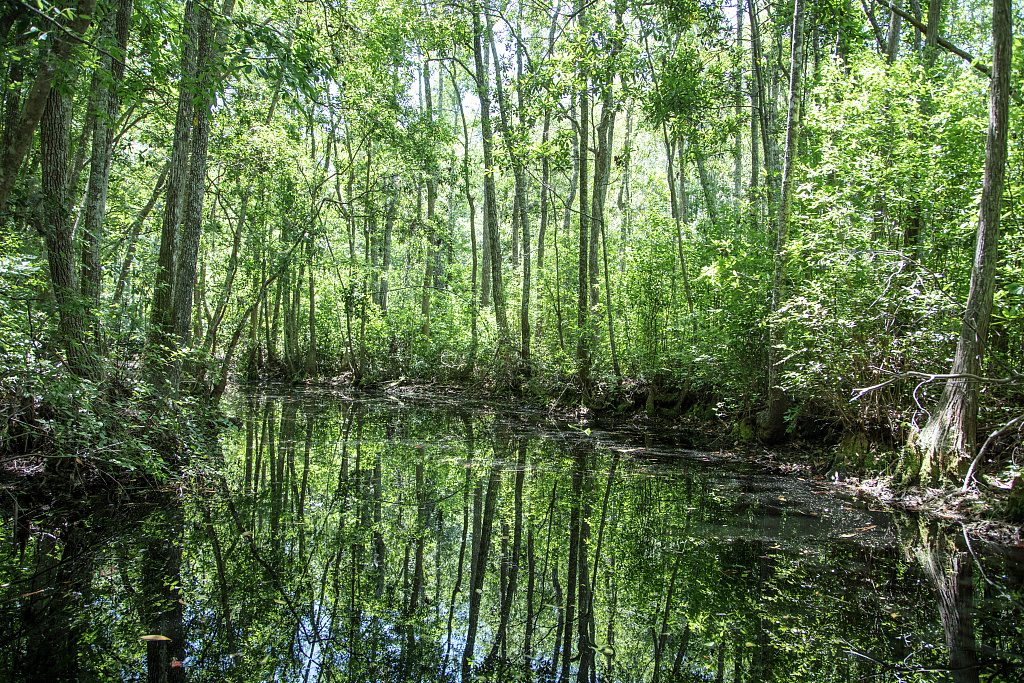
Lees had lived on Billys Island, deep in the western Okefenokee, since the 1860s. When Charles R. Pendleton reached Jim Lee's clearing in September 1875, he found a family that bought almost nothing but ammunition, coffee, salt and a few tools. They raised their own food, tanned their own leather and made their own shoes, and the women spun, wove and sewed the family's clothes. Jim Lee's son-in-law Daniel and his wife, Nancy, had made the island their homestead by 1884, and Jim died there in January 1888.
A night on Billys Island
In May 1912 a Cornell University biological party pushed into the swamp. Its junior member was Francis Harper, 25, whose brother, the botanist Roland Harper, had called for the swamp's preservation in 1908 and 1909. Harper reached the Lee home after dark and was taken in. The Cornell men were struck by how much the family knew and how content they seemed, and Harper wrote down how they lived: corn, sweet potatoes, peanuts and cane on the clearing; cattle and razorback hogs in the woods; deer, turkey and turtles; bear run with hounds; wild honey from bee-gums; hides sold for cash. In 1921 he photographed Noah Lee eating huckleberries on Billys Lake.
He kept coming back until 1951, collecting specimens for northern institutions. On July 12, 1921, he first visited the Chessers on the swamp's eastern side, where about seven of the eleven children were home and supper was hominy, tomatoes, peas, cane syrup and biscuits. In his field notebooks he recorded swamp speech, tall tales, home remedies and beliefs, and the songs: versions of "Barbara Allen" and "The Little Mohee," and the hollering swampers used to call stock or to signal they were coming home. Sacred Harp singing had been heard in the Okefenokee since at least the 1860s.
The refuge
The Harpers wanted the swamp protected. Francis worked with the Georgia Society of Naturalists, founded in 1929, and the Waycross society that insisted on spelling the swamp Okefinokee. The society persuaded a U.S. Senate committee to visit in 1931, and Harper fought a proposed Atlantic-Gulf ship canal in 1933 and a scenic highway in 1934. In 1935 and 1936 he moved his family to a camp on Chesser Island. His wife, Jean, a Vassar graduate, had once tutored Franklin Roosevelt's children. On March 30, 1937, Roosevelt created the Okefenokee National Wildlife Refuge by executive order.
The folklorist Laurie Kay Sommers notes the cost: the refuge led the swamp's residents to move out, ending the way of life Harper had spent a quarter-century writing down. The last Chessers left in 1958.
The album
The Harpers settled in Chapel Hill, North Carolina. Francis vowed to write his Okefenokee book and never did, and he died in 1972, on his 86th birthday. Jean Harper and the Georgia Southern English professor Delma Presley finished it from his notes and photographs, and Okefinokee Album appeared in 1981. His notebooks, letters and pictures are in the Presley collection at Georgia Southern.
Boat trails from Okefenokee State Park lead toward Billys Island. The Chesser homestead stands on Swamp Island Drive in the Okefenokee refuge near Folkston.