Herman Ehrenberg was born in the Prussian village of Steuden in 1816, the youngest of three sons of an innkeeper. The family moved to Eisleben when he was four, and his father became a district magistrate. In 1834 he sailed alone from Bremen to New York on the Ludwig. The Handbook of Texas says nothing definite is known of his life there until October 1835, when he signed on with the New Orleans Greys. He was a teenage volunteer at the siege of Bexar, and in March 1836 he was captured at Coleto Creek with the rest of Col. James Fannin's command.
Palm Sunday
After the surrender of March 20, some 230 or 240 unwounded men were marched to Goliad and held in the chapel of Presidio La Bahia. Santa Anna's order of March 23, under a decree treating foreigners taken in arms as pirates, told the post commander to shoot them. Col. José Nicolás de la Portilla received it on March 26 and decided he was bound to obey. At sunrise on March 27, Palm Sunday, the prisoners, who had been told they would gather wood, drive cattle or board a ship home, were marched out in three groups along three roads, halted, and shot at a range too close to miss. Fannin and the wounded were killed inside the presidio. The Handbook counts 342 dead, twenty-eight escapes and twenty men spared as physicians, orderlies, interpreters or mechanics.
Ehrenberg was among those who got away. A saber cut left a scar across his forehead for life. The Handbook says he wandered alone to the Colorado River, was recaptured and was taken with other Texan prisoners to labor for the Mexican army at Matagorda. He escaped a second time during the Mexican retreat after San Jacinto.
A book in Leipzig
He became a citizen of the Republic and served briefly in a ranging company in 1840. Illness took him back to Europe, and in 1843 he published Texas und seine Revolution in Leipzig. It went through three editions and became the most popular German-language book on Texas of the 1840s. The Handbook warns that it embellishes the story with imaginary incidents, invented characters and invented dialogue, so historians must use it with extreme caution. The English translations of 1925 and 1935 were marred by errors and censorship, and a new translation with scholarship appeared in 2021.
Ehrenberg in Arizona
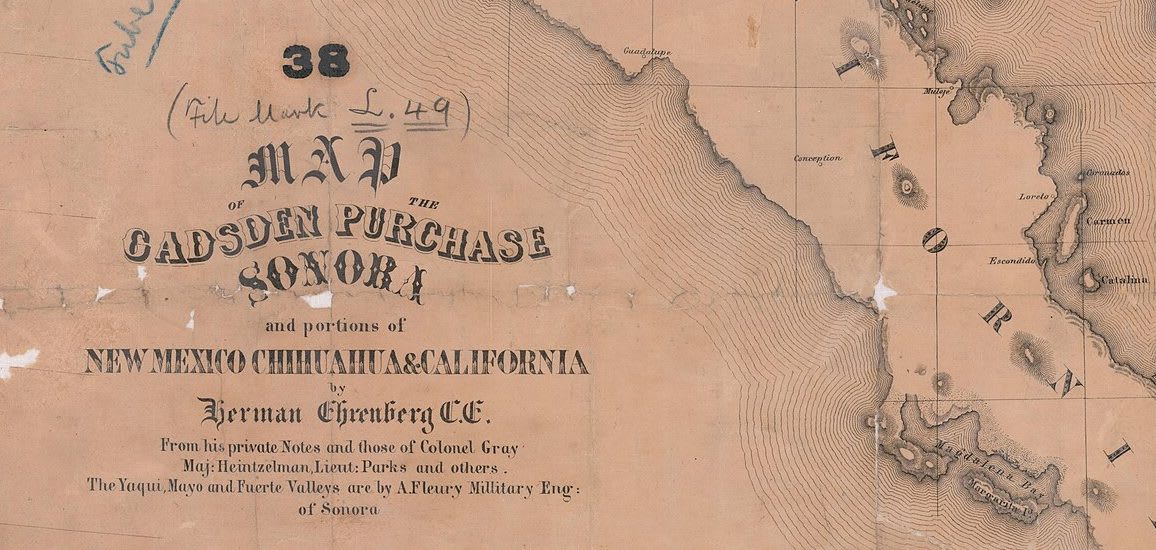
By the summer of 1843 he was back in New Orleans. In 1844 he crossed the Oregon Trail with a fur-trapping party and the next year surveyed Honolulu's streets for the Hawaiian government. He took part in the California gold rush, and in 1854 he published the first map of the Gadsden Purchase. He surveyed Colorado City, Arizona, in 1855, worked with Charles Poston at Tubac and served as an Indian agent for the Mojaves on the Colorado River Reservation. On October 9, 1866, he was murdered by an unknown assailant at Dos Palmas, near present Palm Springs. Mineral City, Arizona, was renamed Ehrenberg in his honor.
The chapel where his comrades were held is part of Presidio La Bahia, and the grave of Fannin's men is at the Fannin Memorial Monument in Goliad.