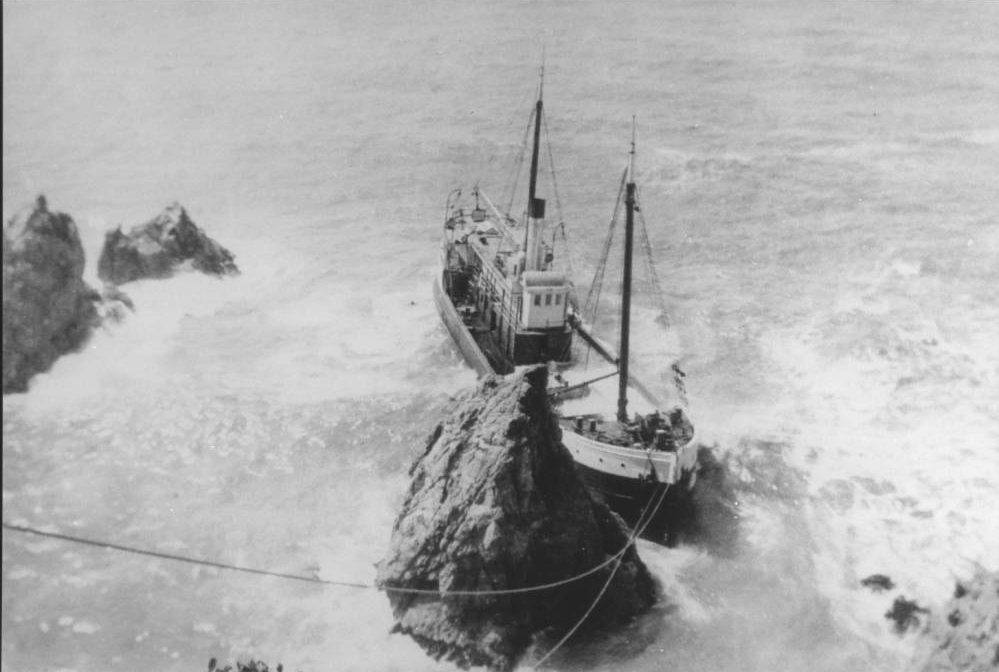
The coast north of the Russian River had timber in staggering quantities and almost nowhere to load it. The shore is cliff and reef for most of its length, open to the swell, with only a few places, Mendocino, Noyo and Caspar among them, where the larger coasting vessels could come in. Everywhere else, mills built on the creeks had to get their lumber off the bluff and onto a ship that could not come close. They did it with gravity, and later with wire.
The apron chute
By about 1860 the answer was a wooden slide. A chute ran from the top of the bluff down toward the water and ended in an apron, a movable tongue of planks that a rig of pulleys and cables raised and lowered. A schooner made fast to moorings below, and the boards came down one at a time, the apron set at whatever angle the swell allowed, with a crew on deck catching and stowing each piece. Railroad ties and other products went down the same way.
Mill owners built their landings on the lee side of a point, usually the south side, out of the prevailing northwesterlies. Even so, loading stopped when a southeasterly blew, and a ship caught on its moorings in a southeast storm was in real trouble. The wreck lists for this coast are long.
The wire
The change came with strong steel cable in the 1870s. A wire chute was a cable run from a frame on the bluff out to the moorings; the ship picked up the wire and made it fast, and a carriage called the traveler, worked by a steam engine at the top, ran out along it carrying a whole sling-load of lumber at once. Where the apron chute fed a ship board by board, the wire put a full sling aboard in a single run, and it could serve bigger ships lying farther out.
Through the 1890s wire chutes went in at almost every shipping place on the Mendocino coast. Mendocino itself was late, and ship owners complained about how long it took to load there. On March 28, 1902, the town's new wire chute at the Shipping Point sent its first load out to a waiting ship. The old slide chute was kept beside it for the smaller schooners.
The ships
The trade made its own vessels. The Pacific Coast lumber schooner was small, shallow and handy enough to work into a cove with little room to spare. Two masts gave way to three, and then to steam schooners, wooden-hulled coasters with a small engine that could keep a schedule. They carried passengers as well as lumber, because for much of this coast the boat was the easiest way in or out; a steam schooner could reach a landing from San Francisco within a day, where the stage took far longer.
One three-masted lumber schooner of the trade, the C.A. Thayer, built in 1895, survives at San Francisco's maritime national park.
What is left
Railroads, trucks and the paved highway finished the dogholes. The last load of lumber to leave the Mendocino coast by sea went out in 1938, from the Union Lumber Company's pier at Fort Bragg.
The chutes are gone, but the places kept their names, Bihler Landing, Nip and Tuck, Rough and Ready, Bourn's Landing, Cuffey's Cove, and the rocks in many coves still hold iron: eyebolts, ring bolts and lengths of chain rusted into the stone where a mooring or a chute was made fast. At Salt Point the bolts are easy to find on both sides of the cove. Look anywhere a creek reaches the sea under a cliff with a flat place on top. There is a fair chance a chute stood there.