Home / Tennessee / Chattanooga & Southeast Tennessee / Walnut Street Bridge
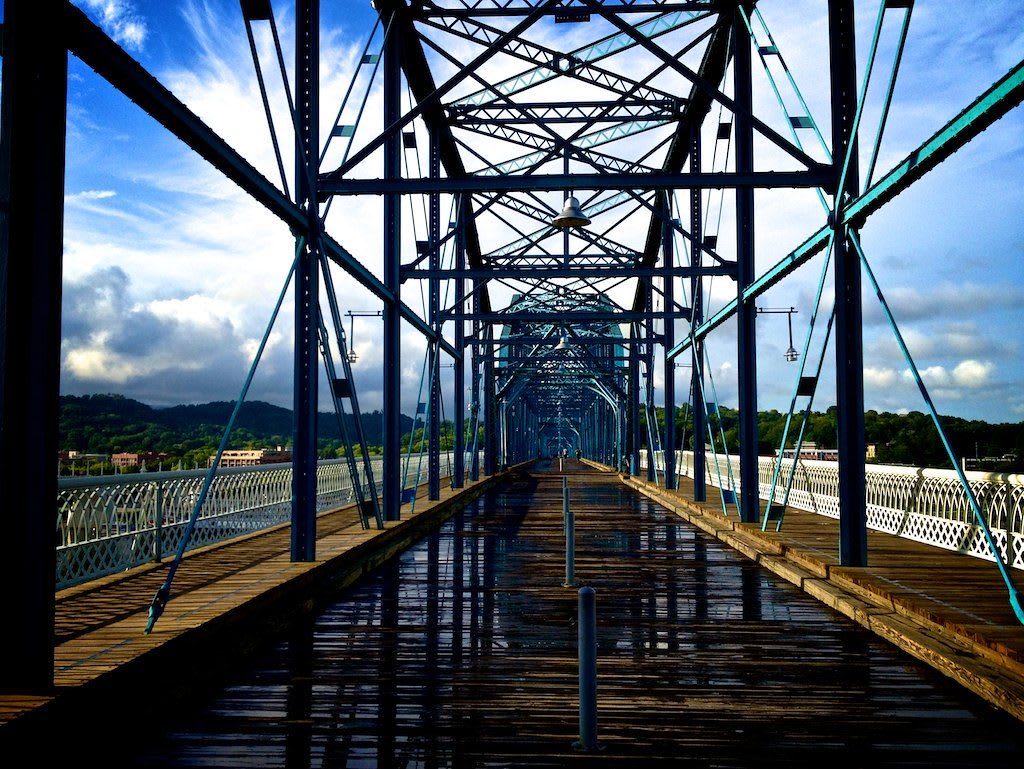
The Walnut Street Bridge crossing the Tennessee River at Chattanooga.riverharbor / CC BY 2.0 via Flickr
🏛️Historical

Walnut Street Bridge

Part ofChattanooga & Southeast Tennessee

An 1890 truss bridge now open to walkers, and the place where Alfred Blount in 1893 and Ed Johnson in 1906 were lynched, the case that led to the Supreme Court's only criminal trial.

⏱
Duration
Thirty minutes to an hour.
🎟
Admission
Free; a public pedestrian bridge.
📅
Best Season
Year round. Mornings and evenings are cooler; the bridge is open to walkers in all seasons.

The Story

The Walnut Street Bridge opened in 1890 and runs 2,376 feet across the Tennessee River between downtown Chattanooga and the north shore. It closed to cars in 1978, reopened as a pedestrian bridge in 1993 and is on the National Register of Historic Places. It is also where two Black men were lynched. Alfred Blount was hanged from it in 1893 on an accusation of attacking a white woman.

On March 19, 1906, Ed Johnson, a Black man in his early twenties, was lynched here. He was convicted in a rushed trial of raping a white woman, Nevada Taylor. She would not swear he was her attacker, and thirteen witnesses placed him at the saloon where he worked. Two Black lawyers, Noah Parden and Styles Hutchins, took his case to Washington, and Justice John Marshall Harlan stayed the execution. That night Sheriff Joseph Shipp gave his deputies the night off, and a mob took Johnson from the jail, hanged him from the bridge and shot him. The Supreme Court then tried Shipp and others for contempt, the only criminal trial it has ever held, and in 1909 found Shipp and five others guilty. Parden and Hutchins left Chattanooga for Oklahoma after threats. A judge vacated Johnson's conviction in 2000.

The Ed Johnson Memorial was unveiled near the bridge on September 19, 2021. The Bessie Smith Cultural Center, about a mile away, includes his story in its exhibits.

Visitor Info

⏱
Time Needed
Thirty minutes to an hour.
🎟
Admission
Free; a public pedestrian bridge.
📅
Best Season
Year round. Mornings and evenings are cooler; the bridge is open to walkers in all seasons.
🛣️
Highway
Walnut Street

On the Map

Nearby

The closest stops worth working into your route

attraction0.3 mi away
Tennessee Aquarium
A river-themed aquarium that opened on May 1, 1992, on the Chattanooga bank where John Ross kept a trading post, tracing a raindrop from the Appalachians to the Gulf.
historical0.5 mi away
Ross's Landing
The Tennessee River landing where Chattanooga began and where Muscogee (Creek) and Cherokee people were put on boats and ferried out in 1837 and 1838.
cultural0.9 mi away
Bessie Smith Cultural Center
Chattanooga's African American museum and performance hall on the old Ninth Street, named for the Empress of the Blues, who started out singing for change on that same street.
historical4.2 mi away
Point Park on Lookout Mountain
The Tennessee end of Lookout Mountain, where a ten-acre Park Service memorial overlooks Moccasin Bend and the November 1863 fight called the Battle Above the Clouds.
historical21 mi away
Red Clay State Historic Park
The last seat of the Cherokee Nation before removal, where eleven general councils met from 1832 to 1837, now a state park with a council house replica, a sacred spring and an eternal flame.
historical30 mi away
Cherokee Trail of Tears State Park
The Blythe Ferry landing at the mouth of the Hiwassee, where Cherokee and Muscogee people camped in 1838 to cross the Tennessee River, made a state park in June 2026.

Historical markers nearby

Roadside plaques and monuments within a short detour

Marker0.4 mi away
Ernest Walter Holmes, Sr.
Chattanooga
Marker0.5 mi away
Chattanooga's First School
Chattanooga
Marker0.7 mi away
William "Uncle Bill" Lewis
Chattanooga
Marker0.7 mi away
Abby Crawford Milton
Chattanooga
Marker0.9 mi away
First Coca-Cola Bottling Company in the United States
Chattanooga
Marker0.9 mi away
Carver Memorial Hospital
Chattanooga