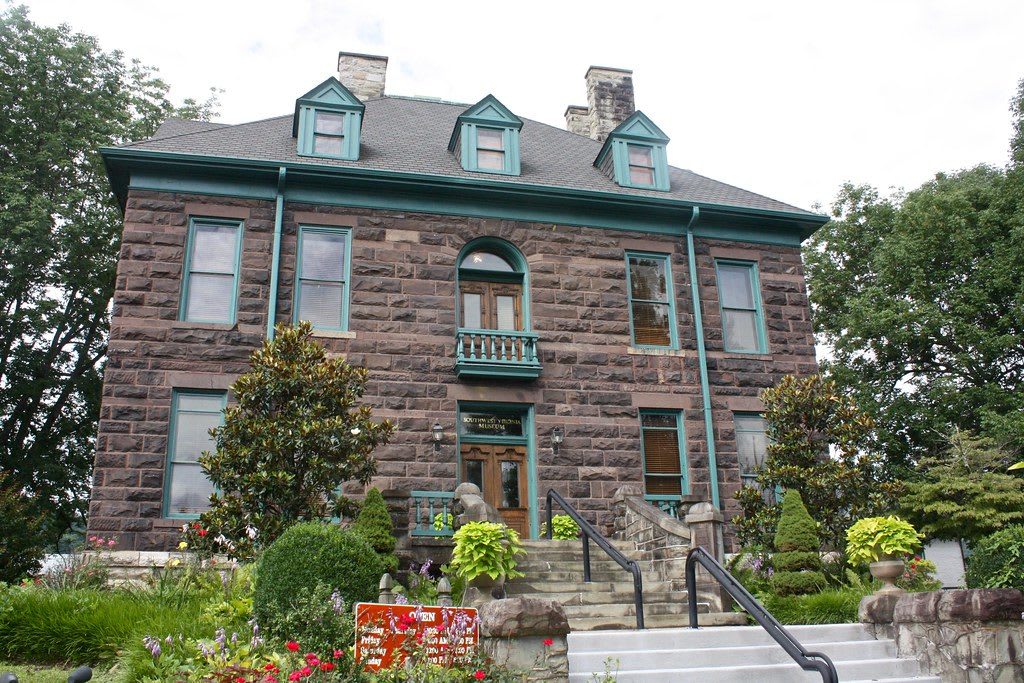
 vastateparksstaff / CC BY 2.0 via Flickr
The Story
In the 1880s investors poured into the valley where the Powell River breaks through Stone Mountain, betting that coal and iron would make a town once called Mineral City and Three Forks into the Pittsburgh of the South. It took the name Big Stone Gap in 1888. That same year Rufus A. Ayers, a former attorney general of Virginia, began this house, finished in 1895, in limestone and sandstone from local quarries, its rooms lined in red oak and the whole once ringed by a small moat.
The boom broke in the 1890s before the town became the city its backers had drawn, though coal kept the gap and its camps working for most of the century that followed. In 1946 C. Bascom Slemp, a member of Congress and later private secretary to Calvin Coolidge, left the house through his foundation to the state, and it opened as a museum in 1948. It is a National Register and Virginia Landmarks Register property.
The collection runs past 60,000 pieces, only a small share of them out at once. Galleries cover the frontier of the 1700s and the Wilderness Road, the boom and bust of the 1890s, and life and labor in the coal camps, with an interactive station on the camps. A quilt show fills the house in April and May and a Festival of Trees at the end of the year. The Harry W. Meador Coal Museum is a few blocks east.
Visitor Info
On the Map
Nearby
The closest stops worth working into your route
Historical markers nearby
Roadside plaques and monuments within a short detour