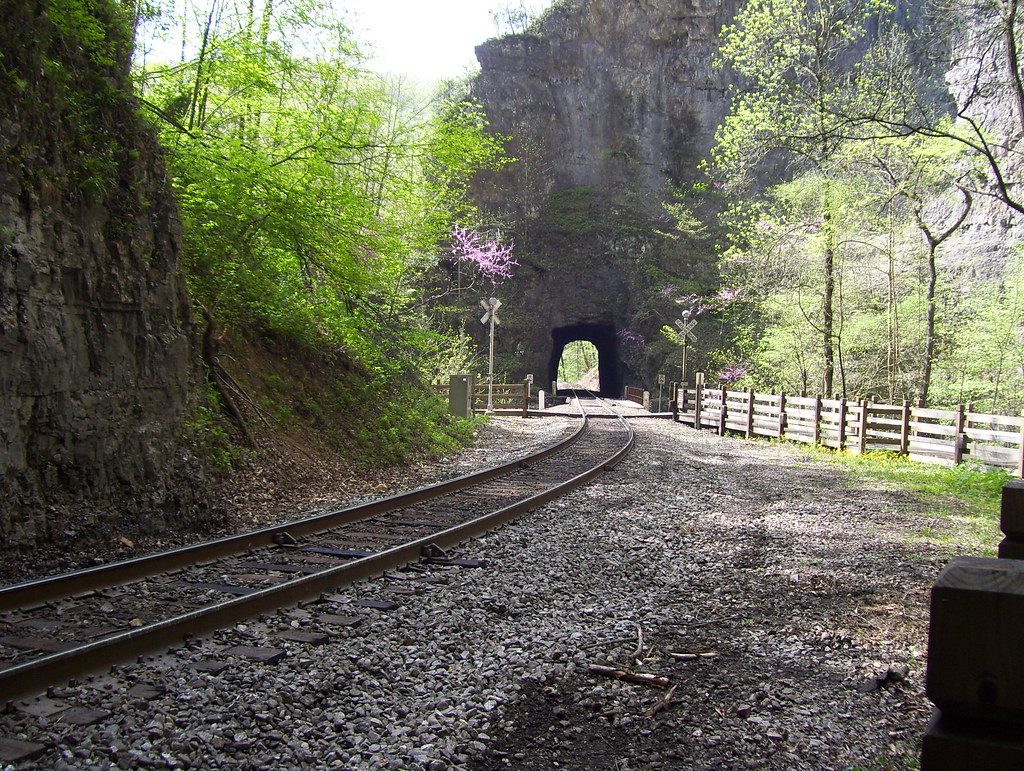
 vastateparksstaff / CC BY 2.0 via Flickr
The Story
Stock Creek did the work here. For more than a million years groundwater carrying carbonic acid ate through the limestone and dolomite of Purchase Ridge, and the creek, diverted underground, kept cutting until it had made a passage some 850 feet long and about ten stories high. Around the mouth the creek has opened an amphitheater of sheer walls, and fossils turn up in the rock and in the creek bed. Daniel Boone, whose road west passed close by, was probably among the first Europeans to see it; the explorer Stephen H. Long described it in print in 1832.
Railroad men saw a ready-made tunnel. A line was surveyed through it in 1852, and after the Civil War stopped that plan, the South Atlantic and Ohio pushed track from Bristol to Big Stone Gap through the tunnel by the early 1890s. Passenger trains such as the Lonesome Pine Special ran until 1939. The line now carries coal, and Norfolk Southern and CSX trains still pass through the cave.
The state made the 909-acre park in 1967 and opened it in 1971. A chairlift, the only one in Virginia's state parks, carries visitors from the visitor center down to a 500-foot boardwalk and an observation deck at the south mouth; walkers can take the steep trail instead. Seven trails lead out to Lover's Leap, Tunnel Hill and the Gorge Ridge, and a blockhouse exhibit near the picnic area tells the frontier's push west along the Wilderness Road in the 1700s.
Visitor Info
On the Map
Nearby
The closest stops worth working into your route
Historical markers nearby
Roadside plaques and monuments within a short detour