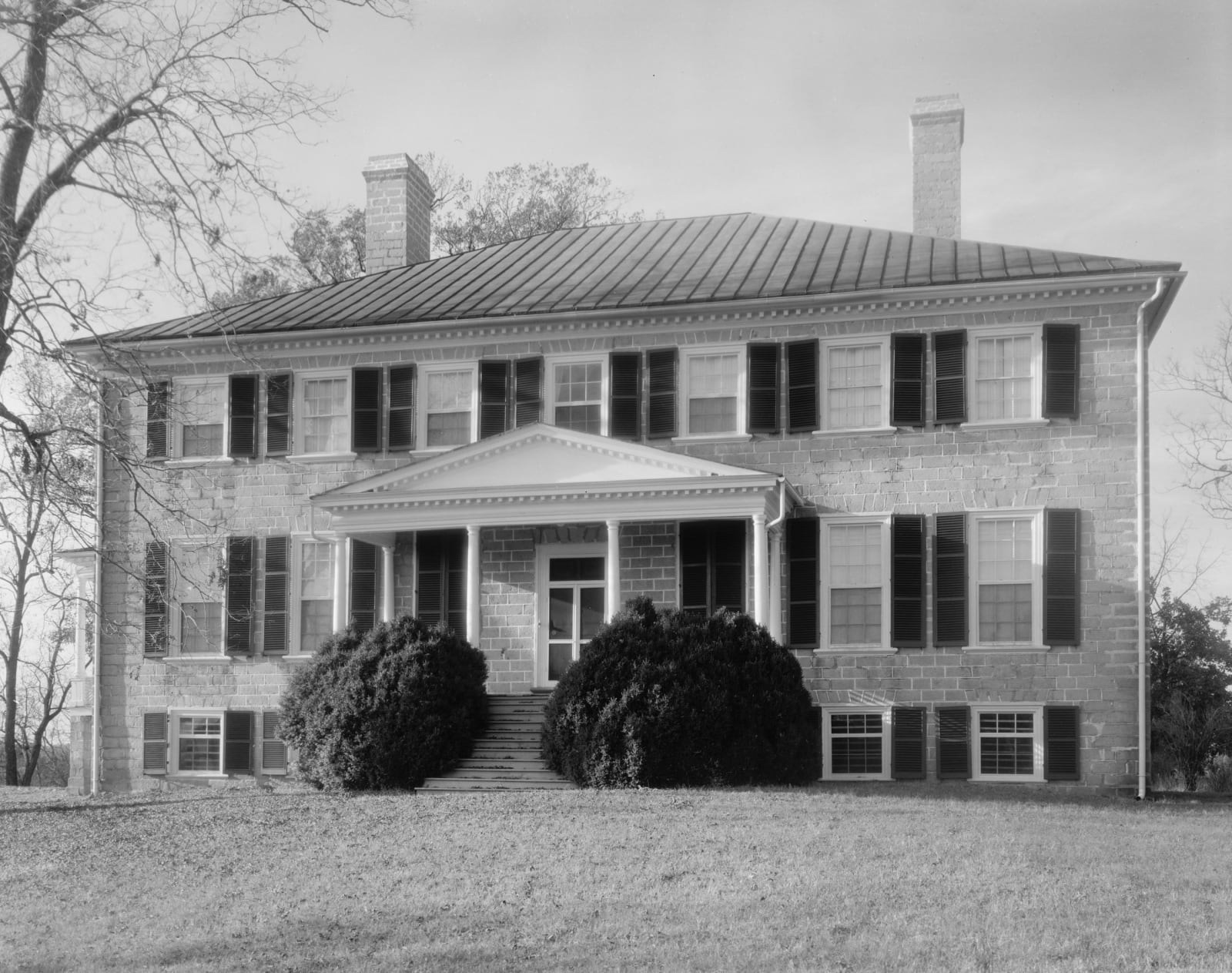
 Frances Benjamin Johnston, 1935 / public domain via Library of Congress
The Story
Sir Peyton Skipwith, the only Virginia-born baronet, gathered a plantation of about 10,000 acres on the Roanoke River above Clarksville, and in 1795 finished Prestwould, a two-story house of dressed sandstone looking south over the river, now Buggs Island Lake. The stonemason Jacob Shelor did most of the masonry, and the carpenter John Inge leased two enslaved men from Skipwith, Dick and Pliny, to work on it. Lady Jean Skipwith laid out a garden in 1801 that is among the best documented in Virginia.
In 1787 Skipwith held 144 people in slavery, 135 of them in Mecklenburg, and before the Civil War several hundred enslaved people lived at the home quarter and on outlying quarters, including farms on a large island where the Dan and Staunton met, now under the lake. Pliny, a carpenter, made furniture for the plantation. Three buildings from their lives still stand below the house: a two-family slave house of the 1780s, the last of a group the 1798 plat called the New Quarter and possibly the oldest frame slave dwelling left in the South; a 1790s plantation store turned into workers' housing after the war; and a loom house of about 1830 with rooms upstairs where enslaved people lived.
The Skipwiths held Prestwould until 1914, and the Prestwould Foundation has owned the house and 46 acres since 1963. It is a National Historic Landmark, with French scenic wallpaper hung in 1831 still on the walls. The plantation papers survive in unusual depth, which is why so many names are known.
Visitor Info
On the Map
Nearby
The closest stops worth working into your route
Historical markers nearby
Roadside plaques and monuments within a short detour