Home / Mississippi / Oxford & the North Hills / Oxford Square
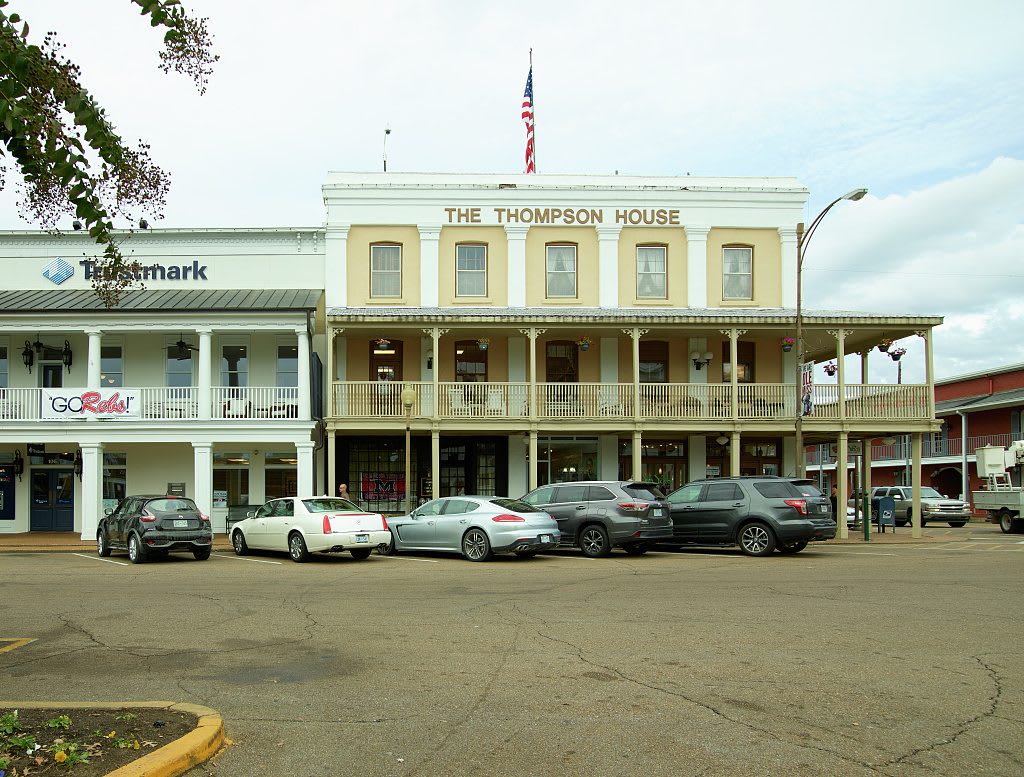
The two-story Thompson House with its upper gallery and a neighboring bank building on the Oxford courthouse square, with parked cars in front.Carol M. Highsmith / public domain via Library of Congress
🎭Cultural

Oxford Square

Part ofOxford & the North Hills

The courthouse square laid out in 1837 on land bought from a Chickasaw woman, rebuilt after the 1864 burning and home to Square Books and a memorial to Lafayette County's lynching victims.

⏱
Duration
One to two hours.
🎟
Admission
Free; shops, restaurants and the courthouse lawn are open to walk.
📅
Best Season
Year round; shops keep their own hours and the lawn is best in spring and fall.

The Story

Oxford began in 1837 when John Martin, John Chisom and John Craig bought land from Hoka, a Chickasaw woman, five years after the Treaty of Pontotoc Creek opened the country to settlement. They named the town for Oxford, England, to sell it as a seat of learning, and in 1841 the legislature agreed by putting the state university here.

The square has been rebuilt before. Union troops occupied the town in 1862 under Grant and Sherman, and in 1864 Major General A. J. Smith burned the buildings around the square, the courthouse among them. A new Lafayette County Courthouse was finished in 1872. On its east side, a marker placed in September 2021 with the Equal Justice Initiative names the county's known lynching victims: Harris Tunstal in 1885, William McGregory in 1890, William Steen in 1893, William Chandler in 1895, Lawson Patton in 1908 and Elwood Higginbottom in 1935, along with a man killed in 1891 whose name was not recorded.

The stores around the square include Square Books, an independent bookstore founded in 1979. Lafayette County is generally taken as the model for Faulkner's Yoknapatawpha County, and Oxford for its seat, Jefferson, though he moved and renamed places freely. Rowan Oak is less than a mile away.

Visitor Info

⏱
Time Needed
One to two hours.
🎟
Admission
Free; shops, restaurants and the courthouse lawn are open to walk.
📅
Best Season
Year round; shops keep their own hours and the lawn is best in spring and fall.
🛣️
Highway
MS-6 / MS-7

On the Map

Nearby

The closest stops worth working into your route

historical0.6 mi away
Rowan Oak
William Faulkner's Greek Revival house in Oxford, bought in 1930 and kept by the University of Mississippi, with the outline of A Fable still written on his study wall.
historical1 mi away
The Lyceum and the Circle, University of Mississippi
The 1848 Greek Revival building at the center of the Ole Miss campus, where federal marshals held off a mob on 30 September 1962 and James Meredith registered the next morning.
recreational16 mi away
Sardis Lake and Dam
A flood-control lake on the Little Tallahatchie, built from 1930s labor and a dredge named Pontotoc, with a dam that for years was the largest earth-filled dam in the world.
historical16 mi away
Casey Jones Railroad Museum
The old Illinois Central depot in Water Valley, where Casey Jones worked in the 1890s, with a Mississippi Blues Trail marker for the songs written about his death in 1900.
recreational27 mi away
Enid Lake
A Corps of Engineers lake on the Yocona River, finished in 1952 after farm families were moved off the valley floor, and the home water of a world-record white crappie.
historical28 mi away
Ida B. Wells-Barnett Museum
The house in Holly Springs where Ida B. Wells was born into slavery in 1862, now a museum of African American history, art and culture.