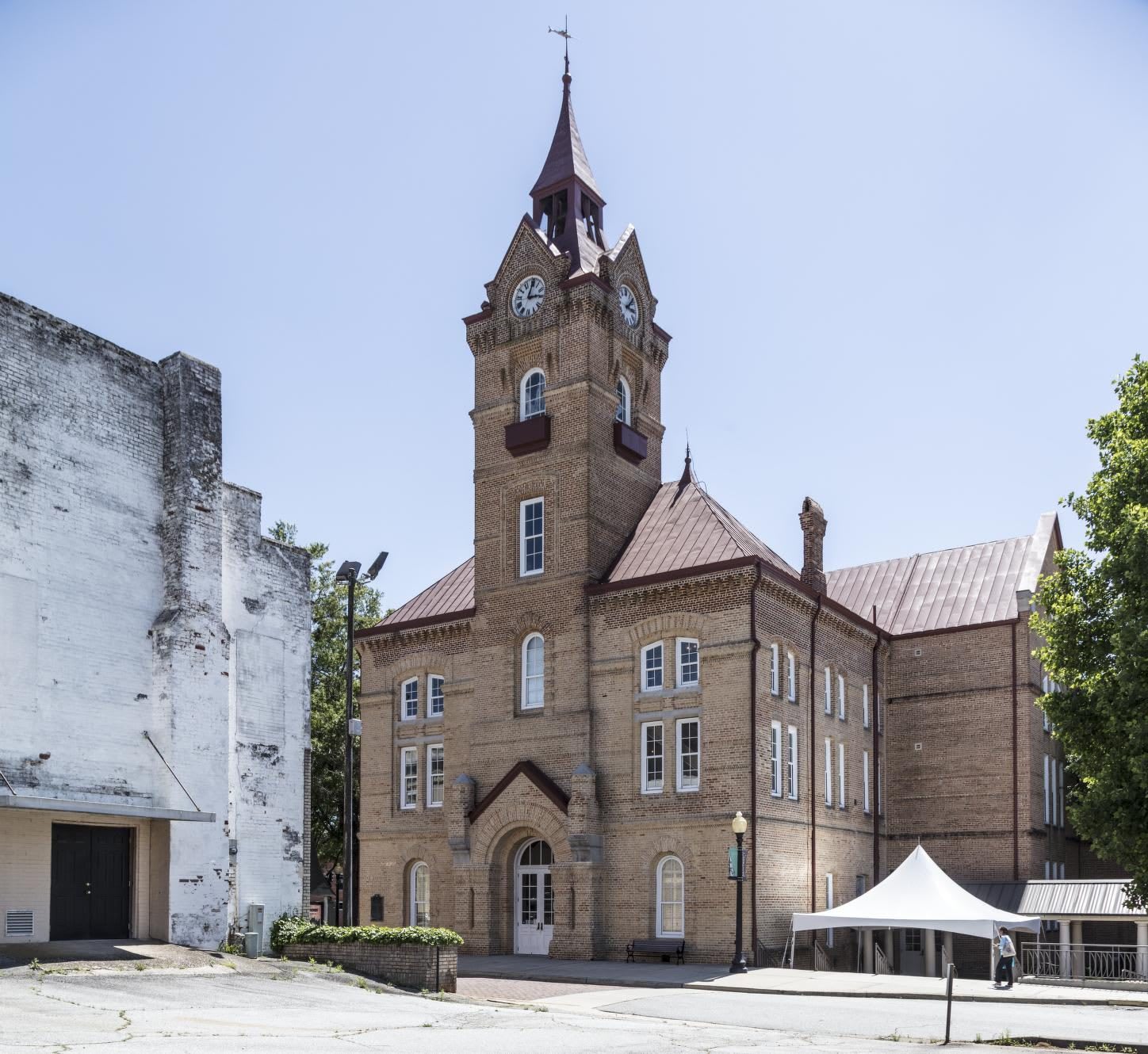
 Carol M. Highsmith / public domain via Library of Congress
The Story
Newberry was a small court town until the Greenville and Columbia Railroad came through in 1853. By 1873 the local paper claimed it as the second-largest cotton market in South Carolina, and the town built this hall as a sign of its prosperity. Designed by G. L. Norrman in a French Gothic style, it was finished in 1881 and dedicated in 1882, with a 130-foot clock tower topped by a garfish weather vane. The ground floor held the fire engine room, the town council chamber, the clerk, the police and three jail cells; upstairs was a 426-seat theater.
Touring New York plays, minstrel shows, singers, magicians and boxing matches came through, along with Edwin Booth, the Barrymores and Tallulah Bankhead. The first film shown here was The Birth of a Nation, the 1915 picture that glorified the Ku Klux Klan, and in the 1920s the hall became a movie theater. The balcony was cut back, and Black patrons were confined to it and sent up an outside stairway. Newberry's cotton mill workers struck against the stretch-out in 1934 and again in 1936. The last picture ran in 1952, and by 1959 there was talk of tearing the building down.
The Newberry Historical Society took up its cause in 1969 and the building went on the National Register. The exterior was restored by 1994; after the city moved out, a foundation took on the interior, finished in 1999 at a cost of about $5.5 million, and the opera house reopened as a performing arts hall that helped bring downtown Newberry back.
Visitor Info
On the Map
Nearby
The closest stops worth working into your route
Historical markers nearby
Roadside plaques and monuments within a short detour