Home / Mississippi / The Mississippi Gulf Coast / LaPointe-Krebs House (Old Spanish Fort)
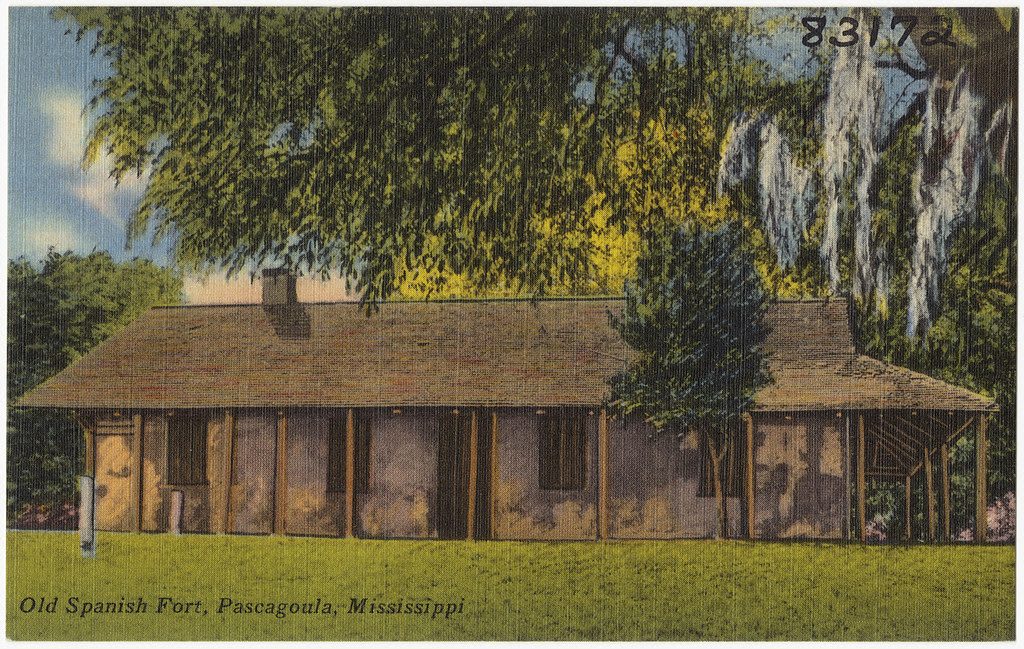
A tinted postcard of the low, shuttered LaPointe-Krebs House with a deep gallery under a spreading oak hung with Spanish moss.Boston Public Library (Tichnor Brothers Collection) / CC BY 2.0 via Flickr
🏛️Historical

LaPointe-Krebs House (Old Spanish Fort)

Part ofThe Mississippi Gulf Coast
On this driveUS 90 on the Gulf Coast: Bay St. Louis to Pascagoula

The oldest standing structure in Mississippi, a French colonial plantation house in Pascagoula, set on land where Pascagoula and Biloxi peoples lived before the colonists came.

⏱
Duration
About one hour.
🎟
Admission
Check the foundation's website for current admission and hours.
📅
Best Season
Year round; the museum was described as open seven days a week except holidays in 2026 (WLOX).

The Story

When French ships anchored off the Mississippi coast in 1699, the Pascagoula, Biloxi and Capinan peoples already had towns along the Pascagoula River. The Pascagoula spoke a Choctawan language and the Biloxi a Siouan one. By 1700 Iberville found a Biloxi village deserted, the nation thinned by disease, and in 1763 the Pascagoula and other small coastal nations moved west into Spanish Louisiana. Excavations on this small park have turned up Native pottery, much of it attributed to the Pascagoula and the Choctaw, alongside the colonial record.

About 1718 Joseph Simon de la Pointe received a land concession here and, with enslaved labor, had a working plantation within a decade. His daughter Marie Josephine married Hugo Krebs in 1741, and the Krebs family held the property until 1940. A 1745 census recorded ten European colonists and sixty enslaved Africans in the area. The house is a French colonial-style building that the archaeology dates to the 1770s, standing over the remains of an earlier French structure. The state archives call it the oldest standing structure in Mississippi.

The place was listed on the National Register in 1971 as "Old Spanish Fort," and the foundation that runs it now says the house was formerly known by that name. Hurricane Katrina flooded the house and museum in August 2005, and FEMA-funded restoration through the state archives and new excavations in 2010 turned up 96 features in the ground. It is a short stop, and the Lighthouse Park walk on the river is close by.

Visitor Info

⏱
Time Needed
About one hour.
🎟
Admission
Check the foundation's website for current admission and hours.
📅
Best Season
Year round; the museum was described as open seven days a week except holidays in 2026 (WLOX).
🛣️
Highway
US 90

On the Map

Nearby

The closest stops worth working into your route

historical0.6 mi away
Round Island Lighthouse at Lighthouse Park
What survives of the 1832 Round Island light, moved to the foot of the Pascagoula River bridge, with a free walking pathway through nine eras of Pascagoula history.
natural7.6 mi away
Mississippi Sandhill Crane National Wildlife Refuge
A refuge for one of the rarest birds in North America and the wet pine savanna it needs, created in 1975 as the first refuge established under the Endangered Species Act.
cultural16 mi away
Walter Anderson Museum of Art
A museum in downtown Ocean Springs built around the artist who rowed to Horn Island to paint, with his 1952 murals of Iberville's 1699 landing and the Seven Climates of the town.
cultural18 mi away
Maritime & Seafood Industry Museum
A Point Cadet museum on Biloxi's oyster, shrimp and schooner past, from the packing houses and the shrimpers' unions to the Vietnamese families who rebuilt the industry.
natural18 mi away
Pascagoula River Wildlife Management Area
State-held bottomland along one of the last unchanged river systems in the lower forty-eight, in George and Jackson counties near Lucedale.
cultural19 mi away
Ohr-O'Keefe Museum of Art
Frank Gehry's pavilions on the Biloxi waterfront, built around the pottery of George Ohr, the self-styled Mad Potter, and the rebuilt Pleasant Reed House.