Home / South Carolina / Myrtle Beach, Georgetown & the Grand Strand / Kingstree
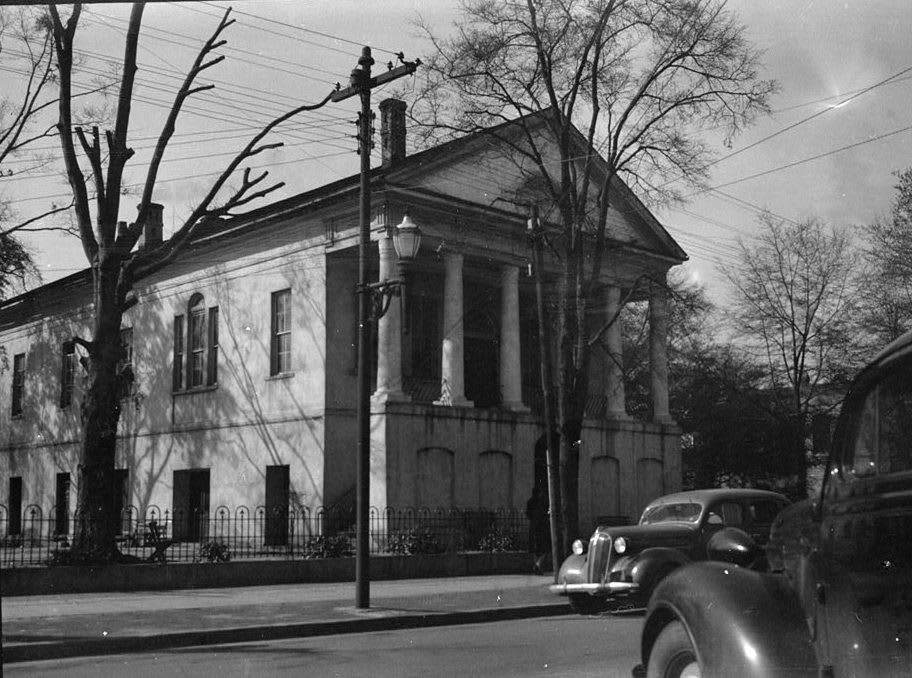
A black-and-white photograph of the Robert Mills courthouse in Kingstree, with its columned portico over an arcaded ground floor and 1930s cars parked in front.Historic American Buildings Survey / public domain via Library of Congress
🏛️Historical

Kingstree

Part ofMyrtle Beach, Georgetown & the Grand Strand

Williamsburg County's seat on the Black River: the king's marked pine, Marion's recruits, the 1867 jail fire that killed 22 Black prisoners, and a Robert Mills courthouse.

⏱
Duration
One to two hours.
🎟
Admission
Free to walk.
📅
Best Season
Spring and fall.

The Story

On January 7, 1867, fire swept the Williamsburg County jail here and killed twenty-two Black prisoners, nineteen men and three women locked on the third floor. Most were held on small charges, cattle or rice or cotton stealing, fence burning, resisting an officer. The keys were slow to come, and the rescue failed. Twenty-one of their names survive: Josiah Alston, Lunnon Brown, Nelson Brown, Doctor Graham, Ellis Graham, Julius Graham, Louisa Graham, Nancy Graham, Harry Scott, Lewis Scott, John Sessions, John Shaw, Charles Singletary, Jack Speights, Nias Speights, Wesley Speights, Charles Tisdale, Cyrus Tisdale, John Tisdale, Minda Tisdale and Sam Witherspoon. The Army arrested the sheriff, his deputy and an assistant jailer; a county jury acquitted them in April.

The Black River, which Native people called the Wee Nee, runs past the town. Kingstree is named for a great white pine on its bank, marked with the king's broad arrow as a ship's mast. Forty Scots-Irish settlers took up Williamsburg Township in 1732; indigo brought plantation slavery in the 1740s, and by 1830 Black residents outnumbered white three to one. In 1780 local men formed the core of Francis Marion's brigade.

The courthouse on Main Street, designed by Robert Mills in 1823, survived an 1883 fire on walls thirty inches thick. Thorntree, the 1749 house of James Witherspoon, was moved into town in 1969 for safekeeping. A 75-mile stretch of the Black River is a state scenic river, good for paddling under cypress.

Visitor Info

⏱
Time Needed
One to two hours.
🎟
Admission
Free to walk.
📅
Best Season
Spring and fall.
🛣️
Highway
US 52

On the Map

Nearby

The closest stops worth working into your route

historical15 mi away
Ronald E. McNair Life History Center
The 1950 Lake City library where nine-year-old Ronald McNair refused to leave without his books, now a museum of the astronaut's life beside his memorial and grave.
culinary21 mi away
Scott's Bar-B-Que
A country store in an oak grove where the Scott family has cooked whole hogs over wood coals since 1972.
historical33 mi away
Liberty Hill AME Church
The Clarendon County church where parents met to plan Briggs v. Elliott, the first of the five cases decided as Brown v. Board of Education.
historical33 mi away
Old Santee Canal Park
The surviving end of the 1800 Santee Canal at Moncks Corner, dug by enslaved and Black laborers, with boardwalks through Biggin Creek swamp.
historical36 mi away
Florence Stockade
The Confederate prison camp of 1864-65 outside Florence, where about 2,800 Union prisoners died, now a walking trail beside the national cemetery that began as their burial trenches.
historical36 mi away
Santee Indian Mound and Fort Watson
A Mississippian ceremonial mound above Lake Marion, later the stockade the British called Fort Watson, taken by Francis Marion and Henry Lee in 1781.

Historical markers nearby

Roadside plaques and monuments within a short detour

Marker0 mi away
Old Muster Ground and Courthouse
Kingstree
Marker0.3 mi away
St. Alban's Episcopal Church
Kingstree
Marker0.4 mi away
Williamsburg Church
Kingstree
Marker0.4 mi away
Stephen A. Swails House
Kingstree
Marker0.7 mi away
Tomlinson School
Kingstree
Marker0.8 mi away
"Let Us March on Ballot Boxes"
Kingstree