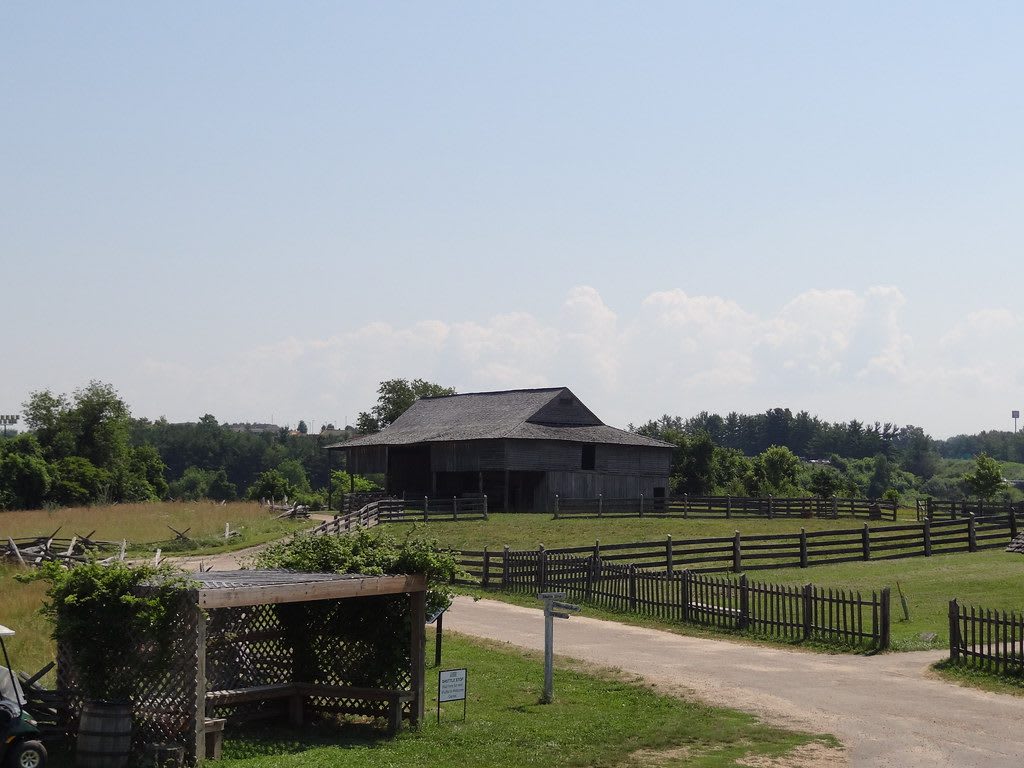
 westher / CC BY 2.0 via Flickr
The Story
Virginia's General Assembly created this open-air museum in 1986, and it opened in 1988 to show who came into the Shenandoah Valley in the 1700s and 1800s, by choice or by force. Farm buildings from England, Ulster and the German Palatinate were taken down in Europe and raised again here on 188 acres: a seventeenth-century yeoman's timber-frame house from Worcestershire, a tenant farmhouse from County Tyrone with a forge from Fermanagh, and a Palatine farm. Beside them stands a reconstructed eighteenth-century Igbo family compound from what is now Nigeria, with its central obi, wives' houses, son's house and kitchen.
The Eastern Woodlands Indian site, set in the years from the 1650s to the 1760s, represents no single nation. It stands for peoples such as the Pamunkey, Mattaponi, Chickahominy, Monacan, Nansemond, Rappahannock, Cheroenhaka (Nottoway) and Patawomeck, all nations still in Virginia, with wigwams, a cooking area, shelters for watching the crop fields and a place where dugout canoes are burned out.
The paths then cross to the American farms: a 1760s settler's log cabin, a house built by a German immigrant in Rockingham County in 1773 and given an English-style parlor around 1820, a Botetourt County farm of the 1850s, an 1840s schoolhouse, and a log church from New Hope whose Black Methodist congregation remembers it as built by enslaved people. By the 1820s about a quarter of the valley's people were enslaved, and the museum sets the blending of European farm ways against that fact. Interpreters cook, plant and work the forge in period dress, and heritage breeds graze the fields.
Visitor Info
On the Map
Nearby
The closest stops worth working into your route
Historical markers nearby
Roadside plaques and monuments within a short detour