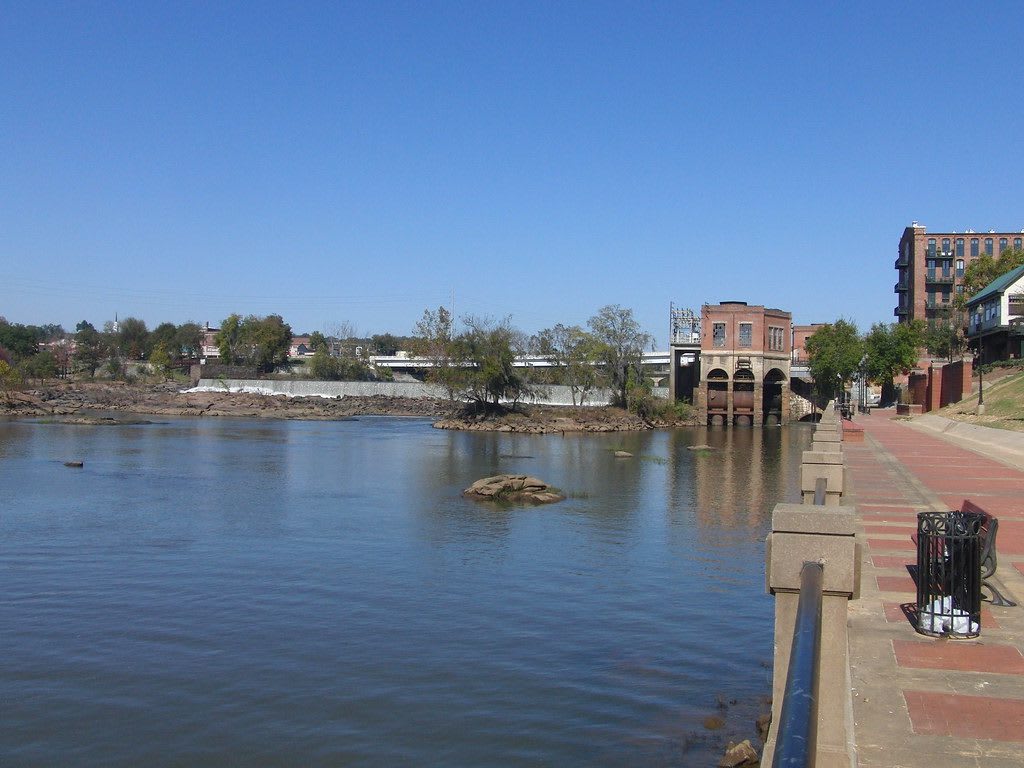
 xoder / CC BY 2.0 via Flickr
The Story
The falls of the Chattahoochee at Columbus carry the name of Coweta (Kvwetv), one of the four mother towns of the Muscogee Confederacy, which stood on the river's west bank in what is now Alabama. Downstream on the Georgia side lay Cusseta (Kvsehtv), the other great town of the Lower Creeks, and Muscogee oral history holds that both were settled from Ocmulgee about a thousand years ago. The treaties of 1825 and 1826 took the Georgia bank. In 1828 the legislature laid out Columbus at Coweta Falls, the head of steamboat navigation, and auctioned its lots; the Muscogee held the far bank until the removals that followed the war of 1836.
The falls then went to work. The city sold the rights to dam the river and kept the mills to a narrow strip along the water, where by 1880 the Eagle and Phenix Company was turning out most of the county's textiles. The first public bridge across to Alabama here was built under contract by John Godwin and probably planned by Horace King, the enslaved builder who directed the work; King was freed in 1846 and became the best-known bridge builder in the region. In 1860 more than 3,500 enslaved people lived in Columbus.
The RiverWalk opened in 1992 and now runs some 22 miles from the Lake Oliver dam to Fort Benning. In 2012 and 2013 the City Mills and Eagle and Phenix dams were breached to open a two-and-a-half-mile whitewater run through downtown. Start at Bay Avenue near the Dillingham Street Bridge and walk north to the 14th Street footbridge.
Visitor Info
On the Map
Nearby
The closest stops worth working into your route
Historical markers nearby
Roadside plaques and monuments within a short detour