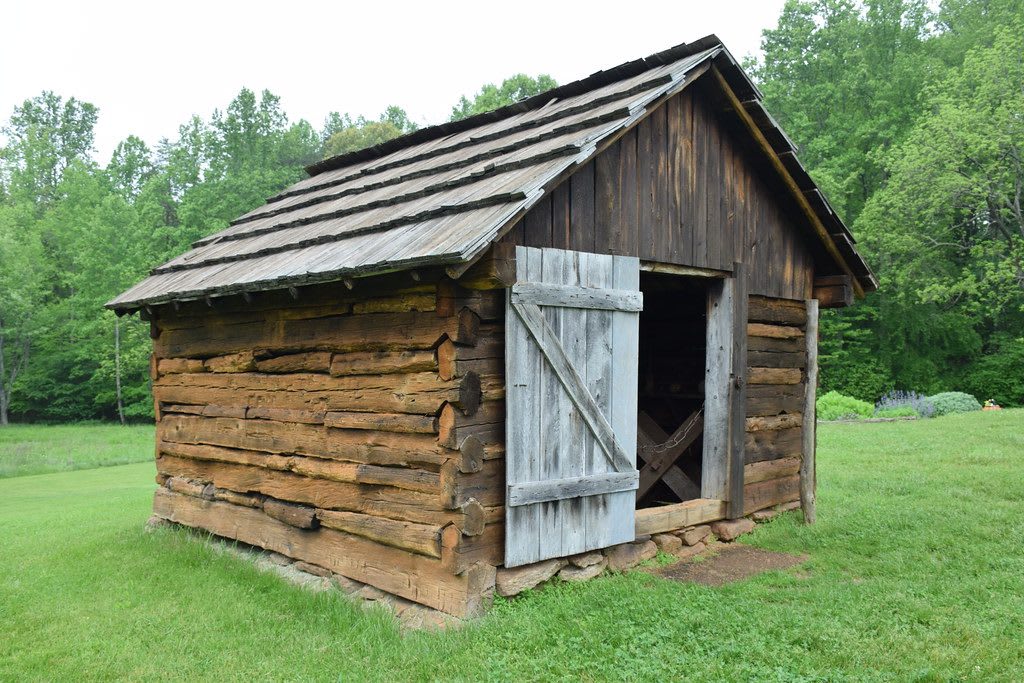
 tvanhoosear / CC BY-SA 2.0 via Flickr
The Story
Booker Washington was born enslaved in the late 1850s on James Burroughs's tobacco farm near Hale's Ford; his headstone gives 1856. His mother, Jane, was the Burroughses' cook, and he lived with her and his half-siblings, John and Amanda, in the farm's one-room kitchen cabin. His father was a white man from a nearby plantation whom he never knew. As a small boy he carried water to the men in the fields, carried the Burroughs daughters' books to school and hauled grain to the mill.
James Burroughs died in 1861 and his sons went to fight for the Confederacy. Jane's husband, Washington Ferguson, enslaved on another farm, escaped to West Virginia in 1864. In 1865 a Union soldier read the Emancipation Proclamation from the porch of the Burroughs house, and late that summer Ferguson sent for the family to join him at the salt works in Malden. The boy went on to Hampton, opened Tuskegee in 1881 with about thirty students, gave his Atlanta speech in 1895 and published Up From Slavery in 1901, which begins with his birth here.
Congress authorized a commemorative half dollar, minted from 1946 to 1951 and the first United States coin to show an African American, to buy the site; it fell short, Virginia made up the difference, and the monument was established on April 2, 1956. The grounds now keep portions of the 207-acre farm as it was in the 1850s, with log buildings, gardens and farm animals, a picture of slavery on a middling Piedmont farm rather than a great plantation.
Visitor Info
On the Map
Nearby
The closest stops worth working into your route
Historical markers nearby
Roadside plaques and monuments within a short detour