County guide · Tennessee
Knox County
2 places to stop and 64 historical markers in Knox County, Tennessee.
Towns: Knoxville (58), Farragut (3), Oak Ridge (2), Powell (1), Claxton (1), Corryton (1)
Places to stop
cultural · Knoxville
Beck Cultural Exchange Center
Knoxville's Black history museum and archive, opened in 1975 in the 1912 Dandridge Avenue house the community bought for $22,500.
historical · Knoxville
Blount Mansion
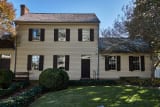
The 1792 frame house of William Blount, governor of the Southwest Territory, Knoxville's only National Historic Landmark, where the people he enslaved are named.
Historical markers
Powell
Airplane Filling Station
Elmer Nickle had a strong interest in airplanes, and he and his brother Henry wanted a station that would stand out for travelers on the newly widened U.S.
Farragut
Archibald Roane
Archibald Roane, a Pennsylvanian who was at Yorktown, taught at Liberty Hall Academy in Virginia before settling in Jonesborough as a lawyer.
Knoxville
Battery Wiltsie
Orlando Poe, Burnside's chief engineer, laid out Knoxville's defenses on a ridge at least 100 feet above the ground around it.
Farragut
Battle of Campbell's Station
Burnside slipped away from Lenoir's Station in the night and ran for Knoxville along the muddy Kingston Road, with Longstreet trying to cut him off at the crossroads.
Knoxville
Beauford and Joseph Delaney
Beauford Delaney left Knoxville for Boston and reached New York in 1929, in the Depression, working at the Whitney to get by.
Knoxville
Blount Mansion
William Blount signed the Constitution and became one of Tennessee's first U.S. senators in 1796, deep in debt from land speculation.
Knoxville
Blount-Knox Co. Line
Henry Knox, for whom Knox County is named, was Secretary of War when the Treaty of Holston's aftermath landed on his desk.
Knoxville
Burnside's Headquarters
The house belonged to John Hervey Crozier, a Knoxville lawyer who served two terms in Congress as a Whig from 1845 to 1849 and opposed the Mexican War.
Knoxville
Cavett's Station
At dawn on September 25, 1793, a Cherokee war party, put by one account near a thousand strong and led jointly by John Watts, Bob Benge, James Vann and Doublehead, had…
Knoxville
Civil War Hospital
Jacob Newman built the Greek Revival main building of the Tennessee School for the Deaf in 1846 and added its wings in 1851 and 1852; its marble entrance stair may be…
Knoxville
Colored (Negro) Department: Tennessee School for the Deaf (TSD)
In 1852 a petition to admit a Black pupil to the Tennessee School for the Deaf was refused.
Knoxville
Confederate Cemetery
Bethel Cemetery holds more than 1,600 Confederate dead, about a hundred of them killed at Fort Sanders, along with some 50 Union men and a few dozen veterans.
Farragut
David Glasgow Farragut
He was born James Glasgow Farragut at Lowe's Ferry on the Holston, the son of a Menorcan sea captain who had fought in the Revolution and a North Carolina woman of…
Claxton
David Hall Cabin
The two-story log cabin is said to date from about 1799, though accounts differ on who built it: one names George Walker, building for Isaac Brazelton, while Hall is…
Knoxville
Death of Gen. William P. Sanders
William Price Sanders, a Kentuckian raised in Natchez, finished 41st at West Point in 1856. He was a cousin of Jefferson Davis, yet stayed with the Union.
Knoxville
Desegregation of the University of Tennessee
Four Black applicants sued for admission to graduate and professional schools, and in 1952 two of them enrolled.
Knoxville
First African American Church
Greater Warner Tabernacle is described as Knoxville's oldest surviving Black congregation, begun in 1845 on Fuller Street on land given by a German.
Knoxville
First Presbyterian Church
For its first seventeen years under Samuel Carrick the congregation had no building and met under trees, in the territorial barracks and in the first courthouse.
Knoxville
Fork of the River
Mecklenburg, the Ramsey estate at the meeting of the French Broad and Holston, held a mansion, a ferry across the Holston and a 4,000-volume library of early Tennessee…
Knoxville
Fort Adair
John Adair, a Revolutionary veteran and one of the area's first settlers, built a four-room log house on White's Creek that became a stockaded supply station for the…
Knoxville
Fort Byington
Before it held lecture halls, the ridge was called Barbara Hill, after Governor Blount's daughter.
Knoxville
Fort Dickerson
Fort Dickerson and its neighbor Fort Stanley were the big earthworks on the south bank of the Tennessee, with Fort Higley built southwest of Dickerson.
Knoxville
Fort Higley
Black laborers, refugees from slavery among them, began digging Fort Higley on November 27, 1863.
Knoxville
Fort Sanders
Union engineers raised the work as Fort Loudon, the name Confederates kept using, and it became Fort Sanders on November 24, 1863, for the cavalry officer mortally…
Knoxville
Fountain City Schools
Hassie K. Gresham, a Holbrook Normal College graduate, became principal of Central High School in 1919 and is reported as the first woman to head a high school in…
Knoxville
Fountain City United Methodist Church/Fountain Head Campground
The spring that gave the place its first name drew camp meetings in the 1820s, some attracting 2,000 worshipers.
Oak Ridge
Freels Bend Cabin
Edward Freels, whose family came from North Carolina in the 1790s, is credited with the oldest room, built around 1810 with a loft reached by ladder; a second room and…
Knoxville
General Clifton Bledsoe Cates 1895-1970 United States Marine Corps
At Belleau Wood on June 6, 1918, Cates took over his company when its commander was mortally wounded and led the attack on Bouresches, earning the Navy Cross and a…
Knoxville
Island Home
Perez Dickinson bought the land from Colonel Thomas Spence in 1869 and built a large Italianate house in 1875 on a farm of about 600 acres, named for the island in the…
Knoxville
James H. Robinson
Robinson spent his early childhood in the Bottoms, a poor, polluted part of downtown Knoxville, before his family moved to Cleveland when he was about ten.
Knoxville
James Park Home
James Park, a Scots-Irish merchant who reached Knoxville in 1798, bought Sevier's abandoned foundation in 1812 and finished the house.
Knoxville
James Rufus Agee
Agee's father died in a car accident in 1916, when James was six, and the boy was sent to boarding school, most notably St.
Knoxville
John Sevier Farmstead
Tree-ring dating in 2007 found that the oldest logs in the cabin called Sevier's were cut around 1835, two decades after he died; its likely builder was George Kirby, a…
Knoxville · Erected 2020
Knoxville Birthplace of Mountain Dew
The name came before the soda. Mountain dew was old slang for whiskey, used in Scots-Irish and Southern speech for moonshine and carried by the 1882 Irish song The Rare…
Knoxville
Knoxville College
R. J. Creswell of the United Presbyterian Church began the school in 1864 as a mission for free Black residents and formerly enslaved people, and the church bought this…
Knoxville
Knoxville: A Divided City
Samuel Bell Palmer was born in Knoxville in 1843, the son of an Irish immigrant who went from tailor to merchant, and he drew the crowded Gay Street scene of 1861 from…
Knoxville
Land Grant University
The Morrill Act of 1862 gave each state scrip for 30,000 acres per member of Congress, to be sold to fund colleges of agriculture and the mechanic arts.
Knoxville
Longstreet's Headquarters
Bleak House went up in 1858 as a wedding gift to Robert Houston Armstrong and his wife, Louisa Franklin, from her father, and they named it for the Dickens novel.
Knoxville
Market Square
In 1853 William Swan and Joseph Mabry gave the city part of an eleven-acre tract on condition that it be used for a market, or it would revert to them or their heirs.
Knoxville
Mary Frances Housley Hero of National Airlines Flight 83 (1926-1951)
The DC-4 came from Newark on January 14, 1951, and the pilots touched down too far along an icy Philadelphia runway.
Knoxville
Mecklenburg Place
J. G. M. Ramsey owned eight enslaved people in 1860, was a radical defender of slavery, and even called for reopening the Atlantic slave trade.
Knoxville
Nicholas Gibbs
Johann Nickel Gibs reached Philadelphia on the ship Phoenix in 1751 and served about three years in the French and Indian War with a Northampton County company.
Corryton
Nicholas Gibbs Homestead
The pine-log house has two stories on chestnut sills, with half-dovetail notching and timber cut on the property.
Knoxville
Norris Freeway
TVA built the road in 1934 to haul material from the railroad at Coal Creek to the Norris Dam site, 21 miles ending at Halls Crossroads.
Knoxville
Odd Fellows Cemetery
Two of Knoxville's most prominent Black figures lie in this ground. William F. Yardley, the lawyer and newspaper founder who ran for governor in 1876, died in 1924 and…
Knoxville
Old Gray Cemetery
Landscape architect Frederick Douglass drew the plan for a garden cemetery, dedicated in 1852 and named for the poet Thomas Gray at Henrietta Reese's suggestion.
Knoxville
Old Gray Cemetery
Ellen Renshaw House was nineteen when she began a diary in Knoxville in 1863, three years after her family arrived from Georgia.
Knoxville
Old Knox County Courthouse
On April 12, 1862, Union volunteers led by the civilian scout James Andrews seized the locomotive General in Georgia and raced north, with conductor William Fuller…
Knoxville
Old Mechanicsville
In 1867 the brothers Joseph and David Richards brought more than a hundred Welsh families from Pennsylvania to work at a rolling mill, buying ground from the railroad…
Knoxville
Ramsey House
Thomas Hope, an English-trained architect, probably built the house between 1795 and 1797 for Francis Alexander Ramsey, who had held the Swan Pond land grant since 1786.
Knoxville
Robert Reynolds
Knollwood, as the house is also called, went up on land bought from James White while Major Robert Reynolds was away in the Mexican War, with his sister Rebecca…
Knoxville
Speedway Circle
Cal Johnson, born enslaved in 1844 at Gay Street and Church Avenue, leased a saloon at Gay and Vine in 1879 and later bought it, then added two more, including the…
Knoxville
States' View
Charles McClung drew the plat of Knoxville in 1791 and sold its lots at auction on October 3 that year.
Knoxville
Staub's Theatre
Peter Staub, born in Glarus, Switzerland, trained as a tailor, reached the United States in 1854 and opened a Gay Street tailor shop in 1856.
Knoxville
Sutherland Avenue McGhee Tyson Airport
The field that carried Charles McGhee Tyson's name outgrew its site, and in 1937 the airport moved to Blount County.
Knoxville
The Assault Upon Fort Sanders
At 6:20 on the morning of November 29, after a twenty-minute bombardment, about 2,400 men under Lafayette McLaws went forward in two columns.
Oak Ridge
The Scarboro Community
Scarboro began as hutments without plumbing where Black workers and their families lived apart in the Manhattan Project town, with married couples separated by a fence.
Knoxville
Thomas William Humes
When Humes refused to observe Jefferson Davis's day of prayer in 1861 he lost his pulpit at St.
Knoxville
Treaty of Holston
Cherokee leaders came to the Holston with grievances: they had wanted settlers off their land, and Blount instead proposed buying the settled ground.
Knoxville
University of Tennessee
Samuel Carrick was both the president and the whole faculty of Blount College, chartered in 1794 and named for the territorial governor, and tuition was $8 a semester.
Knoxville
War on the Home Front (Mabry-Hazen House and Bethel Cemetery)
Joseph A. Mabry Jr. built this house around 1858 for his wife Laura Evelyn Hazen, while ranking among Knoxville's largest slaveholders.
Knoxville
West Wing of Federal Lines
Burnside's besieged army ate because of what it brought in and what the French Broad valley sent.
Knoxville
White's Mill
James White, born in North Carolina in 1747, was a militia captain in the Revolution who explored the upper Tennessee Valley in 1783 and moved here in 1785.
Knoxville
William Francis Yardley
Born free in 1844 to a Black father and an Irish mother, Yardley was left on the doorstep of a white family, who raised him.