County guide · North Carolina
Halifax County
4 places to stop and 42 historical markers in Halifax County, North Carolina.
Towns: Halifax (12), Scotland Neck (8), Enfield (7), Hollister (3), Roanoke Rapids (3), Tillery (3), Littleton (3), Hobgood (2), Weldon vicinity (1), Garysburg (1)
Places to stop
cultural · Hollister
Haliwa-Saponi Indian Tribe
The Meadows of Halifax and Warren counties, home of the Haliwa-Saponi, whose April powwow has run every year since the state recognized the tribe in 1965.
historical · Halifax
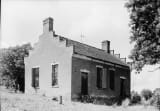
Historic Halifax State Historic Site
The Roanoke River port where the Halifax Resolves of April 12, 1776, were adopted, and where the river carried freedom seekers toward the sounds and the sea.
natural · Hollister
Medoc Mountain State Park
A 325-foot granite ridge, the worn-down root of a range some 350 million years old, where Sidney Weller grew grapes for his Halifax wine in the 1800s.
industrial · Roanoke Rapids
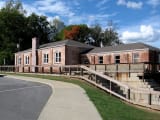
Roanoke Canal Museum and Trail
A canal of the 1820s that carried boats around the falls of the Roanoke, then powered mills, now a 7.2-mile towpath trail from Roanoke Rapids Lake to Weldon.
Historical markers
Halifax · Erected 1953
'Colonial Churchyard'
The churchyard surrounds the site of an Anglican chapel of Edgecombe Parish, later St. Mark's Episcopal, that stood until 1911.
Roanoke Rapids · Erected 1972
Andrew Joyner
With Cadwallader Jones, Joyner formed the Roanoke Steamboat Company in 1826; its first steamboat reached Halifax on April 15, 1829.
Enfield · Erected 2004
Bartholomew F. Moore
When the Confederate court opened in Raleigh and Judge Asa Biggs demanded an oath of allegiance, Moore walked out and never returned.
Weldon vicinity · Erected 1995
Benjamin S. Turner
Turner was five when his owner, the widow Elizabeth Turner, took him and his mother from the Weldon area to Alabama.
Tillery · Erected 1987
Caledonia
The nine-mile dike that held the Roanoke River off Caledonia's bottomland was built by people James Cathcart Johnston enslaved.
Scotland Neck · Erected 2001
Claude Kitchin 1869-1923
Claude Kitchin graduated from Wake Forest College in 1888 and practiced law in Halifax County.
Tillery · Erected 1973
Conoconnara Chapel
James Moir, a Scot who had come to the Cape Fear in 1739 and sent more reports to the Society for the Propagation of the Gospel than any other missionary, moved to…
Halifax · Erected 1968
Cornwallis
Banastre Tarleton's mounted advance guard reached Halifax ahead of the main army and caught the militia gathering on the wrong side of a bridge over a deep ravine…
Halifax · Erected 1977
Eagle Tavern
The tavern began in a cluster of inns on town lot fifty-one, where a house of about 1760 was a tavern by 1774, praised by an English traveler as the town's best public…
Littleton · Erected 2011
Ella Baker
Baker was seven when her mother brought the children from Norfolk, after a 1910 riot in which white mobs attacked Black shipyard workers, back to her own home ground…
Enfield · Erected 1960
Enfield Riot
About two dozen men, many of them substantial landholders and one a judge, William Hurst, rode some seventy miles to Edenton in January 1759 and took Francis Corbin from…
Garysburg · Erected 1960
First Railroad
Chartered by both Virginia and North Carolina in 1830, the Petersburg Railroad was built in good part by enslaved men hired from planters, entered in the company's…
Hobgood · Erected 2000
Frank Armstrong 1898-1969
Frank Armstrong Jr. grew up in Hobgood, attended Wake Forest College, and enlisted in 1928 as a flying cadet.
Scotland Neck · Erected 1982
Gallberry
William Hodge Kitchin, an Alabama-born captain in the army of the Confederacy, which fought to keep Black people enslaved, practiced law in Scotland Neck and won a seat…
Enfield · Erected 2022
Halifax Movement
The movement grew from Enfield's own protests. Days after residents came home from the March on Washington in August 1963, hundreds of Black townspeople marched on City…
Halifax · Erected 1998
Hutchins G. Burton
As governor Burton pressed hardest for primary schooling, warning that the common rudiments of learning were harder to come by than when the constitution was written…
Halifax · Erected 1978
Independence
All 83 delegates of the Fourth Provincial Congress voted together on April 12, 1776, but what they approved was a permission, not an order.
Enfield vicinity · Erected 1992
James E. O'Hara
When O'Hara first ran in 1878, Republican leaders pulled him from the ticket over a bigamy charge he denied, Democrats questioned whether he was a citizen, and when he…
Hobgood · Erected 1965
James Hogun
Hogun came from Ireland and married Ruth Norfleet in Halifax County in 1751. As colonel of the Seventh North Carolina he fought at Brandywine and Germantown, then raised…
Enfield · Erected 1954
John Branch
At the state constitutional convention of 1835, Branch argued against taking the vote from free Black men and for removing religious qualifications for office, and the…
Halifax · Erected 1989
John H. Eaton
Deed research places Eaton's birth on one of four adjoining lots in the block bounded by King, Granville, St.
Scotland Neck · Erected 1965
Kehukee Primitive Baptist Church
The church gave its name to a turning point in Baptist history. In 1827 the Kehukee Association adopted a declaration, drafted the year before by Joshua Lawrence, the…
Roanoke Rapids · Erected 2020
Keys v. Carolina Coach Company
Private Sarah Keys of the Women's Army Corps was riding home on furlough from Fort Dix just after midnight on August 1, 1952, in the fifth row, when a new driver here…
Enfield · Erected 2022
Landmark Case
Willa Cofield Johnson had taught English for ten years at the all-Black Thomas S. Inborden High School when Enfield's movement took hold in 1963, and she joined it.
Enfield · Erected 2018
Louis Austin
Austin's father taught him to stand up for his rights, and when the boy spoke out against discrimination at school, his parents sent him to finish at the Brick School in…
Halifax · Erected 1965
Masonic Lodge
Halifax's Masons met first in homes and taverns, among them William Martin's Sign of the Thistle, from April 1765, under a warrant issued the previous November by…
Halifax · Erected 1988
North Carolina Constitution
North Carolina's first constitution was never put to the people. A committee named on November 13, 1776, with Samuel Ashe prominent, read instructions from Mecklenburg…
Littleton · Erected 1995
Plummer Bernard Young
Young learned the trade in Littleton, where his father, Winfield Scott Young, born enslaved in Halifax County, kept a dry goods store and in 1884 founded a weekly, the…
Littleton · Erected 2005
Raleigh and Gaston Railroad
At Gaston the line crossed the Roanoke on a bridge and met the Greensville and Roanoke road into Virginia.
Scotland Neck · Erected 1938
Ram Albemarle
Gilbert Elliott was nineteen when he contracted to build the ironclad for the Confederacy, a government formed to keep Black people enslaved.
Scotland Neck · Erected 1967
Roanoke River
Deadly spring floods once earned the Roanoke the name 'River of Death.' The worst on record came in August 1940, when a hurricane's rains wrecked crops, homes and…
Hollister · Erected 1982
Sidney Weller 1791-1854
Sidney Weller was born in New York in 1791, earned a master's degree at Union College and trained as a Presbyterian minister before moving to Halifax County in 1829.
Tillery · Erected 2006
Tillery Resettlement
For the Black families who came, Tillery meant land of their own on ground enslaved people and then sharecroppers had worked for generations.
Scotland Neck · Erected 1952
Trinity Church
Joseph Blount Cheshire, an Edenton lawyer turned Episcopal priest, came to Scotland Neck at the congregation's invitation and served as rector for thirty-five years…
Scotland Neck · Erected 1991
W. W. Kitchin
Kitchin's congressional years were the years North Carolina's Democrats stripped Black men of the vote, and he defended the white supremacy campaign and the 1900…
Airlie · Erected 1991
Walter Clark 1846-1924
Walter Clark joined the Confederate army at fourteen and was an adjutant by 1863, when he resigned to finish at the University of North Carolina.
Halifax · Erected 1939
Washington's Southern Tour
Washington set out a little after five on the morning of April 16, 1791, and rode 'thro' a cloud of dust' toward North Carolina.
Enfield · Erected 1965
Whitaker's Chapel
Richard Whitaker built the first log chapel on his land, and Francis Asbury preached there in 1786, 1789 and 1804.
Scotland Neck · Erected 1959
Whitmel Hill
Hill, a 1760 graduate of the University of Pennsylvania, worked Palmyra, his plantation at Hill's Ferry, with enslaved labor; the 1790 census counted 140 people enslaved…
Brinkleyville · Erected 1967
William H. Wills
When William H. Wills led the Methodist Protestant General Conference in 1866, he called on President Andrew Johnson at the White House in a homespun suit his family had…
Halifax · Erected 2014
William R. Davie
In 1799 President John Adams sent Davie to France with Oliver Ellsworth and William Vans Murray to end the undeclared naval war that followed the XYZ affair; after…
Halifax · Erected 2014
Willie Jones
Jones, whose first name was said 'Wiley,' led the opponents of the federal Constitution at the Hillsborough convention of 1788.