Buffalo Creek runs about 18 miles down a narrow Logan County hollow to the Guyandotte River at Man. In 1972 some 5,000 people lived along it in a string of coal camps, from Saunders near its head down to Kistler. Families had raised children there for generations, and home meant the hollow and its neighbors as much as any one house.
At the head of the Middle Fork, Buffalo Mining Company, a division of the Pittston Company, had dumped mine refuse into the stream to build three impoundments for black waste water. Dam No. 3, the highest, sat on the sludge behind the other two rather than on bedrock. In 1967, after a waste tip at Aberfan in Wales killed 147 people, the U.S. Department of the Interior warned state officials that the Buffalo Creek dams and 29 others were unstable.
The morning of February 26
Rain had fallen for days. Through the night company men checked the water every two hours. A Pittston official was told of the danger, but residents were not, and two deputy sheriffs sent to help with an evacuation were turned away. At 8:05 a.m. the dam gave way, took the two lower dams with it and sent about 132 million gallons down the hollow in a wave 15 to 20 feet high.
The flood killed 125 people and injured about 1,100. More than 4,000 residents lost their homes, and 17 communities were wrecked or damaged.
An act of God
Pittston called the flood an act of God. Federal, state and citizens' commissions found instead that Buffalo Mining had disregarded standard safety practice. The Rev. Charles Crumm, a disabled miner, told the citizens' commission that God had not driven the slate trucks up the hollow. A grand jury returned no indictments.
About 600 survivors, represented by the Washington firm Arnold & Porter and its lawyer Gerald Stern, sued Pittston for $64 million. The sociologist Kai Erikson, an expert witness in the case, described a loss beyond lives and houses: the destruction of the community itself. Survivors told him of children who slept in their clothes and asked, whenever it rained, whether the family would go up on the hill. In June 1974 the suit settled for $13.5 million, about $13,000 a person after costs. The state sued for $100 million, and Governor Arch Moore settled for $1 million three days before leaving office in 1977.
The rebuilding
The federal housing agency moved the homeless into trailer camps, often apart from their old neighbors. Of 750 public housing units proposed, 17 model homes and 90 apartments were built, the homes on an old waste pile near Robinette. The state bought hundreds of survivors' lots for a super highway that never came; a two-lane road was built instead. The community center the governor promised in May 1972 was never built, though the plaintiffs' lawyers gave part of their fees toward one. Congress and the legislature passed new laws on dam safety.
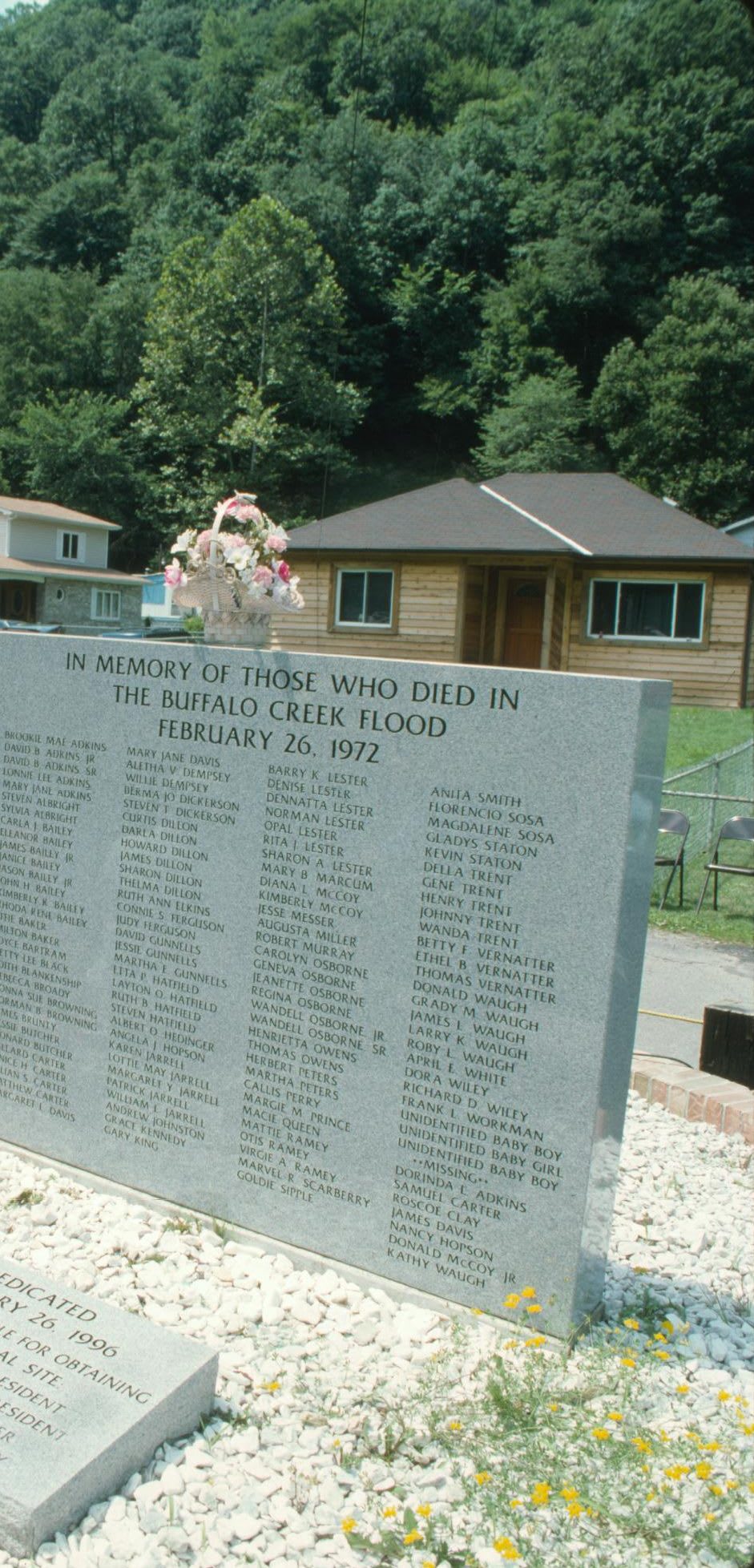
Since 1996 a granite memorial at the mouth of the creek has carried the names of the dead. Logan County's longer history, from the Mingo leader it is named for to Aunt Jennie Wilson's banjo, is told at Chief Logan State Park.