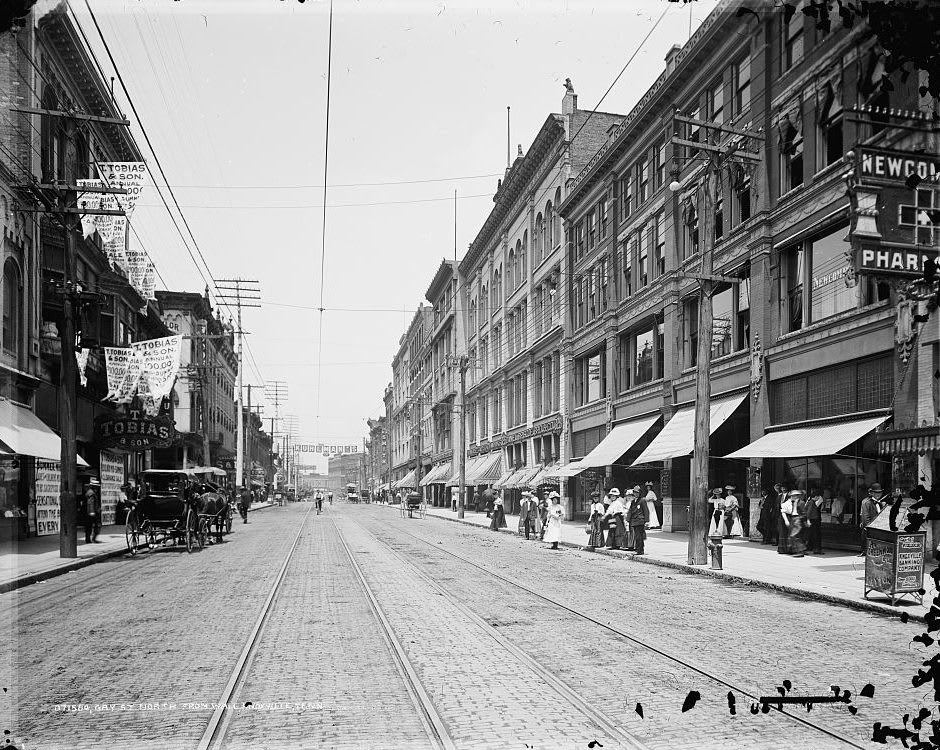
Before dawn on August 30, 1919, Bertie Lindsey, a white woman, was shot in her bed in Knoxville. Her cousin Ora Smyth was in the house. Police arrested Maurice Mays, 31, a Black man who had been a deputy sheriff and who delivered Black votes to white politicians, and rumor held that he was the son of Mayor John E. McMillan. Smyth identified him under a street light, the only lineup. A patrolman, Andy White, led the search, and a witness for Mays later testified that White held a grudge against him.
The jail and the Guard
Sheriff W. T. Cate moved Mays to Chattanooga. A crowd of white men gathered at the Knox County jail anyway, broke in with a telephone pole, freed the white prisoners, looted the liquor and wrecked the building. No Black prisoner was hurt. The crowd then broke into hardware stores for guns and moved toward Vine and Central, the heart of Black Knoxville's businesses. Residents aware of that summer's riots in other cities had armed themselves and barricaded the streets. Guardsmen of the Fourth Tennessee Infantry arrived, and gunfire broke out. Two Browning machine guns were set up on Vine and fired toward Central. Black defenders charged them several times and could not take them.
The count
Joe Etter, a Black veteran of the Spanish-American War, was killed trying alone to capture a machine gun. Lieutenant James W. Payne, 24, a guardsman, was wounded by a sniper and then struck by his own side's machine guns. Early reports also named Jim Henson and two unidentified Black men. The total is still disputed. Some papers printed two deaths, a deputy sheriff estimated 25 to 30, and a Guard major guessed 30 to 40. The Chicago Defender reported that perhaps more than 1,500 Black residents fled the city. Thirty-six white men were arrested, and an all-white jury convicted none. Governor A. H. Roberts declared martial law, and the Guard searched Black homes under curfew. Charles Cansler, a respected Black educator, later admitted there were many deaths "on both sides."
Maurice Mays
Mays was tried October 1 to 4, before twelve men picked from 520 white men. The state's case rested almost entirely on Smyth's identification. No motive was shown, and the fatal bullet was never matched to his revolver. The jury took under twenty minutes. Mays testified that he was innocent. The Tennessee Supreme Court reversed the verdict in January 1920, a second jury convicted him in April 1921, and Governor Alfred A. Taylor refused to intervene after a commission found him guilty but possibly insane. He was electrocuted in Nashville on March 15, 1922, having written an open letter asking Smyth to admit her mistake. She never answered. In August 1927 a white woman, Sadie Mendil, confessed in Norton, Virginia, to killing Lindsey, saying she acted out of jealousy over her husband. Knoxville's police chief dismissed it, and her husband said she was temporarily demented. About 2,000 people viewed Mays's body at the Wheeler funeral home on Vine Avenue.
The Beck Cultural Exchange Center keeps the archive of Black Knoxville.