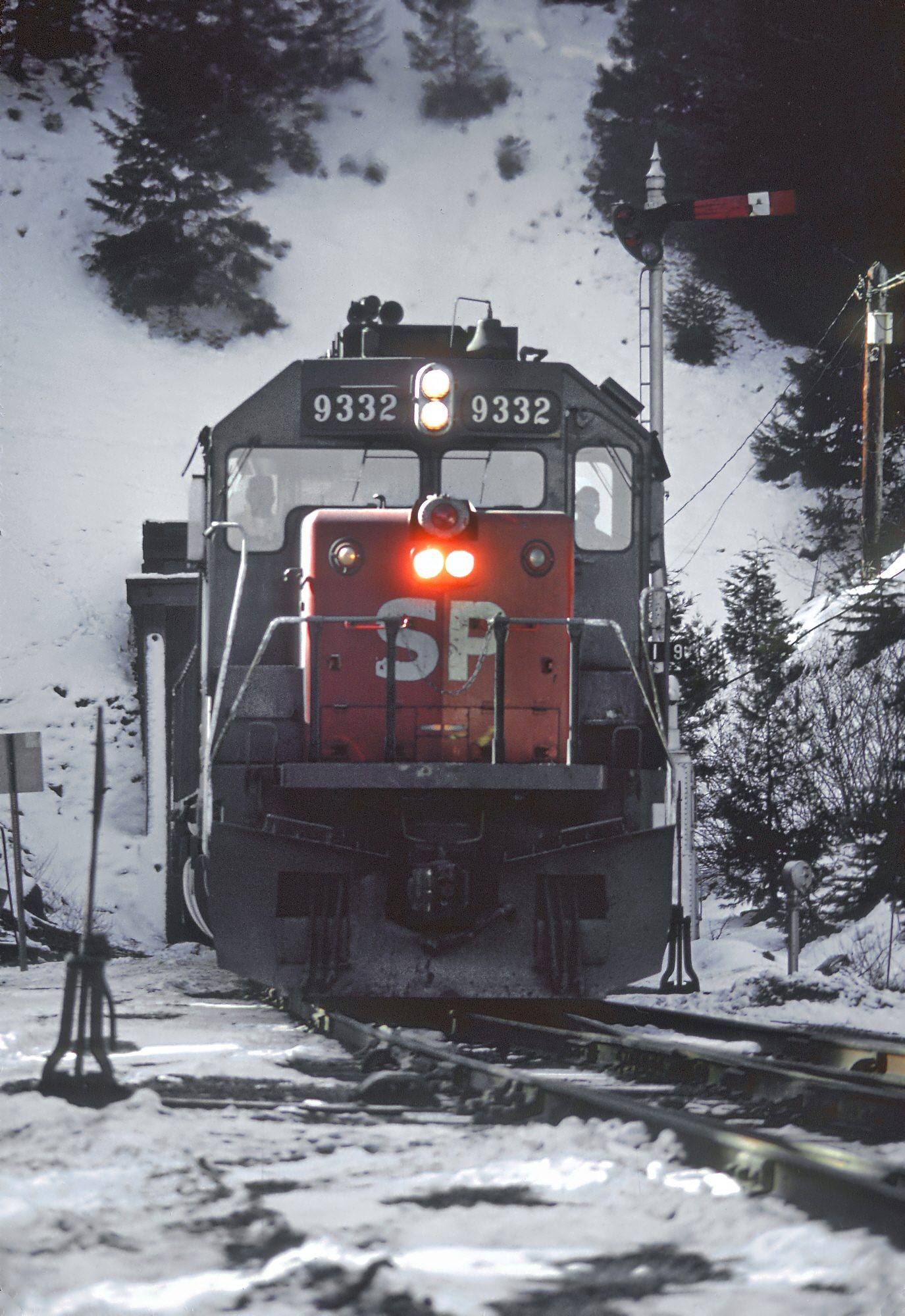
The Southern Pacific line between Ashland and the California border climbs the Siskiyou Mountains in long loops and bores through the summit ridge in a tunnel 3,108 feet long. Trains worked hard on that grade, and southbound ones stopped near the tunnel for a brake test before the long descent. Three brothers from Eugene had noticed.
The four men
Train 13, the Portland to San Francisco mail and passenger train, came up the grade about noon on October 11, 1923. In the cab were engineer Sidney Bates, who had been with the Southern Pacific since 1894, and his fireman, Marvin Seng, twenty-three years old, of Dunsmuir. Behind them in the mail car was the railway postal clerk, Elvyn Dougherty of Ashland, who had a wife and a young son at home. Riding the train that day was an off-duty brakeman, Charles Johnson, whom everyone called Coyl.
As the train eased out of the south portal of the tunnel, two young men with sawed-off shotguns climbed over the tender into the cab and forced Bates to stop with most of the train still inside the bore. A third waited by the tracks with a case of dynamite. They were Ray and Roy DeAutremont, twins of twenty-three, and their brother Hugh, nineteen, and they believed the train carried gold.
Dougherty saw them coming and shut himself in the mail car. The brothers packed the dynamite against the door and set it off. They had used far too much. The blast wrecked the car, set it on fire, killed Dougherty and filled the tunnel with smoke so thick they could not find anything to take. Johnson, thinking the boiler had blown, walked forward through the tunnel to help and was shot. Then, with nothing to show for it and four men who had seen their faces, the brothers shot Bates and Seng beside the engine and ran into the mountains.
The overalls
Searchers fanning out from the tunnel found a black traveling bag and a pair of overalls, and no suspects. The postal inspectors sent the overalls to Edward Oscar Heinrich, a criminologist at the University of California in Berkeley who was building a reputation for reading a crime from its traces. He reported that the stains were not grease but fir pitch, that the wearer was a left-handed logger, from the wood chips caught in one pocket, and that he was a young man. Deep in a pencil pocket was a wad of paper that, treated with iodine vapor, turned out to be a registered mail receipt signed by Roy DeAutremont.
Two and a half million posters
Knowing who they were did not find them. The postal service printed some two and a half million wanted posters and sent them across the United States and to Mexico, Central America and Europe, and the search cost more than half a million dollars. In February 1927 an army sergeant in the Philippines recognized a private serving under the name James Price as Hugh DeAutremont. The publicity put the twins' faces back in the papers, and in March they were recognized in Steubenville, Ohio, where they had been working under the name Goodwin.
They were tried in the Jackson County courthouse in Jacksonville in 1927. Hugh confessed in exchange for a life sentence rather than death, the twins sought the same terms, and all three were sentenced to life in prison. Each was eventually released early.
The tunnel now
Tunnel 13 still carries the line over the Siskiyous. The case is remembered as the last great train robbery of the West and as an early triumph of forensic science, and on its hundredth anniversary in 2023 people gathered in a Medford cemetery, at Coyl Johnson's grave, to read the obituaries of the four men who were killed.