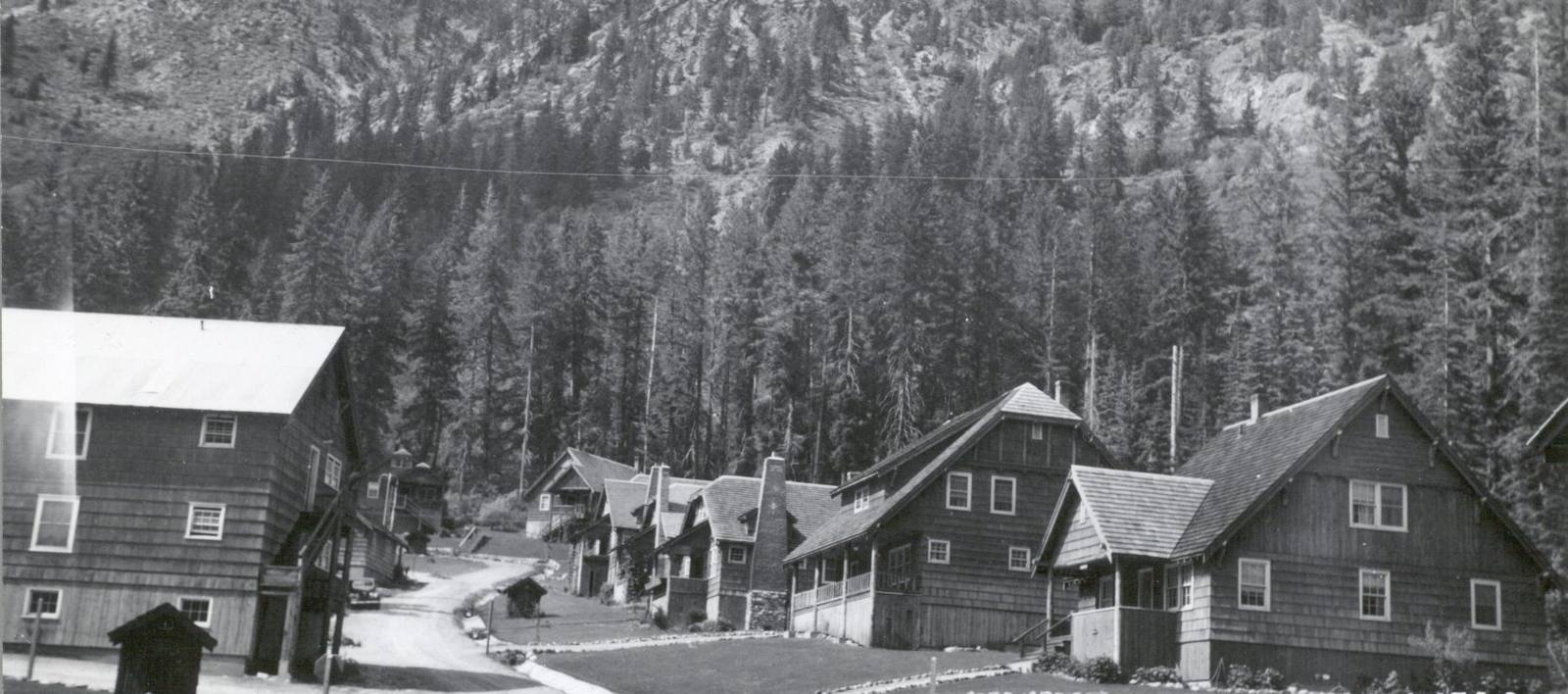
This was Chelan country. The people who lived at the foot of the lake paddled its fifty miles to the head and crossed the passes beyond to trade with the peoples of Puget Sound. On July 24, 1896, a prospector named James Henry Holden noticed a promising outcrop of ore high above Railroad Creek, whose valley runs west into the North Cascades from the middle of the lake. It took forty-two more years, and outlasted Holden himself by twenty, before anyone made it pay. The Howe Sound Company opened the Holden Mine in 1938, and by 1957 it had taken about ten and a half million tons of rock out of what is now Copper Peak, worth some $66 million in copper, gold, zinc and silver.
There was no road in, and there still is none. Ore and people moved by boat on the lake to the landing at Lucerne and then up eleven miles of mountain road to a company town of about six hundred people, with dormitories, chalets and family houses. Below the town the mill ground the ore and piled what was left, the tailings, in long banks beside the creek.
A newspaper and a church picnic
When copper prices fell in 1957, Howe Sound closed the mine and put the townsite up for sale at $100,000. In Alaska, Wes Prieb, a thirty-four-year-old purchasing agent for the Army Corps of Engineers and a student of the Lutheran Bible Institute in Seattle, read about the sale in a newspaper while waiting for a ride to a church picnic. He started writing to the company, suggesting the town would make a retreat. The company held to its price. Then came its reply to his letter of April 1, 1960: Howe Sound would give the property to the Lutheran Bible Institute. The school's leaders had not known he was writing.
That summer a group of young volunteers who called themselves the Forerunners cleaned the buildings, repaired the vandalism, cut trails and brought back the lawns. Programs began in 1962. Holden Village became a retreat center run by a Lutheran nonprofit on Forest Service land, open to anyone who would make the trip, with more than six thousand guests and volunteers in a busy summer.
What the mine left
The tailings did not go away. When a state geologist examined them in 1967, he collected reports that they had killed the vegetation and the fish of Railroad Creek and that floods were carrying orange mud down toward the lake. Acid water drained from the mine and the waste piles for decades. In 2012 the agencies settled on a cleanup, paid for by the mining company Rio Tinto, which had never worked the mine but had inherited the obligation through a chain of corporate purchases. From 2013 the village housed and fed up to 250 construction workers in place of its guests. The creek was moved to make room for an underground barrier wall, the old mill came down, the tailings were regraded and planted with thousands of trees, and a treatment plant was built to clean the water that still comes out of the mountain. The village counts it a half-billion-dollar job.
The road
In 2015 the Wolverine Fire forced the village out and burned all around it. Five villagers were flown back in to work alongside the firefighters, and no building was lost. Two more fires came close in 2025. Then, in December 2025, mudslides cut Forest Service Road 8301, the eleven miles up from Lucerne, and Holden closed to guests. The last of the skeleton crew left on December 22, though a small caretaker team has since gone back in. In April 2026 the Forest Service and Rio Tinto counted catastrophic failures at eleven or more places along the road and were still assessing the damage, with repairs hoped for by 2027. For now Holden is what it was before anyone built anything there: a valley that is hard to get into.