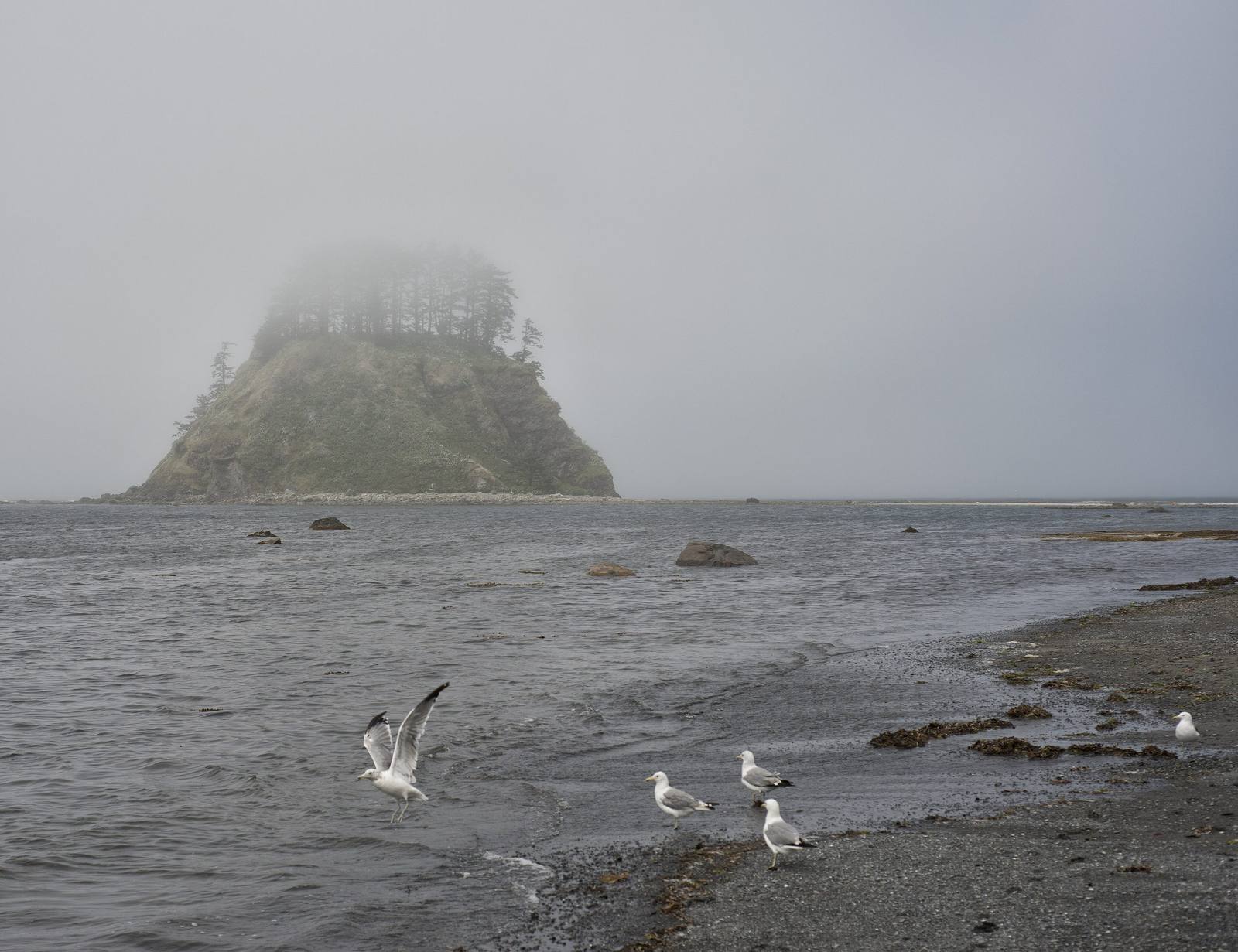
In the winter of 1834 a wreck came ashore on the outer coast south of Cape Flattery, most likely near Cape Alava, beside the Makah village of Ozette. It was a Japanese coastal freighter, the Hojun Maru, fifty feet long, its rudder gone and its mast cut away. It had sailed from the Chita Peninsula, near Nagoya, in the autumn of 1832 with a crew of fourteen and a cargo of rice and porcelain, bound a few hundred miles up the coast to Edo. A storm tore off the rudder, and the Kuroshio, the current that sweeps from Japan toward North America, carried the ship across the Pacific for some fourteen months. Most of the crew died of scurvy on the way. Three were alive: the navigator, Iwakichi, about twenty-eight, and two apprentice cooks, Kyukichi, fifteen, and Otokichi, fourteen. At home in Onoura their families had given them up and set a gravestone carved with the crew's names in the temple graveyard. It still stands there.
A drawing on paper
Makah seal hunters found the three men, took what they could from the wreck and held the sailors at a village as slaves, as coastal peoples then commonly did with captives. Word travelled along the trade routes, and with it a drawing: three sailors, a boat on the rocks, people carrying things off it, and lines of writing beside them. It reached John McLoughlin, the Hudson's Bay Company's chief factor at Fort Vancouver, who took the writing for Chinese. An overland party he sent in March 1834 was beaten back by terrain and weather. In May he told William McNeill, captain of the company brig Lama, to stop at Cape Flattery and do his utmost to recover them, and to reward the Makah so they would treat any castaways kindly in future. McNeill ransomed Iwakichi and Kyukichi in June. Otokichi had been away gathering berries and was fetched on a second visit.
Around the world, and back to the start
At Fort Vancouver that summer the three learned English at the fort's school and sat in on a Methodist sermon that the preacher, Jason Lee, noted was delivered to English, French, Scots, Irish, Indians, Americans and Japanese, few of whom understood five words of English. Japan had been closed to foreigners for two centuries, and McLoughlin, once he understood who the men were, saw an opening. In November 1834 he sent them to London, to see the power of the empire before they went home and perhaps to open a door to Japanese trade. His superiors were not pleased and said so. The three were kept aboard ship for more than a week, allowed one day to see the city, and sent on to Macao.
There a German missionary, Karl Gutzlaff, took them in, and they helped him put parts of the Bible into Japanese. In July 1837 an American merchant, Charles King, sailed them and four other castaways to Japan on his ship the Morrison. At the mouth of Edo Bay the shore batteries opened fire. At Kagoshima they fired again. Under Japanese law, anyone who had left the country, even by shipwreck, could not come back. The sailors had come within sight of home and been driven off it.
Oto-san
Iwakichi and Kyukichi largely drop out of the record. Otokichi did not. He became an interpreter for British merchants and officials in China, settled in Shanghai, married, took British citizenship and the name John Matthew Ottoson, from Oto-san, what his shipmates had called him. Twice he returned to Japanese waters as an interpreter, in 1849 and again in 1854, when he went with Admiral James Stirling to Nagasaki for the first treaty between Britain and Japan. He is said to have been offered the chance to stay, and to have declined. He died in Singapore in January 1867, at forty-nine. In 2005 a delegation from Mihama, the town that now takes in Onoura, brought part of his ashes home.
In 1997 a theater troupe from Mihama and members of the Makah Nation staged a musical about him together. Near the visitor center at Fort Vancouver stands a stone carved with three faces.