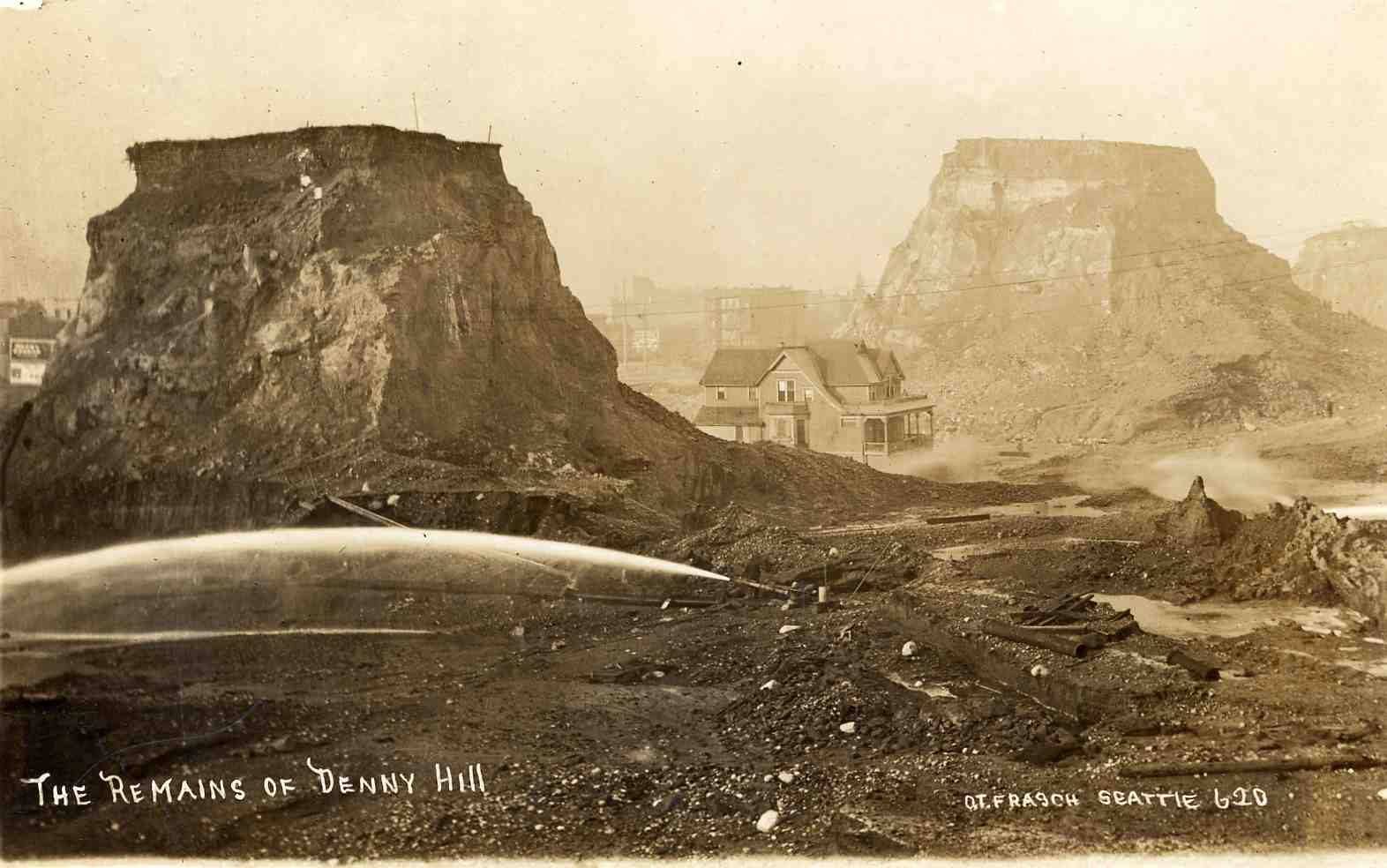
North of Pine Street, where Belltown and the Denny Regrade now run flat to the foot of Queen Anne, there was a hill. Denny Hill rose to about 220 feet, with a sheer bluff on the bay side that pinned Belltown to the waterfront, and in the 1890s it carried more than three hundred houses, stables and a turreted hotel. By 1930 its high point had been lowered by more than a hundred feet, and most of it was at the bottom of Elliott Bay.
The engineer
Reginald Heber Thomson became Seattle's city engineer in 1892. He built the city's sewers and its water system, and he hated its hills. Seattle, he wrote, was in a pit, and to get anywhere it would have to climb out. Its founders, he complained, had platted the streets with little thought for whether anyone could use them, the main idea being to sell lots. He had seen hydraulic mining in California and knew what water could do to a hillside.
The hill already carried a monument to someone else's hopes. Arthur Denny had kept land on its southwest corner for a state capitol that went to Olympia instead, then began a grand hotel there that the Panic of 1893 left an empty shell for a decade. James Moore finished it as the Washington Hotel and handed the first keys to President Theodore Roosevelt in May 1903. Thomson wore Moore down along with the hillside; in 1906 Moore gave up the high ground, and the hotel came down with it.
Water and shovels
The first cut, ordered for First Avenue at the end of 1897, was washed into the bay with high-pressure hoses. After 1906 the big push took the western half of the hill, with hoses fed from the bay and steam shovels where the hoses could not reach, and dumped much of the spoil off a trestle at Battery Street. A crew could wash away about a thousand cubic yards of sand and gravel in a shift.
The pictures from those years show houses perched on columns of earth with the street sluiced away beneath them. People called them spite mounds, and the name stuck to the owners. The truth was duller. One owner could not afford to have his lot lowered, and the other was away in the Klondike and could not sign the papers. When he came home he said he had lived too long in Seattle to be accused of spite about public improvements, and had his holdings brought down. By January 1911 the mounds were gone.
The empty flat
Thomson had cleared the ground for a new downtown, and in 1911 the planner Virgil Bogue drew one, a Beaux-Arts civic center radiating from Fourth and Blanchard. It horrified the property owners south of Pine, and in 1912 the voters rejected it by nearly two to one. The automobile made hills less of a barrier, the Smith Tower showed that business could go up instead of north, and the regrade sat half empty.
The eastern half of the hill still stood. Property owners lobbied to finish it, and from 1928 steam shovels fed a web of conveyor belts that carried more than four million cubic yards to barges in the bay. The work was finished on December 10, 1930, a year into the Depression. Hotels, apartments, warehouses and car dealers slowly filled the flat, and the neighborhood Thomson had pictured did not begin to arrive until the 1990s. The hill is still out there, at the bottom of Elliott Bay.