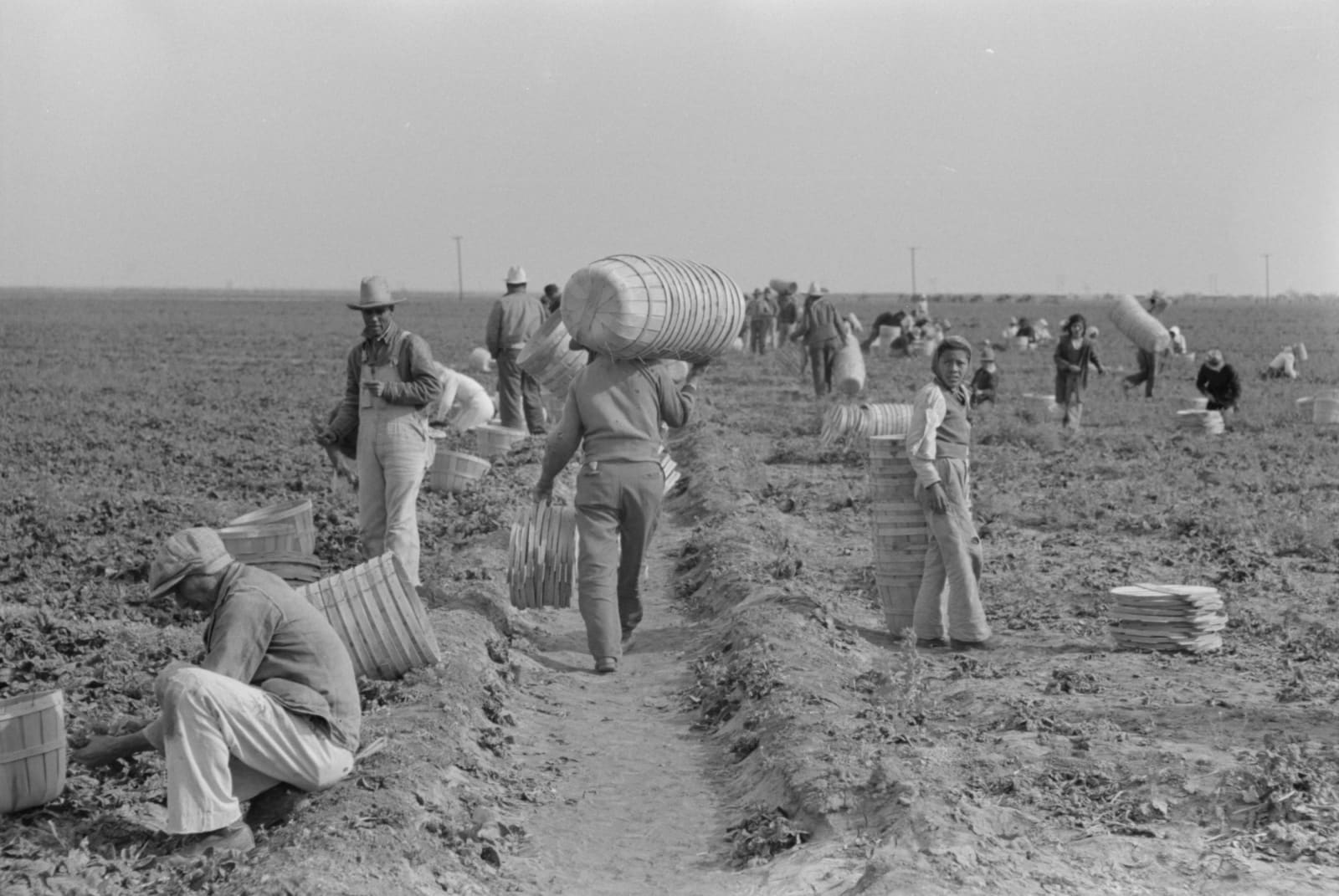
Crystal City exists because of water and a land sale. In 1905 two developers, Carl F. Groos and E. J. Buckingham, bought the Cross S Ranch, sold most of it as farms and platted a townsite they named for the clear artesian water of the area. The first train came in 1908. Onions were the first big crop, but by the 1930s the town called itself the Spinach Capital of the World. A vegetable cannery opened in 1932, the first spinach festival was held in 1936, and in 1937 a statue of Popeye went up across from city hall.
The seasonal round
Most of the people who made that reputation were Mexican and Mexican American farm workers. The Handbook of Texas says that through the 1930s the majority of residents followed a yearly cycle: spinach in the winter, onions in the spring, then beet or cotton work in the summer and fall. The town grew from an estimated 800 people in 1920 to 6,609 in 1930. A government report of 1941 estimated that 97 percent of the 5,500 Mexican Americans in Crystal City were migrant laborers, most living in slum conditions with poor services and few chances at schooling.
The Farm Security Administration photographer Russell Lee spent March 1939 in the town, and his negatives are at the Library of Congress. His captions describe one- and two-room houses, dirt floors, and kitchens in homes crowded with children. One caption notes that families coming back from the beet fields of Minnesota, North Dakota and Colorado commonly made first payments on cars, and that even the more prosperous families lived in those shacks. Another shows a small shed built after a local doctor's persuasion so that a tuberculosis patient could be isolated from his family, the first time that had been done in the neighborhood.
Camp, cannery, council
The workers' camp on the edge of town had another life. The Handbook says an alien internment camp was built on the site of a prewar labor camp, and Densho's encyclopedia says the Immigration and Naturalization Service leased more than 200 acres from the Farm Security Administration. The internment camp took in Japanese, German and other immigrants and their families from across the country, and it closed in 1948. The area then became low-rent housing, and its schools became part of the Crystal City school district.
In 1945 the California Packing Corporation, later Del Monte, opened a cannery northwest of town and became its largest employer. The Handbook says Mexican Americans had made up 80 percent or more of the city since the 1930s, yet Anglos kept a tight hold on city government and school administration. In 1963, and much more successfully in 1969, Mexican Americans sought control of key city and school-board posts in what the Handbook calls the Crystal City Revolts. School superintendents had all been Anglo from 1908 to 1971, and from 1971 to 1990 all were Mexican American. The spinach festival, halted by the war, returned in 1982.
In Crystal City, the Crystal City Family Internment Camp Site marks the camp, and My Story Museum tells the politics that followed.