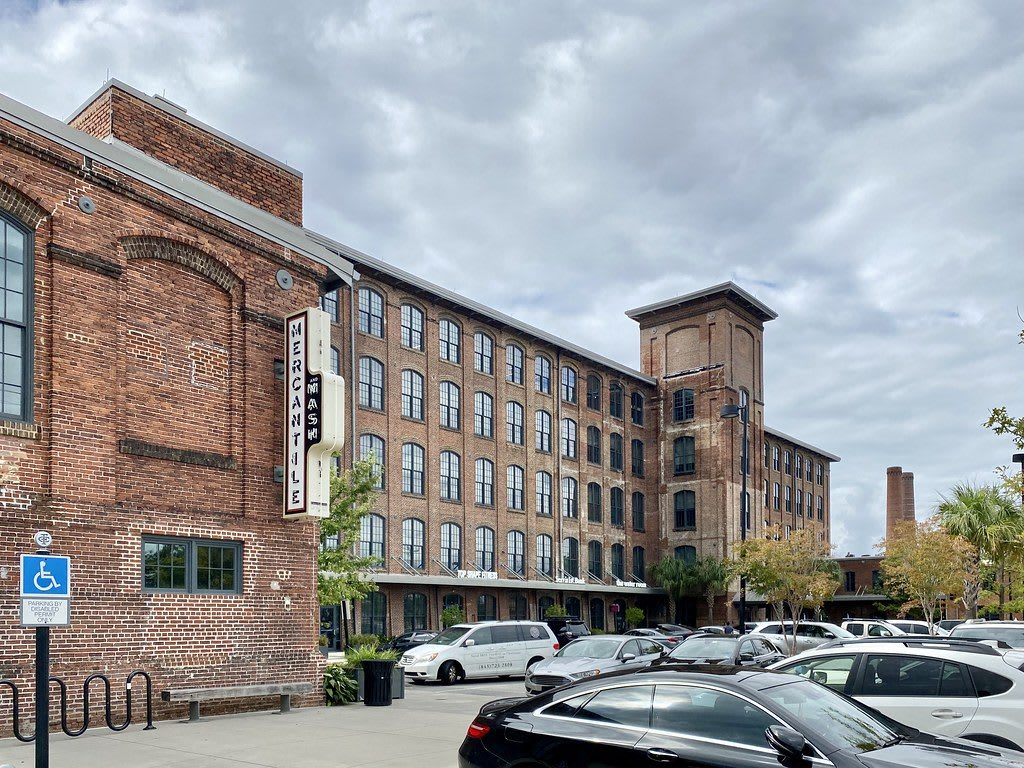
On October 22, 1945, about a thousand workers walked out of the American Tobacco Company's cigar plant on East Bay Street in Charleston, and most of them were Black women. Their union, Local 15 of the Food, Tobacco, Agricultural and Allied Workers, had won its first contract in September 1944 and had waited out the war under a no-strike pledge, on the company's promise of higher pay afterward. Now the workers wanted it: a raise of 25 cents an hour, the back pay owed them, protection against racial discrimination in hiring and firing, paid medical benefits and a closed union shop.
A mill turned cigar plant
The five-story building went up in 1882 as a cotton mill, and American Tobacco ran it as a cigar factory from 1903. Black and white workers held separate jobs at separate pay. Only white men could hold the best-paid machinist jobs. After the war about 900 of its 1,400 workers were Black women. That fall a firing sharpened the grievance: on October 1 the manager, Harold McGinnis, dismissed a Black man on a white supervisor's accusation, and about 900 Black employees walked out on October 4 when he was not taken back.
The winter on the picket line
On October 26 Local 15 held its first integrated meeting, at Morris Street Baptist Church. Pickets walked in front of the plant from morning until evening through a winter of freezing rain, harassed by police and segregationists. On November 8, the day a National Labor Relations Board official, Thomas V. Smith, arrived to investigate, four cab drivers attacked the union representative Reuel Stanfield with a knife in the union office and cut his face. Police released them without charges. Smith ruled for the union and ordered $120,000 in back wages, and after more than 1,000 Black and white workers demonstrated at the factory office on November 15, the company paid. The strike went on for the rest.
Lucille Simmons, a longtime worker, canvassed neighborhoods for support, and she closed each day's picketing by singing a spiritual she had reworked. The strikers knew it as "We Will Overcome." Its roots run to a hymn Charles Albert Tindley published in 1901.
What the strike won
In the last week of March 1946, after McGinnis agreed to meet the union's stewards, American Tobacco offered eight cents an hour; one 2016 account gives fifteen. Some barriers to skilled jobs appeared to ease. Few strikers were still on the line, nearly all of them Black, and they returned on April 1. The Taft-Hartley Act of 1947 weakened their union, and many white workers left for a rival union. Historians count the strike among the few biracial labor movements in the South of its day.
In 1947, by the usual account, two strikers, Anna Lee Bonneau and Evelyn Risher, carried the song to the Highlander Folk School in Tennessee, where Zilphia Horton learned it and passed it to Pete Seeger. Sung as "We Shall Overcome," it became the anthem of the civil rights movement. The plant laid off 900 workers in 1966 and closed in 1973. A 2013 marker at East Bay and Columbus streets tells the story, and Mother Emanuel AME Church stands under a mile southwest on Calhoun Street.