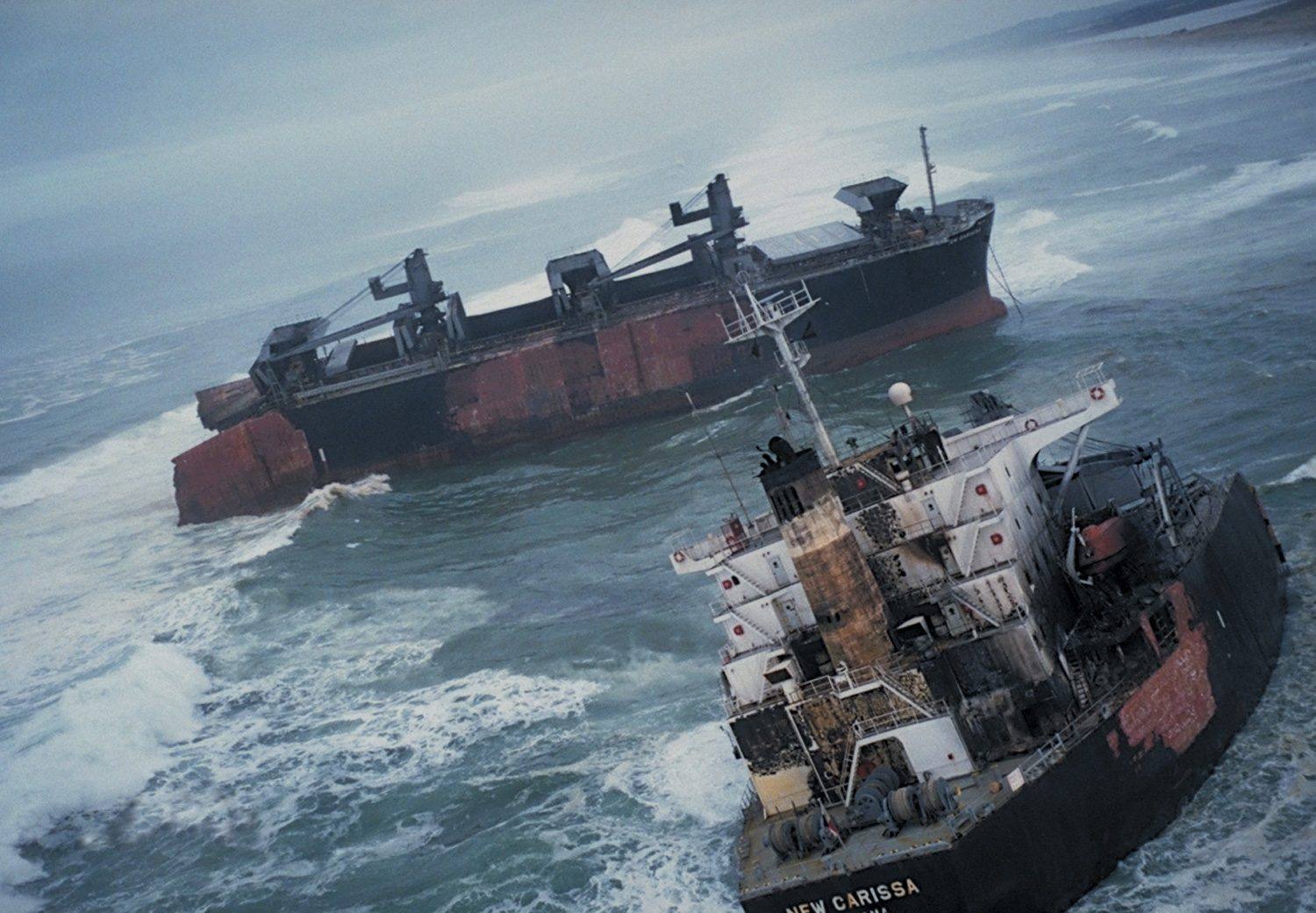
The North Spit is the long arm of sand that shelters Coos Bay from the ocean, the southern end of the dunes that run up the coast to Florence. It is Bureau of Land Management land, quiet, with snowy plovers nesting on the open sand. For nine years, part of a ship sat on it.
Aground
The New Carissa was a 639-foot freighter built to carry wood chips for paper pulp, and in early February 1999 it was bound for the Port of Coos Bay to load. It anchored offshore to wait, and a storm came in. By the time the crew raised the anchor, the wind and sea had pushed the ship too close to shore to recover, and on February 4 it ran aground on the North Spit, about two and three-quarter miles north of the entrance to the bay. The Coast Guard lifted the Filipino crew off by helicopter.
The crew was safe. The trouble was the fuel, roughly 400,000 gallons of it in the ship's tanks, sitting in the surf a short distance from the bay and its oyster beds.
Burning it
About a week after the grounding, after attempts to pump out the fuel had failed, responders decided to burn it where it lay. Navy explosive teams and incendiaries, napalm among them, set the ship on fire. Only one of the diesel tanks burned well. The explosions and the heat broke the hull, and the New Carissa split in two. Fuel escaped into the water and reached the bay, fouling its oyster beds.
The bow
The plan then was to tow the forward section, some 440 feet of it, out to sea and sink it. On March 2 a storm parted the towline, and the bow drifted north, leaking more fuel, until it came ashore at Waldport, far up the coast. A tug pulled it off again with a heavier line, and on March 9 it was finally at sea. On March 11 a Navy destroyer fired some seventy rounds into it, and it stayed afloat. A torpedo from a Navy submarine sent it to the bottom.
The stern
The after section stayed where it was, mired in the sand. That spring an estimated seventy to a hundred and forty gallons more fuel leaked from it, oiling the beach and coating birds. The ship's owners promised to tow it away; their salvage effort lasted until fall storms drove it off in October 1999, and the stern went on rusting in the surf.
The State of Oregon went to court. A Coos County jury found the ship's owner and operator guilty of negligent trespass and awarded the state $25 million to remove the wreck, and in 2006, seven years after the grounding, the owners settled for $22.1 million. In the spring of 2008 Titan Salvage began taking the stern apart, and the last visible piece was hauled off on September 28, 2008, a few months short of ten years after the ship came ashore. Coos Bay and North Bend businesses did nearly all the support work, and the salvage brought the two towns about $4 million.