In January 1919 a Reagan County lawyer named Rupert Ricker used a 1917 law that let the state lease its land for oil exploration. He and four associates applied for leases on 431,360 acres of University of Texas land in Reagan, Upton, Irion and Crockett counties. A filing fee of $43,136 was due at the General Land Office in thirty days. Ricker found no takers in Fort Worth and sold his maps and applications for $2,500 to an old army friend from El Paso, Frank T. Pickrell.
Borrowed money
Pickrell and his partner, Haymon Krupp, did no better at selling the acreage. Krupp had come to El Paso from Lithuania in 1890 and built a dry-goods house known across the Southwest. Rather than lose their stake, the two men decided to drill. Krupp borrowed the filing fee, and with friends in New York they formed the Texon Oil and Land Company, with Krupp as president. When stock sold slowly, Pickrell sold certificates in a sixteen-section block called Group No. 1. Each $200 certificate bought a .0004882 interest. The sale raised more than $100,000.
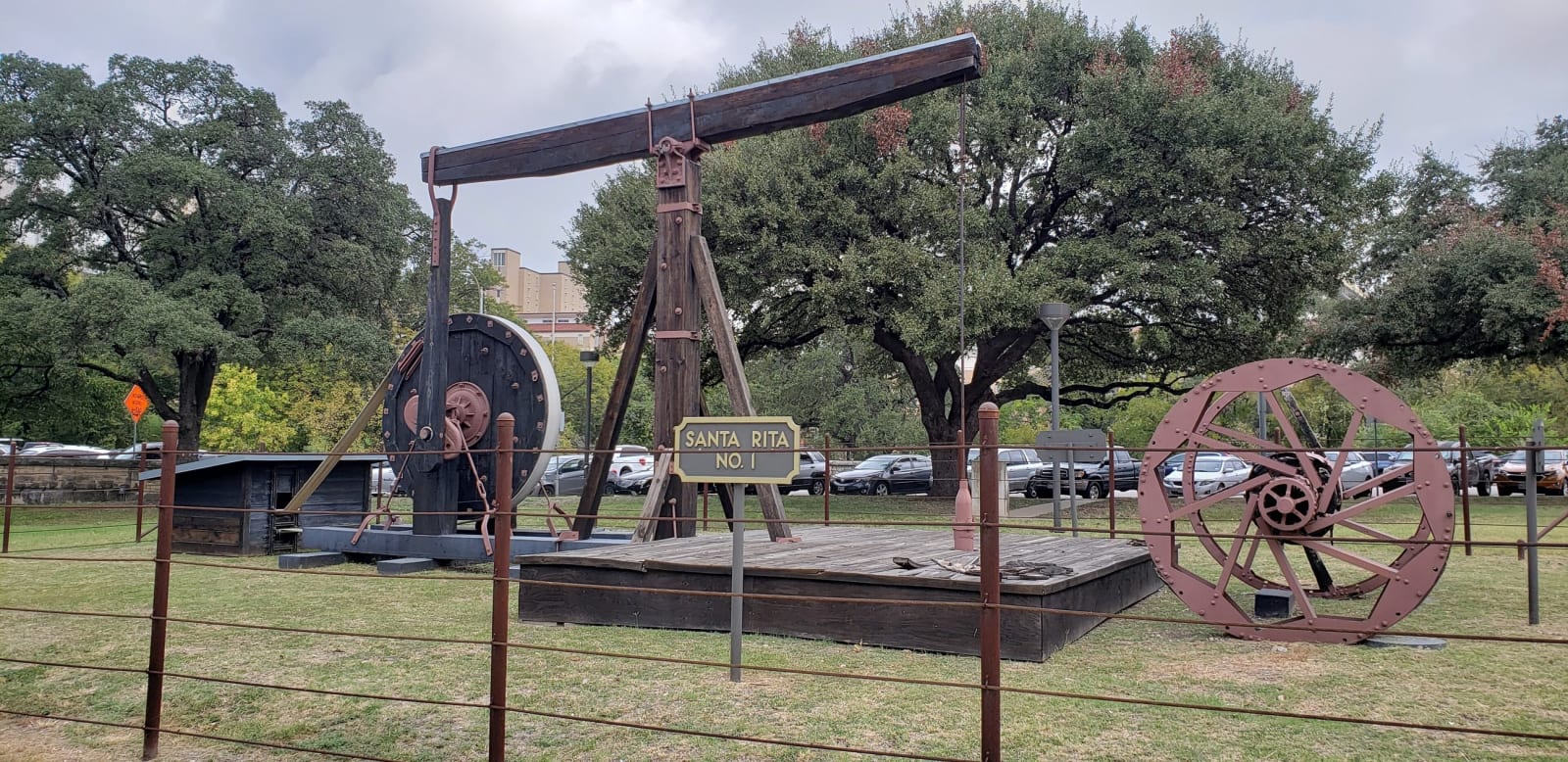
The first test was named Santa Rita No. 1, for the saint of the impossible. It was spudded on January 8, 1921, just ahead of the deadline, beside the Orient Railroad tracks.
Six hundred and forty-six days
For 646 days the cable-tool rig pounded at the hole, averaging 4.7 feet a day. Late on May 27, 1923, just above 3,050 feet, the bit reached a dolomitic sand the drillers called the Big Lime, and gas bubbled at the casinghead. The crew shut down and went off to lease the surrounding mineral rights. Early on May 28, with no more drilling, the Santa Rita roared, threw oil over the top of the derrick and coated the ground for 250 yards around. It flowed off and on until the end of June. In a decade of salted wells, it proved there was oil in the region.
Independent oilman Michael Benedum chartered the Big Lake Oil Company in Pittsburgh on October 5, 1923, paying Pickrell's group $200,000 and a quarter share for a 10,000-acre lease. By May 1926 the company had sixty producing wells, and by 1927 the field was among the first in the nation to run wholly on electricity.
The university's well
Oil money from university land was treated as principal, not income, so the royalties went into the Permanent University Fund and were invested rather than spent. From 1931 the income was split, two-thirds to the University of Texas and one-third to Texas A&M. By the late 1950s the fund was worth more than $283 million, and by 1990 more than $3.5 billion.
In 1940 the Santa Rita rig was moved to the university campus in Austin. The well itself was plugged in 1990, after almost sixty-seven years. The Santa Rita No. 1 marker stands near the old site in Reagan County, and the Permian Basin Petroleum Museum in Midland tells the basin's whole story.