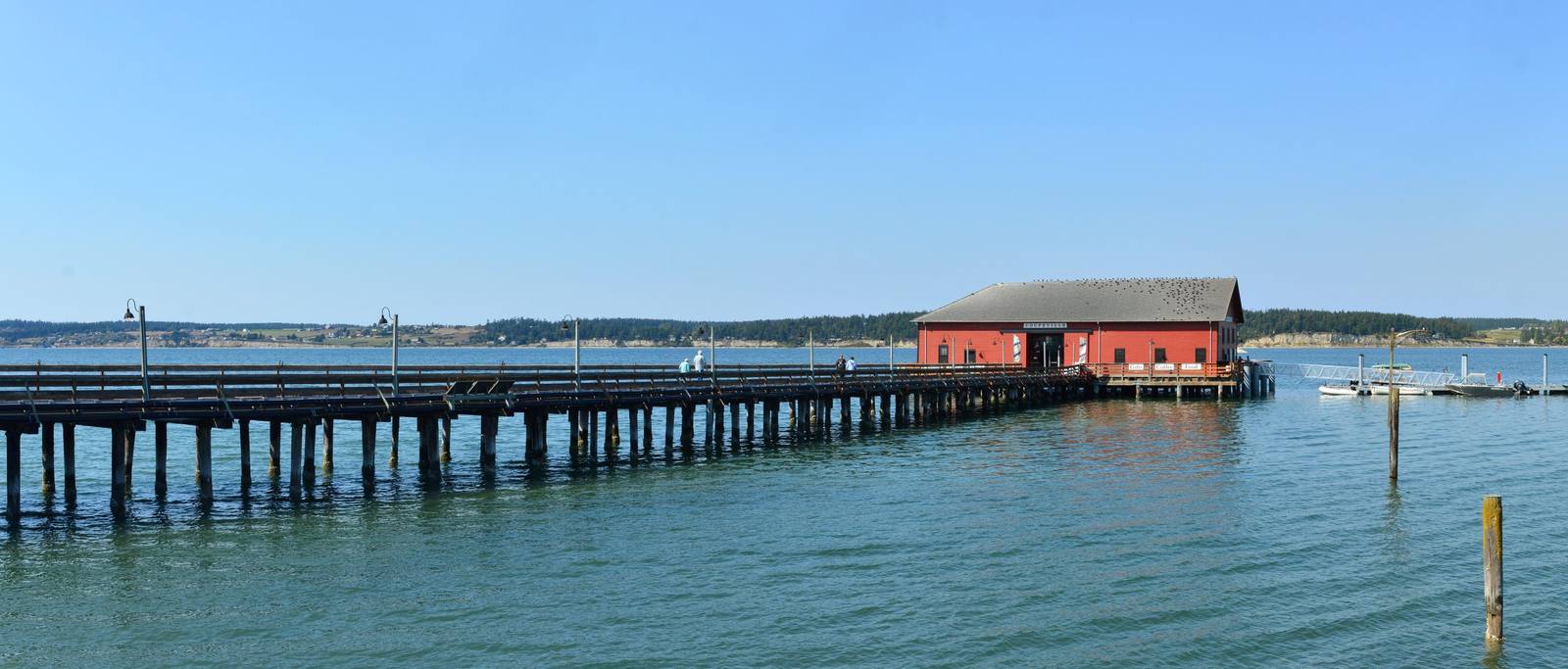
On August 8, 1970, boats drove some eighty killer whales into Penn Cove, the long bay that cuts into the middle of Whidbey Island at Coupeville. They were the Salish Sea's resident orcas, fish-eaters that live in three extended families led by the oldest females, the pods scientists call J, K and L, and all three were in the cove. A Seattle capture company, Namu Inc., strung nets across the water and set about separating young whales from their mothers to sell to marine parks. People in Coupeville watched from the shore. The whales that were not netted stayed close to the ones that were until the last captive had been hauled away on a truck.
Five whales died in the nets, most of them young. One of the crew later admitted that he and two other men had been told to cut three of the dead calves open, fill them with rocks, tie anchors to their tails and sink them, and that they did it at night. Later the bodies washed up on Whidbey beaches anyway.
Seven young whales were sold. One, a female about four years old, went to the Miami Seaquarium for about $20,000. She was named Tokitae, renamed Lolita, and performed in a concrete tank in Florida for more than fifty years. After the other orca there, Hugo, died in 1980, she never saw another of her kind.
Family under the waves
The Lummi, the Lhaq'temish, the people of the sea, count the orcas as family. They named her Sk'aliCh'elh-tenaut, after an ancestral place in the Penn Cove area, and in 2019 two Lummi women invoked the federal repatriation law to ask for her return, while an elder flew to Miami and sang healing songs to her. In 2023 the Seaquarium's owner agreed to move her to a sea pen in the Salish Sea within about two years. On August 18, 2023, three days after a medical update called her very stable, she died of kidney failure at about fifty-seven, the last whale of the Penn Cove capture still alive. That September a Lummi elder carried her ashes home to Bellingham, and the nation returned them to her waters in a private ceremony.
The ones who stayed
From the mid-1960s to the mid-1970s, captures in Puget Sound took dozens of the residents' young, and the population has never made up the loss. The Southern Residents were listed as endangered in 2005 and number in the low seventies. What they lack now above all is Chinook salmon, the fish they live on.
In the summer of 2018 a J-pod mother catalogued as J35, and known as Tahlequah, gave birth to a calf that died soon after it was born. She carried it on her head and pushed it ahead of her for seventeen days and more than a thousand miles before she let it go. Late in December 2024 she gave birth again, to a female. The calf lived only a handful of days, and on New Year's Day 2025 Tahlequah was seen off West Seattle carrying the body. She has lost two of the four calves she is known to have had.
Every August people gather on the Coupeville wharf to set flowers on the water of the cove.