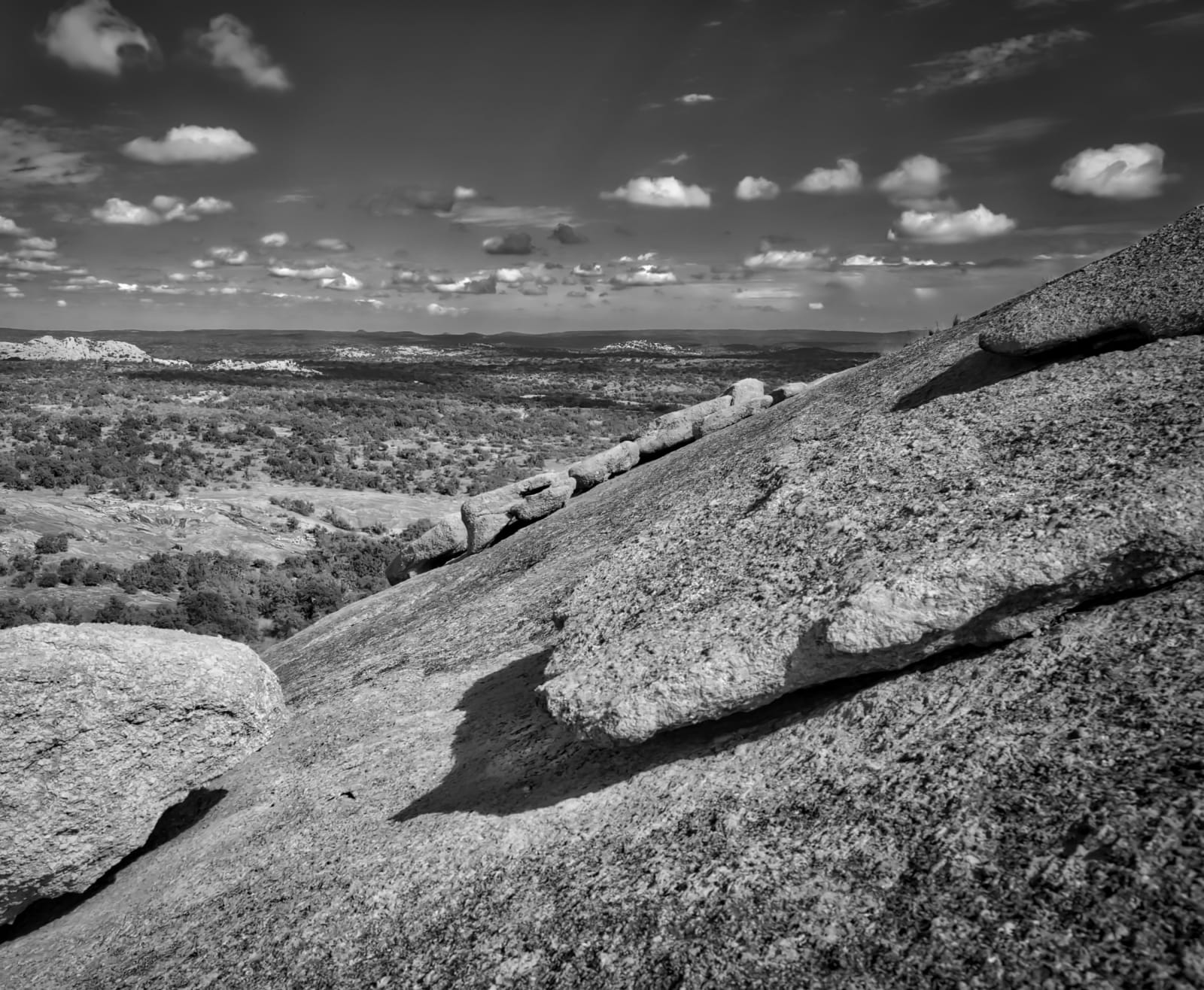
Enchanted Rock is a pink granite dome in southern Llano County, rising some 385 feet above Sandy Creek. People have camped in the area for about 12,000 years. They ground food in hollows in the granite, and the park counts more than 400 archeological sites, 120 of them State Archeological Landmarks. The Comanche and the Tonkawa are among the more recent peoples with a connection to the rock. The Tonkawa are recorded as believing that ghost fires flickered on the dome, and its creaking and groaning frightened them. Geologists attribute the sounds to the rock's surface cooling after warm days.
A rock assumed to be worth something
The name came later. Enchanted Rock derives from Spanish and Anglo-Texan interpretations of Indian legends, and one nineteenth-century writer said the Indians held it in awe amounting almost to reverence. Newcomers also assumed it held money. Spanish explorers believed it was one great chunk of silver or iron, an account written in 1834 said it was supposed to be platinum, and early Texans looked for the lost Bowie Mines to the west. In the 1700s the Spanish tried to start a silver mine on Honey Creek near the Llano River, and Germans and Americans came by the mid-1800s, drawn by land and by stories of gold and silver.
The land went from hand to hand. A headright certificate was issued to Anavato and María Martínez on March 16, 1838. James Robinson bought it in 1841 and sold it in 1844 to Samuel A. Maverick, who believed the rock might be a source of mineral wealth and had part of the property surveyed in 1847. The state patented it to him on September 22, 1851.
The plaque
In 1936, during the Texas Centennial, the state set a bronze plaque on a different kind of story. It says that in the fall of 1841 Captain John C. Hays, surrounded by Comanches who had cut him off from his ranging company, repulsed the whole band from the summit and inflicted such heavy losses that they fled. Retellings make it a stand of three hours in a depression at the top, ending when his companions reached him. The plaque gave the tale official credence, and other writers also describe an Indian encounter of Hays at the rock.
Gate, then park
Brothers Charles T. and Aaron F. Moss bought the property in 1895 and in 1897 divided it, except for the rock itself, which they kept in common. Charles's son Tate opened it to the tourist trade in 1927. After a sale to Albert Faltin in 1946, Charles H. Moss, Charles T.'s grandson, and his wife Ruth ended up with full title, and in 1978 they decided to sell. Texas Parks and Wildlife, offered it first, could not meet his price. The Nature Conservancy bought it for $1.3 million on March 1, 1978, reportedly at the urging of Lady Bird Johnson, and passed it to the state. The park reopened in March 1984 after eighteen months of renovation. More than 250,000 people now visit each year.
The plaque is no longer on the dome. It hangs inside the headquarters at Enchanted Rock State Natural Area, where climbers check in, so you can read it before you climb.