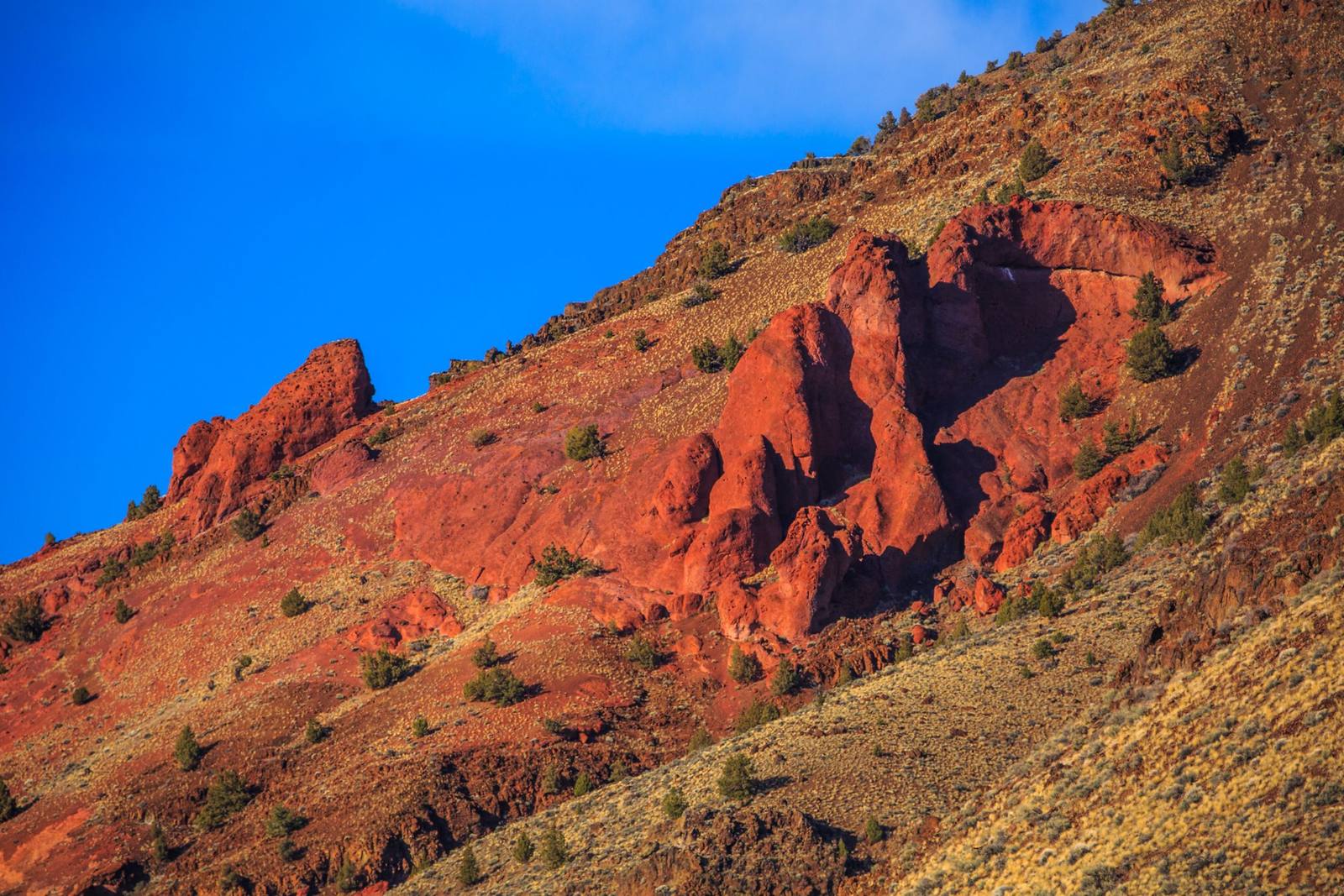
From the hamlet of Plush in the Warner Valley a gravel road heads east toward a wall. Hart Mountain is a massive fault block, and its west face rises about four thousand feet straight out of the valley floor to a crest over eight thousand feet. The road winds up it and comes out on top onto open sagebrush that rolls away east for miles. This is the Hart Mountain National Antelope Refuge, about 270,000 acres of it, and if you drive it for an hour you will almost certainly see pronghorn.
The last herds
Pronghorn once ran in the millions across the West. By the early twentieth century they were down to scattered bands, and in 1936 Franklin Roosevelt set aside Hart Mountain by executive order as a range and breeding ground for them and other wildlife. Sheldon refuge, across the line in northwestern Nevada, was created at the same time, and many of Hart Mountain's pronghorn migrate south to winter there. They are among the fastest land animals in the world, clocked at around sixty miles an hour.
The cliffs of the west face had their own loss. California bighorn sheep had been wiped out here by disease and hunting by 1915. In 1954 twenty were brought back and released, and the herd grew large enough to supply sheep to restock other ranges in Oregon and Nevada. It has fallen since, from about 150 animals in 2017, with cougars taking many, and the refuge now manages it under a dedicated plan.
The cattle
A refuge for wildlife was not, for most of its history, a refuge from livestock. Sheep and then cattle had grazed the mountain for more than a century, and grazing went on after 1936. Overgrazing eroded the stream banks, trampled the springs, and damaged the aspen groves and the wildlife habitat around them.
In the early 1990s drought kept most of the cattle off. A refuge manager named Barry Reiswig, over strong opposition from Lake County ranchers and county commissioners, documented what a century of grazing had done, and his 1994 management plan concluded that grazing worked against the refuge's purpose. Cattle were banned from Hart Mountain. It has been called the largest place in the West to have had cattle removed. Hundreds of miles of obsolete barbed wire fence were left behind, a barrier to the movement of wildlife, and volunteers from the Oregon Natural Desert Association spent from the 1990s until 2012 pulling it out.
What came back
In 2003 the survival rate of pronghorn fawns on the refuge was the highest since its founding. What deserves the credit is still argued. The refuge's pronghorn plan allowed for shooting coyotes if fawn survival fell sharply, as it had in the mid-1990s; a biologist who studied Hart Mountain's pronghorn for nearly half a century called that hogwash and said healthy habitat was what mattered.
The refuge has no paved roads, and its headquarters is often unstaffed. Four miles south of it, the free Hot Springs Campground sits in a grove of aspen and willow along Rock Creek, with an open-air bathhouse built around a natural hot spring. Lakeview, the nearest town of any size, is about sixty-five miles away.