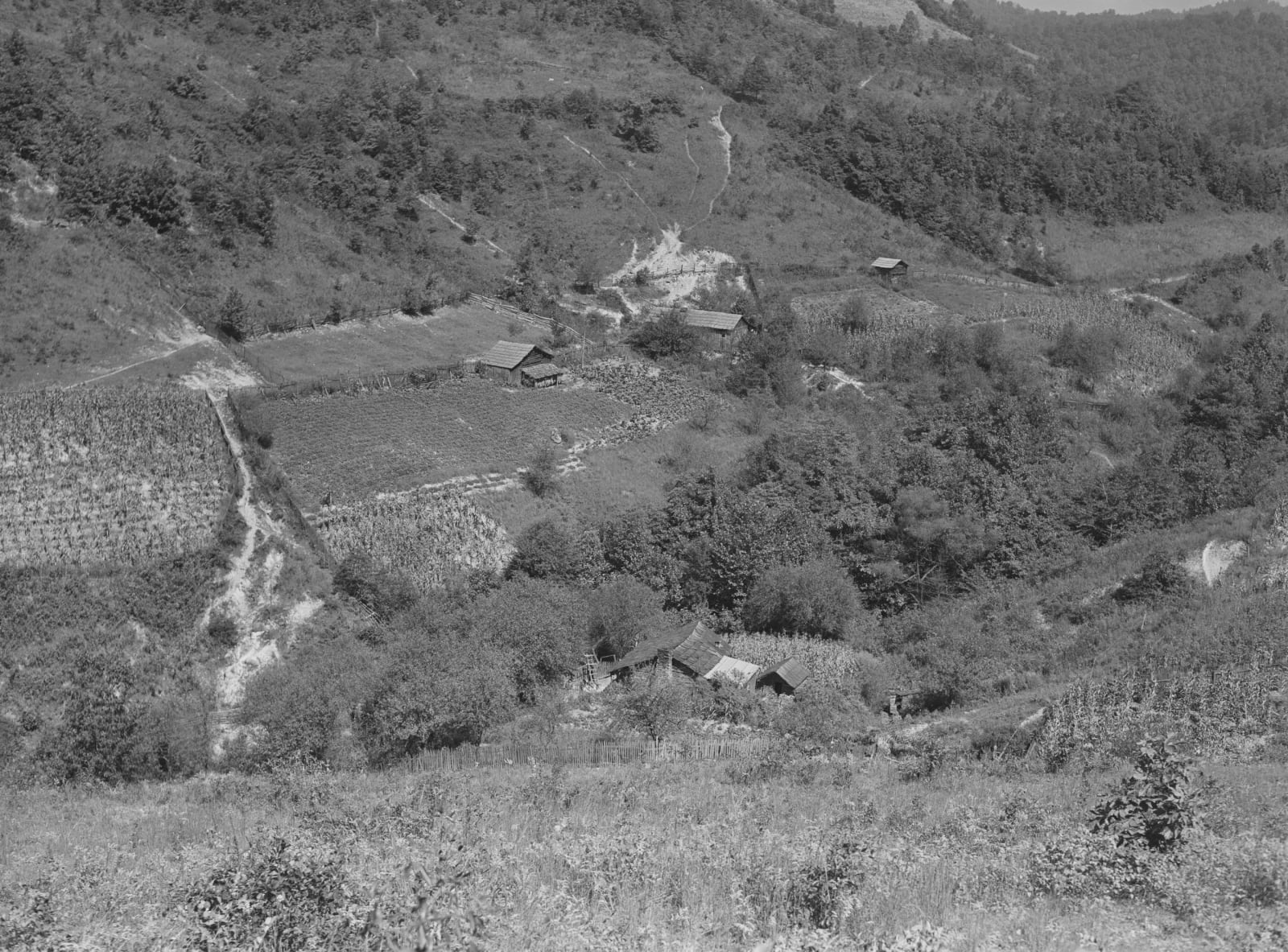
Before the nurses came, Leslie County's babies were caught by its own women. In 1922, by one count in the Wendover nomination to the National Register, 43 midwives attended 265 births in the county while a single physician attended 40. In the summer of 1923 Mary Breckinridge surveyed them. Accounts put the number at 53 to 55, most of them about sixty years old, and none formally trained. There were no roads within thirty miles of Hyden, and supplies took two to five days to haul in from the railroad.
Breckinridge, born in 1881 and a descendant of Senator John Breckinridge, had trained as a nurse at St. Luke's in New York. Both her children died young. After working in France in 1918 and 1919 and seeing the Highlands and Islands Medical Service in Scotland, she trained as a midwife in London and was certified by England's Central Midwives Board.
The Big House
In 1925 she founded the Kentucky Committee for Mothers and Babies, renamed the Frontier Nursing Service in 1928. Two nurse-midwives began work from a vacant house in Hyden. That summer a contractor from Hazard began a log house about four miles south of town, above the Middle Fork of the Kentucky River. Local men built most of it, and men from mountain families laid the stone. The roof was on by Christmas 1925, and she dedicated the house, Wendover, to her two dead children.
Because no American school trained nurse-midwives, she recruited British ones, Betty Lester among them, or sent American nurses abroad. Hyden Hospital opened in 1928, and between 1927 and 1930 six outpost nursing centers went up, nine to twelve miles apart, each covering about seventy square miles. Local people gave land, lumber and labor. Families paid a dollar a year, sometimes in chickens or produce. Nurses rode horseback with supplies in saddlebags until the late 1940s brought a jeep. Couriers, mostly young society women, tended the horses, carried messages and held candles at deliveries.
The record
When war cut off training in Britain, the service opened the Frontier Graduate School of Midwifery on November 1, 1939, which the National Register nomination calls the country's first school of nurse-midwifery. From 1925 to 1975, by the same account, its nurses delivered 17,053 babies with 11 maternal deaths. Breckinridge ran the service until her death in 1965, raising some $6 million.
Its limits have drawn study too. Nancy Dammann, studying the service's first fifty years, found that Breckinridge told nurses to stay clear of politics, religion and moonshining, which she judged kept the service from threatening the county's power structure and narrowed its influence beyond health. Families followed the nurses' advice on child care, Dammann wrote, but sanitation changed little until government programs arrived, and she read Breckinridge's memoir as noblesse oblige.
After the horses
After 1975 a new hospital opened and physicians took charge. In 2011 the service sold Mary Breckinridge Hospital to Appalachian Regional Healthcare, and in 2018 its successor, Frontier Nursing University, moved to Versailles, drawing criticism. Wendover, a National Historic Landmark since 1991, stands above the river.
Another school founded by women in these mountains, Hindman Settlement School, stands on Troublesome Creek in Knott County.