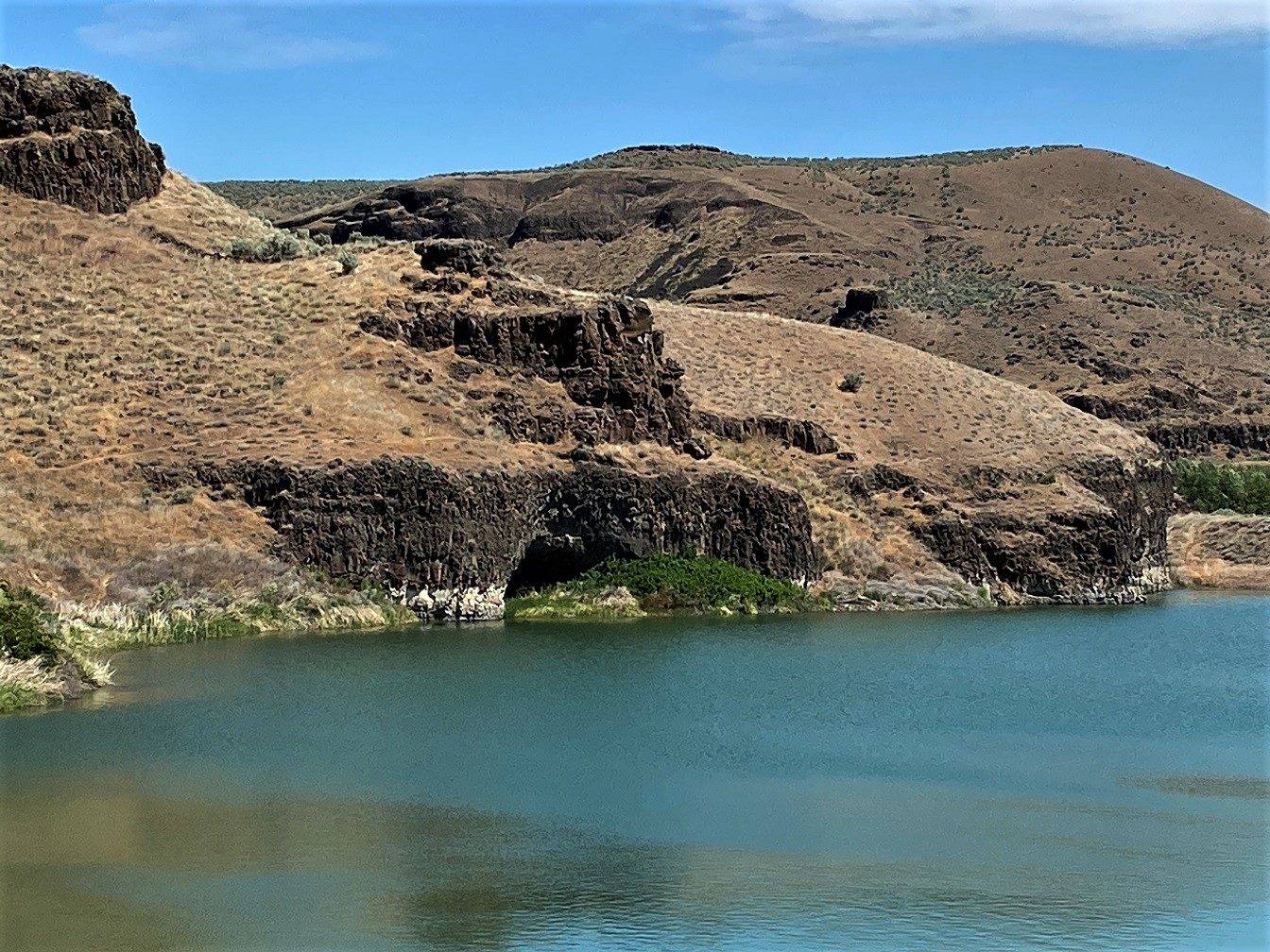
Near the mouth of the Palouse River, a basalt ledge overhangs an alcove about forty feet wide and twenty-five deep. For more than eleven thousand years, from not long after the last of the Ice Age floods, people came back to it: to shelter, to cache food in pits lined with woven grass, and to bury their dead. This was Palus country, and the main Palus village stood for a long time where the Palouse meets the Snake. Since February 1969 the shelter has been under some forty feet of water.
A dig ahead of a dam
The Army Corps of Engineers began building Lower Monumental Dam, twenty miles down the Snake, in 1961. The next year Richard Daugherty of Washington State University came to survey the canyon before it flooded and was taken to a rockshelter on Roland Marmes's ranch. It was plainly rich, and he dropped his other plans to dig there. The first season found storage pits and the partial skeletons of eleven people, three of them beneath ash from the eruption of Mount Mazama in Oregon, more than six thousand years ago. But eighty other sites lay in the reservoir's path, money was short, and by 1964 the work had lapsed.
In 1965 the geologist Roald Fryxell came back to study the layers and asked Marmes to cut a trench with his bulldozer, four inches at a time, down onto the floodplain in front of the shelter. Twelve feet down the blade turned up human bone. Fryxell could not prove it had not fallen there from earlier digging. It was April 1968 before the team found more, undisturbed, and dated it to more than ten thousand years: the oldest human remains then known in the Western Hemisphere.
The press conference
On April 29, 1968, Fryxell and Daugherty stood beside Senator Warren Magnuson in Washington and announced bones that might be thirteen thousand years old, a couple of thousand years older than they turned out to be, split in a way that they said suggested cannibalism. The New York Times ran the story, and visitors crowded the canyon. On October 31, 1968, President Lyndon Johnson ordered the Corps to build a levee around the shelter and the floodplain below it, the first time a president had ordered protection for an archaeological site, and the Corps pushed back the filling of the reservoir to finish it.
What the dig actually found was quieter than the headlines. The remains of at least thirty-eight people were identified. Most had been cremated and then buried, with shell beads, bear teeth and, in one grave, the hoop of an infant's cradleboard.
February 1969
The levee was finished, horseshoe-shaped, in February. Lower Monumental was closed on February 23, 1969, and the water rose inside the levee as fast as outside it, coming up through thick beds of gravel beneath the floodplain that no one had accounted for. The crew covered what they could with plastic and sand. By February 26 the site was gone. Fryxell, who had followed the bulldozer blade down, died in 1974, at forty, with much of the work unwritten.
The loss stirred enough public anger to bring stronger protection for archaeological sites in the years that followed. The people of Marmes waited longer. In 2006 the Confederated Tribes of the Colville Reservation, the Nez Perce Tribe, the Confederated Tribes of the Umatilla Indian Reservation, the Yakama Nation and the Wanapum Band jointly claimed all the human remains from the site, held for decades at the university. The Corps at first refused some of them, finding they did not meet the law's definition of Native American. The nations held that they were Palus, and their ancestors. In June 2010, with Wanapum elders singing on a bluff above the river, the people of Marmes went back into the ground.