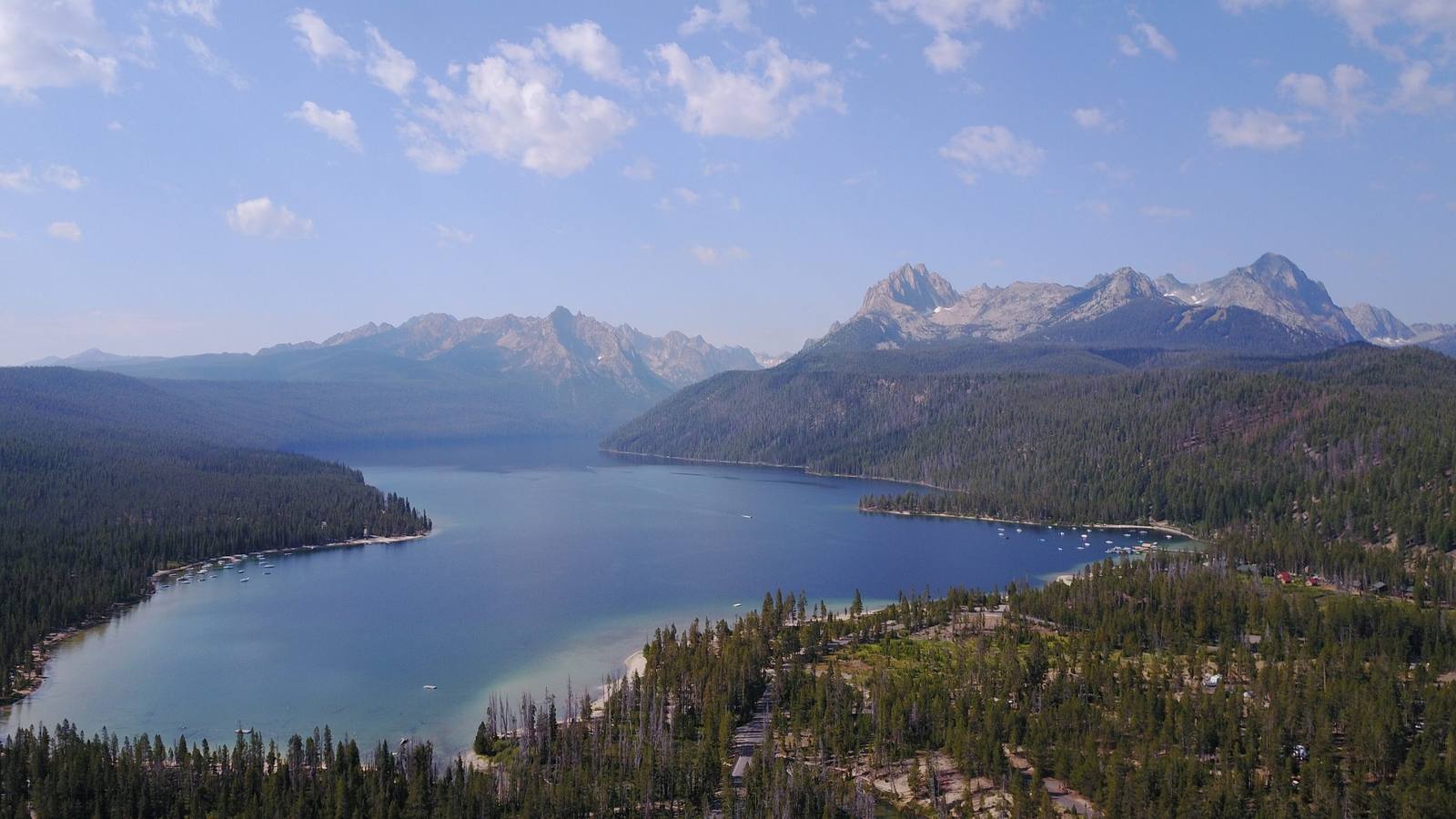
Redfish Lake sits at the foot of the Sawtooths, south of Stanley, and it was named for what used to fill it. Every late summer sockeye salmon came up Redfish Lake Creek from the Pacific, their silver bodies turned brilliant red for spawning, and crowded into the lake and its streams. In the 1880s observers reported the lakes and creeks of the Stanley Basin teeming with them, and there was talk of a cannery. Fish and Game now estimates those runs at 25,000 to 35,000 fish a year, returning to five lakes in the valley: Redfish, Alturas, Pettit, Stanley and Yellowbelly.
Their whole life is a climb. They hatch in a mountain lake at about 6,500 feet, swim some 900 miles to the ocean, spend a year or more at sea, and swim all the way back, up the Columbia, the Snake and the Salmon, climbing the whole height again. No other sockeye population in North America climbs so high, and none lives farther south.
The first dam
The first thing to stop them was small. Around 1910 a mining company built a dam across the Salmon at Sunbeam, below Stanley, to make power for its mine up the Yankee Fork. The mine lasted about a year. The dam stayed, and for more than two decades nothing from the sea could reach the upper Salmon: not sockeye, not Chinook, not steelhead. In 1934 the Idaho Fish and Game Department blasted a hole through the rock where the dam met the canyon wall on the river's right bank. More blasting and a few spring floods made it a passage. You can see the gap from the Sunbeam overlook on Highway 75, on the drive down the Salmon.
The sockeye came back, though no one restocked them. Some sockeye never go to sea at all and live out their lives in the lake, and those residual fish seem to have carried the line through the dam years. Within a couple of decades of the breach, thousands of adult sockeye were returning again.
Eight dams
The second barrier was far bigger. Between the 1930s and the 1970s the federal government built four dams on the lower Columbia and four on the lower Snake, and a sockeye bound for Redfish Lake now has to climb the fish ladders of all eight going up and survive their turbines and slack-water reservoirs as a young fish going down. The reservoirs warm in summer, and a salmon in warm water stops, sickens and dies. By the 1980s returns to the Stanley Basin were in double and then single digits.
In November 1991 the Snake River sockeye became the first Idaho salmon listed as endangered. The next summer, in 1992, one adult sockeye reached the trap on Redfish Lake Creek. He was a male and he had come alone. The seven-year-old daughter of a technician at the Sawtooth Hatchery named him Lonesome Larry.
Every fish
What saved the run was a decision to stop trusting the river with it. State, federal and tribal biologists, among them Idaho Fish and Game, the National Marine Fisheries Service and the Shoshone-Bannock Tribes, took every returning adult they could find into captivity. From 1991 to 1998 that was sixteen fish in all, eleven males and five females, Larry among them. With residual fish from the lake and young fish caught on their way out, they became the founders of a captive broodstock at hatcheries near Boise and in Washington, bred carefully to keep as much of the population's genetic variety as possible. Fish and Game says the program has held on to about ninety-five percent of it.
The first adults from the program came home in 1999. In 2014 about 1,500 sockeye returned to the Stanley Basin, more than in any year since the 1950s. The numbers since have swung with ocean conditions and with how hot the Snake runs in summer, from a few dozen in a bad year to more than a thousand in a good one, and most returning fish are still hatchery-born. The wild, lake-born run that would let the species off the list has not come back on its own.
Larry himself was preserved, and his mounted body has been shown in Boise at the Morrison Knudsen Nature Center. Redfish Lake is still clear and cold under Mount Heyburn. In late summer, if the year is good, you can stand at the creek below the lake and see red in the water again.