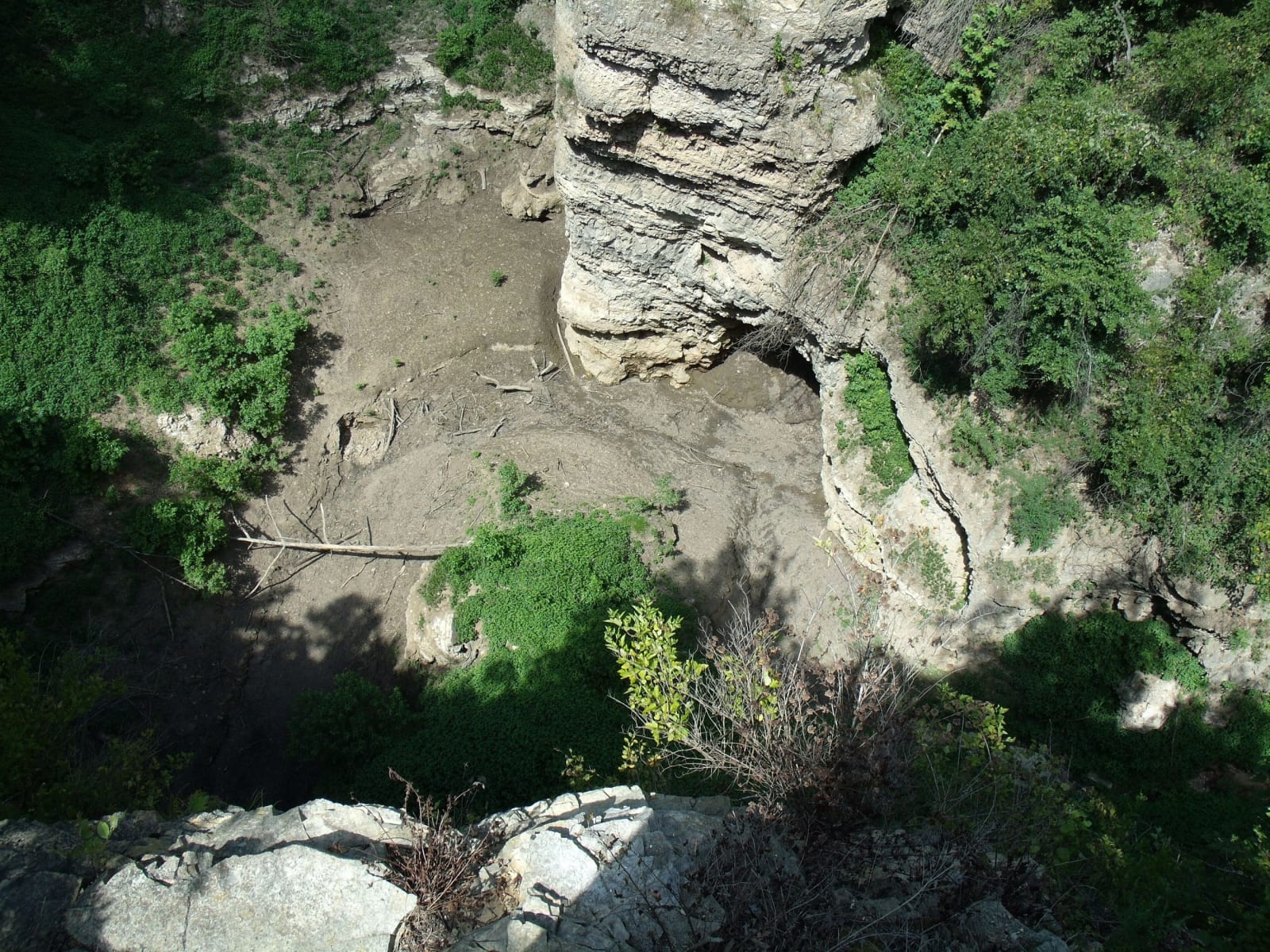
Much of the Ozarks is karst, country built on carbonate rock that water slowly dissolves. Rain seeps into cracks and widens them into conduits and caves, streams disappear into sinkholes, and the water travels underground to come out again as springs. Most of that plumbing is hidden. At Grand Gulf, near Thayer in Oregon County, a piece of it is open to the sky.
A cave without a roof
Grand Gulf is a forked canyon nearly a mile long, with sheer walls up to 130 feet high. It is the remnant of an ancient cave system in dolomite. When the roof collapsed it left the cave's floor and walls exposed as a gulf, and one stretch of the old roof did not fall. That remnant spans 250 feet with an opening 75 feet high, one of the largest natural bridges in Missouri, and on the floor of the gulf you can walk beneath it. The state parks call the gulf the most spectacular collapsed cave system in the Ozarks, and it has been nicknamed the Little Grand Canyon.
Stolen water
A watershed of twenty-eight square miles drains into the gulf, and the gulf drains into a cave entrance at its eastern end. From there the water does not follow the surface valleys at all. Dye poured into the cave has come up one to four days later at Mammoth Spring in Arkansas, nine miles away. Geologists call this kind of diversion stream piracy: an underground route captures water that the land surface would send elsewhere. Mammoth Spring averages about 9.8 million gallons an hour of water at 58 degrees, forms a ten-acre pool and runs south as the Spring River. Part of that flow is rain that fell in Missouri.
The National Park Service made Grand Gulf a National Natural Landmark in 1971 as an excellent example of karst topography and underground stream piracy. Mammoth Spring is a National Natural Landmark as well.
The land was acquired by the conservationist Leo Drey, who died in 2015, and it is still privately owned. Since 1984 the Missouri Department of Natural Resources has run the 322-acre park under a lease from his L-A-D Foundation, and in 1986 the state named sixty acres of it the Grand Gulf Natural Area.
Seeing it
Two trails lead to views of the gulf and the natural bridge. There is no official trail to the bottom, and the state asks anyone who goes down to take extreme care. The foliage is heavy in summer, so the walls show best in fall and winter. The park is open from 8 a.m. to dusk. Mammoth Spring State Park, across the line in Arkansas, has the spring pool, the remains of a mill and a hydroelectric plant, and an 1886 Frisco depot.