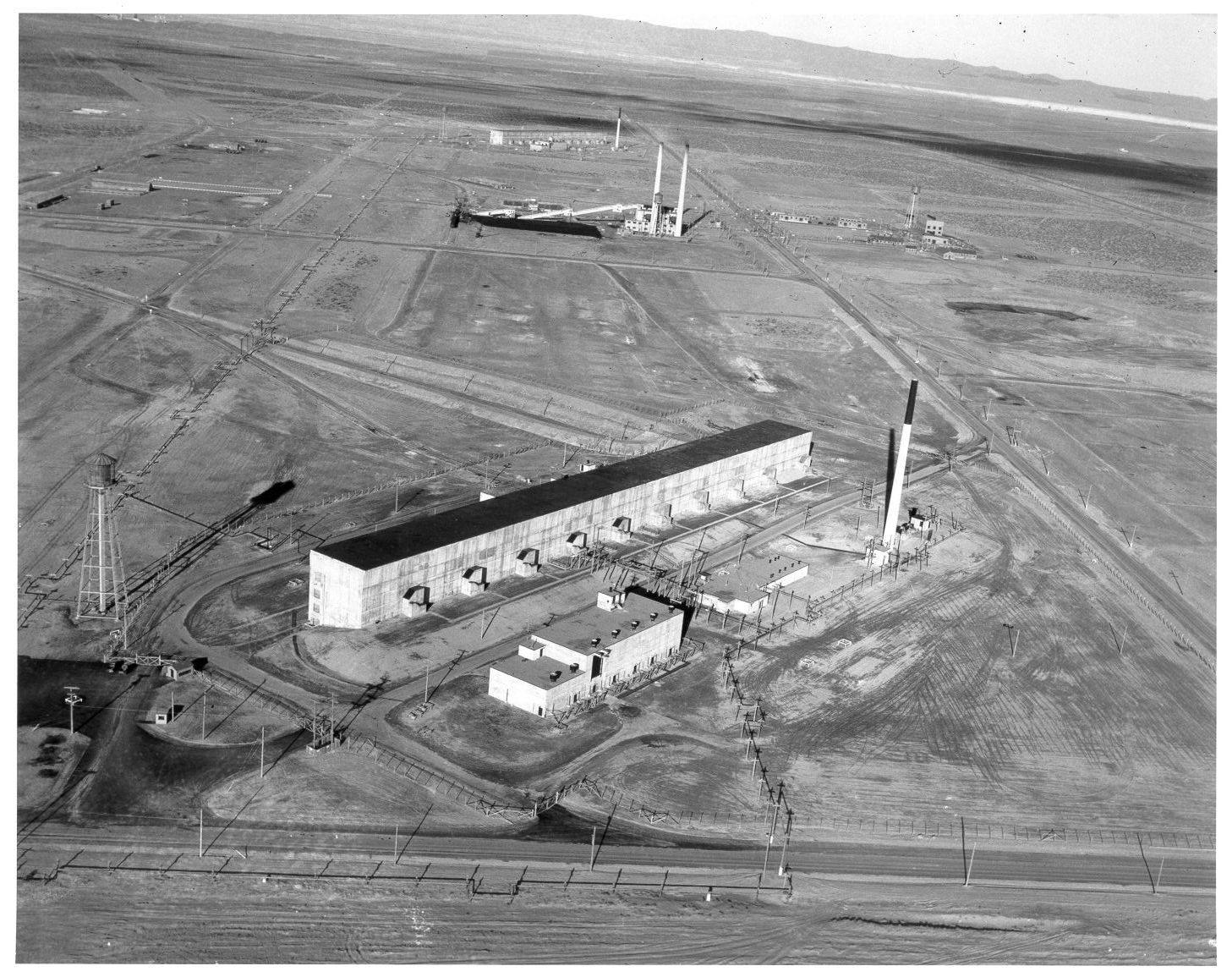
On the night of December 2, 1949, operators at Hanford's T Plant began dissolving a batch of uranium fuel that had come out of a reactor only sixteen days before. By then the usual wait was ninety days or more, long enough for most of the radioactive iodine made in fission to decay inside the fuel. This batch had been chosen because it had not waited. Over the hours that followed, something like eight thousand curies of iodine-131 went up the plant's stack and out over eastern Washington. Nobody living downwind was told, then or for thirty-six years.
A test for the Air Force
In August 1949 the Soviet Union tested its first atomic bomb, and the Air Force wanted a way to judge from the air how much plutonium the Soviets were making. A plant that dissolves reactor fuel to recover plutonium vents gases, and a plume can be measured. Flights over Hanford's routine releases had shown that the instruments were not sensitive enough. So the Atomic Energy Commission approved, on October 25, 1949, a deliberate release far larger than usual, from fuel cooled for so short a time that it would resemble what the Soviets were thought to be processing. The fresh fuel gave the experiment its name: the Green Run.
The plan depended on the weather. General Electric's Health Instrument Division, which ran Hanford's monitoring, set conditions: a cold layer of air near the ground, no rain, and steady light winds from the west or southwest. The evening of December 2 did not meet them. The run went ahead anyway.
Where it came down
The release was about twice what had been predicted. The wind shifted through the night, and the monitoring teams lost track of the plume. Iodine settled on vegetation as far north as Kettle Falls and as far south as Klamath Falls, Oregon, and rain brought it down heavily on Spokane and Walla Walla. In Kennewick, readings on plants ran six hundred times what Hanford then counted as tolerable. Iodine on pasture goes into cows, from cows into milk, and from milk into the thyroids of the children who drink it.
The accident at Three Mile Island in 1979 released about fifteen curies of iodine, and people near it were evacuated. A Walla Walla resident later made the comparison plainly: in 1949 no one here was evacuated, or even told.
Six feet of paper
The Green Run surfaced because people in Spokane went looking. In the mid-1980s Karen Dorn Steele, a reporter for the Spokesman-Review, heard from farm families near the Hanford fence about childhood thyroid pills and illness. She, the Hanford Education Action League and an environmental group in Washington, D.C., asked for Hanford's records under the Freedom of Information Act. On February 27, 1986, the Department of Energy released about nineteen thousand pages, a stack six feet high. Among them were references to an event called the Green Run.
The papers showed something larger, too. The Green Run was the biggest single release in Hanford's history, but it was a small part of the whole. Around 739,000 curies of iodine-131 left Hanford's stacks between 1944 and 1972, most of it in the first few years, in the rush to make plutonium.
The reckoning
The disclosure set off a federal reconstruction of the doses and a long study of people who had been children downwind in the 1940s. The Hanford Thyroid Disease Study reported in 2002 that it found no more thyroid disease among those with higher doses, while cautioning that it could not rule out harm to any one person. Some three thousand downwinders sued the companies that had run the plant. The case lasted twenty-four years. By October 2015 every claim had been settled or dropped, the compensation confined to thyroid disease, and the Department of Energy issued a one-sentence statement saying it was pleased the matter was resolved.
Connie Nelson grew up in Garfield, east of Hanford, and later had thyroid cancer. "We are like a sacrificed group," she said.