On September 28, 1838, more than a thousand Tsalagi (Cherokee) people left Fort Payne, Alabama, under John Benge, a Cherokee sub-chief. The Treaty of New Echota, signed by a minority of Cherokee leaders for $5 million and removal, was the government's authority for sending them west. Principal Chief John Ross opposed it and petitioned Washington for Cherokee control of the removal. Federal troops began gathering families into stockades in May. Benge and George Lowrey camped about 500 Alabama Cherokee near Fort Payne rather than wait in the Tennessee camps, and others joined them. Departure counts run from 1,079 to 1,200, and the Park Service gives 1,090. Seventeen detachments made the journey west, and the whole Trail of Tears National Historic Trail runs 5,043 miles through nine states. Benge's detachment reached Indian Territory with 1,132 people, after 33 deaths and three births, which one account counts among the lowest losses of any detachment.
Across Tennessee
The route crossed the Tennessee River twice. The National Park Service places the detachment at Pulaski in October and November, then on an unimproved path near Sheboss Place, at Natchez Trace milepost 400.2, where it entered Hickman County. At Reynoldsburg Landing the families crossed the river again by ferry, and in November about 1,200 people walked the Reynoldsburg-Paris Road. Built in 1838, a 1.3-mile dirt stretch of it, ten to eighteen feet wide, survives in Nathan Bedford Forrest State Park and was listed on the National Register in 2005.
The wagons
A local history society describes sixty wagons carrying 1,132 Cherokee and the Black people held in slavery by Cherokee families. Named in the records are the physician William P. Rowles, the interpreter A. P. Lowery, the wagon master Robert Benge and the assistant conductor George Lowrey, Benge's father-in-law. Thirty-three people died on the way, and the roll names two gravediggers, Otterlifter Hughes and Two Thousand. From Henry County the route ran through Palmersville to Clinton, Kentucky, where Benge had relatives, and across the Mississippi at what is now Columbus-Belmont State Park.
The warning
Lowrey, the Assistant Principal Chief of the Cherokee Nation, recalled that in September 1838 military officers warned that soldiers would shed blood if the people were not ready to leave. The missionary doctor Elizur Butler later estimated more than 4,000 deaths among the Cherokee, nearly a fifth of the nation. In 1899 W. B. Flippin, who had seen the Benge detachment pass through Arkansas, remembered women and children thinly clothed and how silent the babies were. Overland groups in Arkansas lost three to five people a day, by the Park Service's account. The Benge detachment reached the Arkansas border by December, its records list no desertions, and it ended its route near present-day Stilwell, Oklahoma, on January 17, 1839.
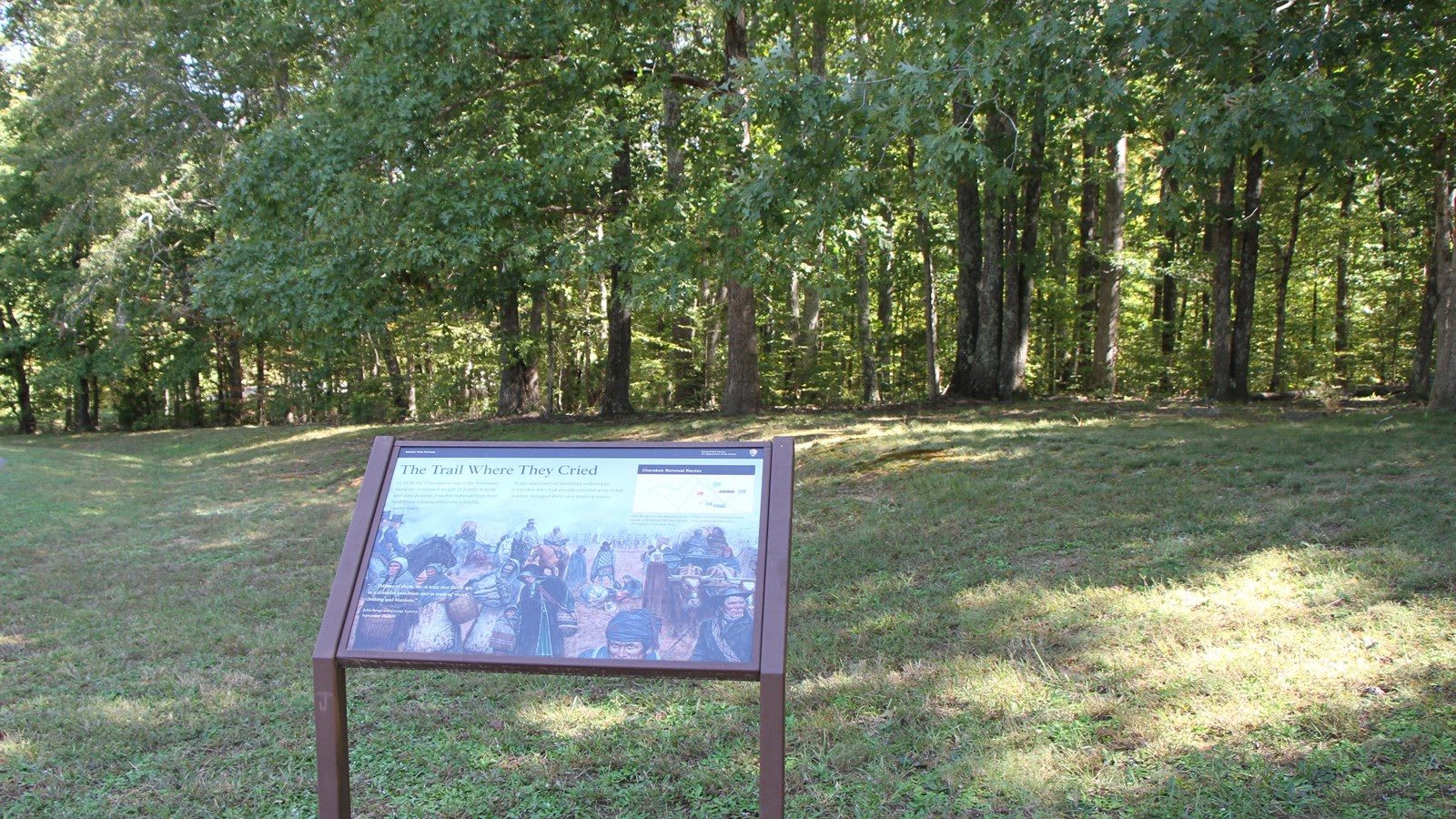
The Trace pull-off at milepost 400.2 has a wayside panel. Other detachments crossed the river at Savannah, which the Tennessee River Museum covers. The Trace itself is told at the Meriwether Lewis Site, and the river's later history at Johnsonville State Historic Park.