Silas Hunt was born on March 1, 1922, near Ashdown, in Little River County, and grew up in Texarkana, where he graduated in 1941 as salutatorian of Booker T. Washington High School. He went on to Arkansas AM&N in Pine Bluff, was drafted, and spent twenty-three months in Europe with Army construction engineers. He was badly wounded at the Battle of the Bulge. After the war he went back to AM&N and finished a degree in English in 1947.
He had been accepted at the Indiana University law school when he changed his mind. In January 1948 the U.S. Supreme Court ruled for Ada Lois Sipuel, a Black woman the University of Oklahoma had refused to admit to its law school, and Hunt decided to try Fayetteville with his classmate Wiley Branton.
February 2, 1948
On January 30 the University of Arkansas had announced that qualified Black graduate students would be admitted, the first white Southern university to do so since Reconstruction. Undergraduates were still turned away. The announcement followed Missouri ex rel. Gaines v. Canada in 1938, which required a state either to provide separate legal training for Black students or to open its law school to them.
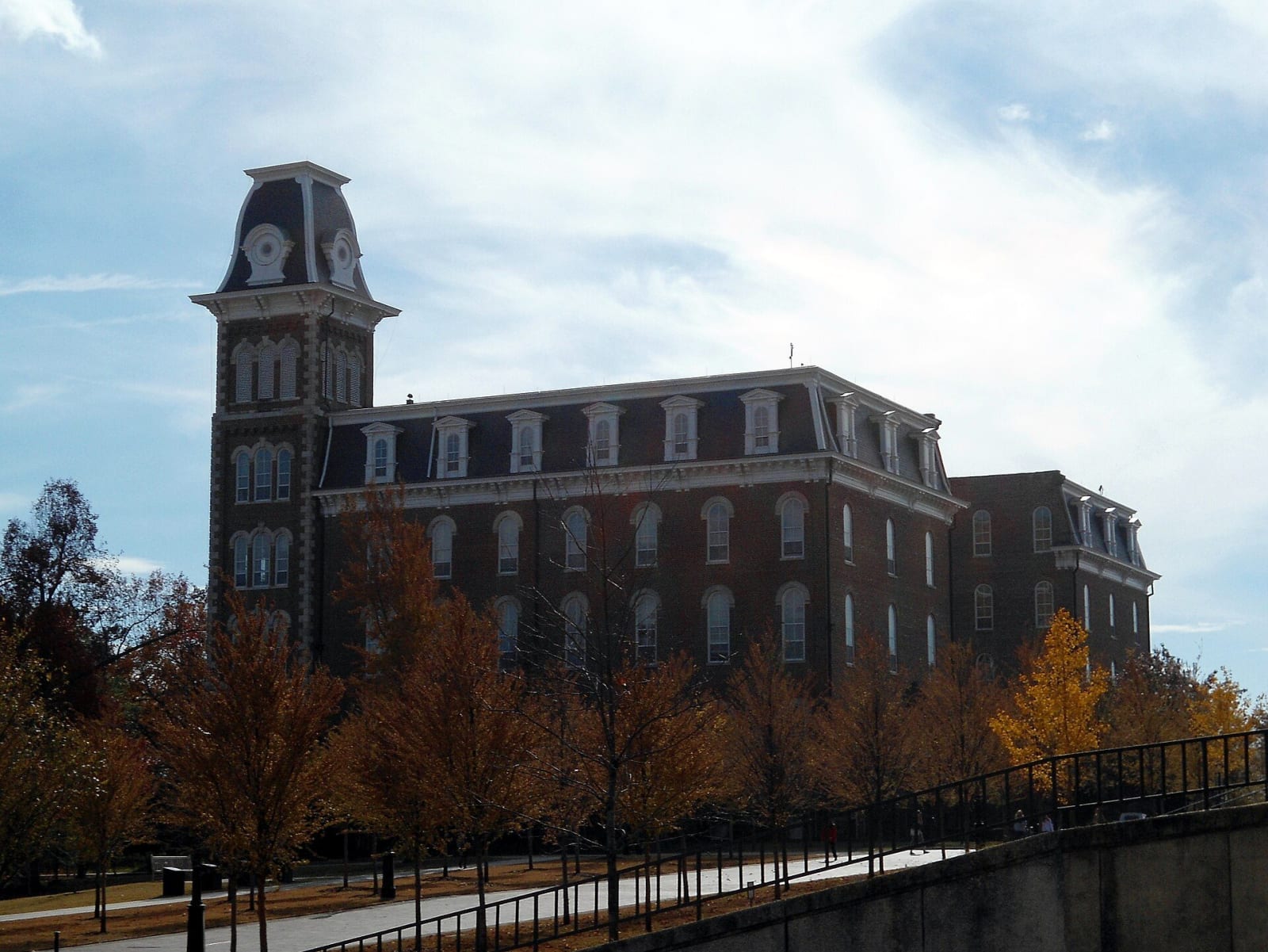
Hunt reached Fayetteville on February 2 with Branton, the Pine Bluff attorney Harold Flowers and the AM&N photographer Geleve Grice. A small crowd of students gathered outside the law building, and no protest was reported. Branton said a few of them came over to shake hands. Branton applied to the undergraduate business school and was refused. Dean Robert A. Leflar looked over Hunt's record and admitted him.
The classroom downstairs
Hunt's classes were held apart, in a basement office of the law building. The professors taught the white students upstairs and then went down to repeat the lesson for him. Three to five white students began sitting in on the basement sessions, partly to show solidarity and partly because a class that small meant more time with the professors.
He finished the spring semester and part of a summer session. In late July 1948 he suffered a hemorrhage from pulmonary tuberculosis and withdrew. He died on April 22, 1949, in the veterans hospital in Springfield, Missouri, at twenty-seven, and is buried in Stateline Cemetery in Texarkana.
Five more
Hunt was the first of the Six Pioneers, the Black students who desegregated the law school between 1948 and 1951. Jackie Shropshire, the first to graduate, finished on June 9, 1951. Branton, refused on that February morning, was admitted in 1950, graduated in 1953 and argued Cooper v. Aaron before the Supreme Court in 1958. George Howard Jr. became a federal judge. George Haley, a Morehouse College graduate and veteran, came in 1949 and later became an envoy to Gambia.
Hunt never saw a degree. The university awarded him one after his death in 2008, and in 2007 the legislature made February 2 a memorial day in his name. A sculpture honoring him was dedicated on the University of Arkansas campus in Fayetteville in 2012, and it is the place to start in town.