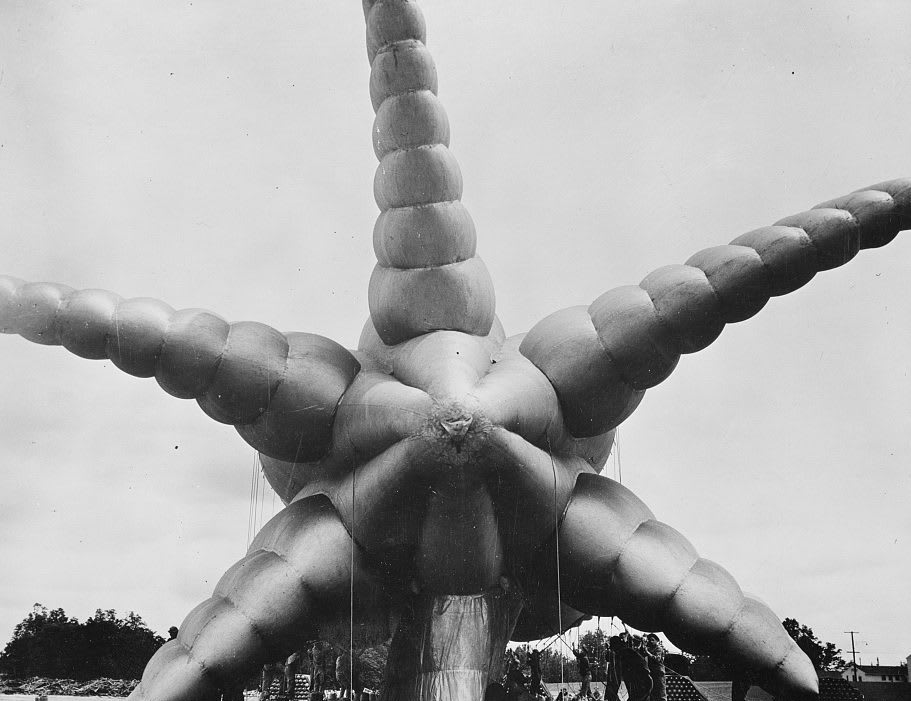
Eight miles south of Paris, on Henry County farmland, the War Department built, on 2,000 acres, the nation's only World War II barrage balloon training center. Camp Tyson was authorized in August 1941 and named for Brig. Gen. Lawrence D. Tyson of Knoxville. More than 8,000 laborers raised 450 buildings, including a 400-bed hospital and a 2,500-seat theater. By the war's end 20,000 to 25,000 soldiers had trained there, and a 1943 expansion tripled the acreage and swallowed an antebellum house, Bowdenville.
Four Black battalions
British instructors taught recruits to inflate gas-filled balloons, camouflage and repair them, and rig the anchor cables with small explosive charges. A good crew could launch one in under 30 minutes. More than thirty battalions trained at Tyson over the course of the war. Four were Black: the 318th, 319th, 320th and 321st, about 1,100 men each, in an Army that was formally segregated.
Waverly Woodson Jr. of Philadelphia was a pre-med student at Lincoln University when he enlisted on December 15, 1942. He applied for antiaircraft officer training and was told he could not be placed in the Coast Artillery Corps because of his race. The Army retrained him as a combat medic and sent him to the 320th at Tyson, where his biographers say he met segregation and discrimination. Henry Parham, a sharecropper's son from Virginia who was drafted in 1942 and trained there too, said he never questioned an all-Black battalion because segregation was how things were.
Omaha Beach
The 320th sailed for England in November 1943. On June 6, 1944, about 600 of its men went ashore on Omaha and Utah beaches in crews of three or four, and many of their balloons were shot up before they could rise. By dawn on June 7 twelve flew over Omaha. Woodson's landing craft hit a mine and then took an 88 mm shell. Wounded in the groin, thigh and back, he ran a dressing station for about 30 hours, setting limbs, giving plasma and amputating a foot. Estimates credit him with saving as many as 200 men, Black and white. Eisenhower commended the battalion for conducting its mission with courage and determination.
His commander recommended the Distinguished Service Cross, and General Lee's office judged his actions worthy of the Medal of Honor. He never received it. Causes cited include racial discrimination and the 1973 records fire in St. Louis. He was given the Bronze Star and Combat Medical Badge in 2023, and in 2024 a posthumous Distinguished Service Cross was announced. He died in 2005 at 83 and is buried at Arlington National Cemetery, and in 2022 an Army clinic at Rock Island Arsenal was renamed for him.
After the war
Tyson held German and Italian prisoners of war, then closed, and the H. C. Spinks Clay Company bought the land. Parham spent 68 days on Omaha Beach, came home to work as a bus terminal porter in Richmond and, as the last surviving member of the 320th, died in July 2021.
Paris Landing State Park is also in Henry County.