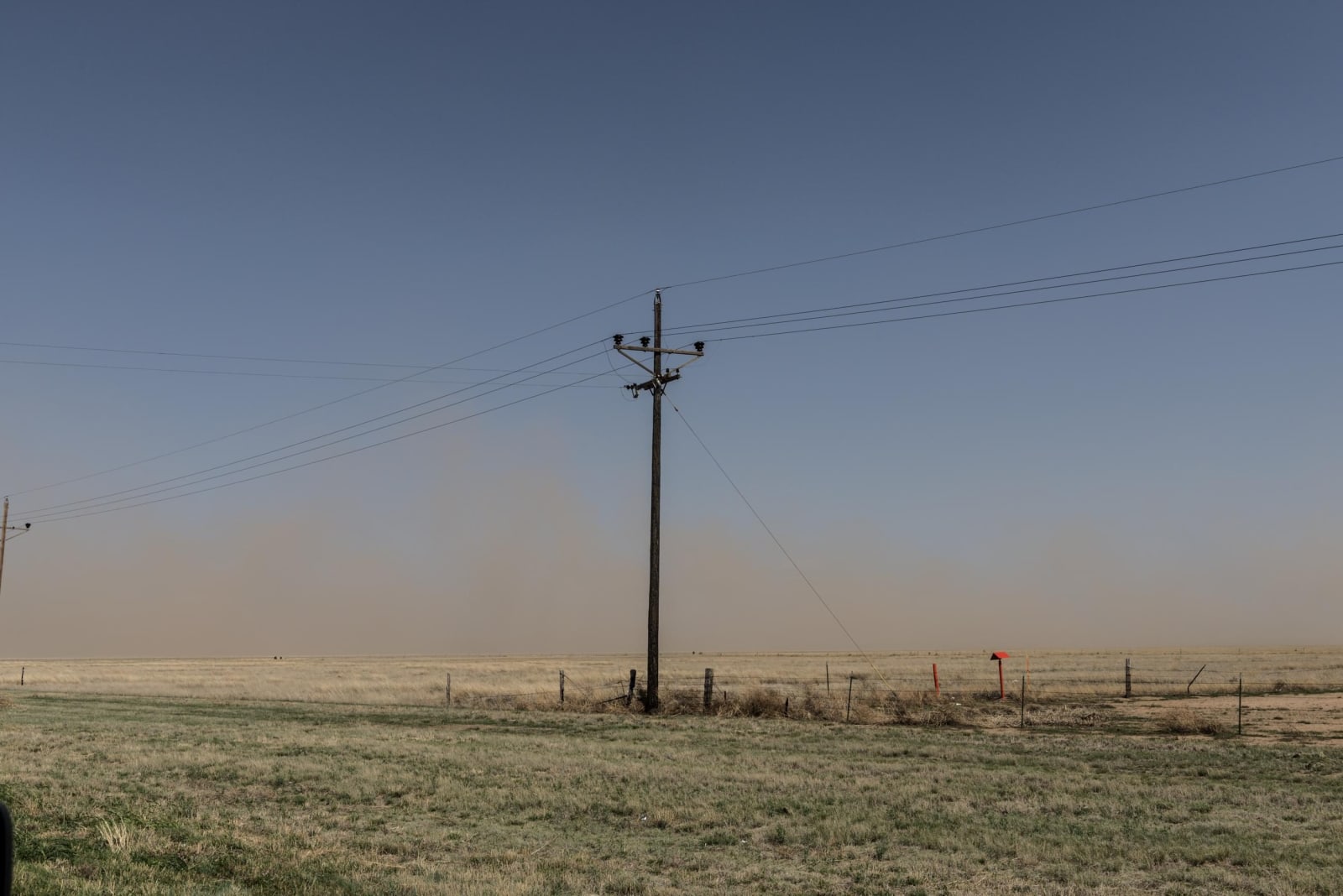
Between 1925 and 1930 farmers tore up the native grass on millions of acres of the southern plains. New gasoline tractors let them plow faster than ever, and some, called suitcase farmers, came only to gamble on a crop or two. In 1929 the movie businessman Hickman Price set up a factory farm of more than fifty-four square miles in Swisher, Castro and Deaf Smith counties. Most of the new ground went to wheat, production rose by 300 percent in the decade, and by 1931 there was a glut. When the black blizzards began, a third of what became the Dust Bowl lay bare to the wind.
The storms
The Handbook of Texas counts the dust storms of regional extent year by year: 14 in 1932, 38 in 1933, 22 in 1934, 40 in 1935, 68 in 1936 and 72 in 1937. In Amarillo the worst year was 1935, when storms lasted a total of 908 hours. Seven times between January and March the visibility in the city fell to zero, once for eleven hours. The black blizzards came on a cold front, rising like a wall of muddy water 7,000 or 8,000 feet high. People stuffed rags around their windows and swept dirt out of their houses by the bushel. Grit ruined car and tractor engines. The Red Cross handed out gauze masks, and the old and the very young suffered most in their eyes and lungs. Dalhart, in the northwest corner of the Panhandle, became notorious for its black dusters.
The wind-erosion project
In May 1934 dust from a great storm fell on the White House, which helped turn federal attention to the plains. That August Dalhart got one of the first three erosion-control demonstration projects in Texas and the first devoted specifically to wind erosion, directed by Howard H. Finnell for the Soil Erosion Service. Federal money went to feed loans and payments for starving cattle, and farmers got seed loans and were paid to plow high ridges against the wind. In 1935 the new Soil Conservation Service opened its Region Six office in Amarillo, where Finnell directed the conservation work for the whole Dust Bowl. The same year the Texas legislature set up wind-erosion conservation districts in nine Panhandle counties and gave local authorities the power to force farmers to take measures against blowing soil. Between 1935 and 1937 more than a third of the area's farmers left.
After the dust
The Soil Conservation Service reckoned the Dust Bowl at 100 million acres in 1935 and 22 million in 1940, and in the 1940s it was gone. The Handbook notes that dust storms came back in the 1950s and the 1970s. John L. McCarty, editor of the Dalhart Texan until 1936, took up painting late in life, and scenes from the Dust Bowl years were among his subjects. North of Dalhart, eroded land the government bought in the 1930s under the Bankhead-Jones Farm Tenant Act was put back to grass as the Rita Blanca National Grassland. The XIT Museum keeps Dalhart's history.