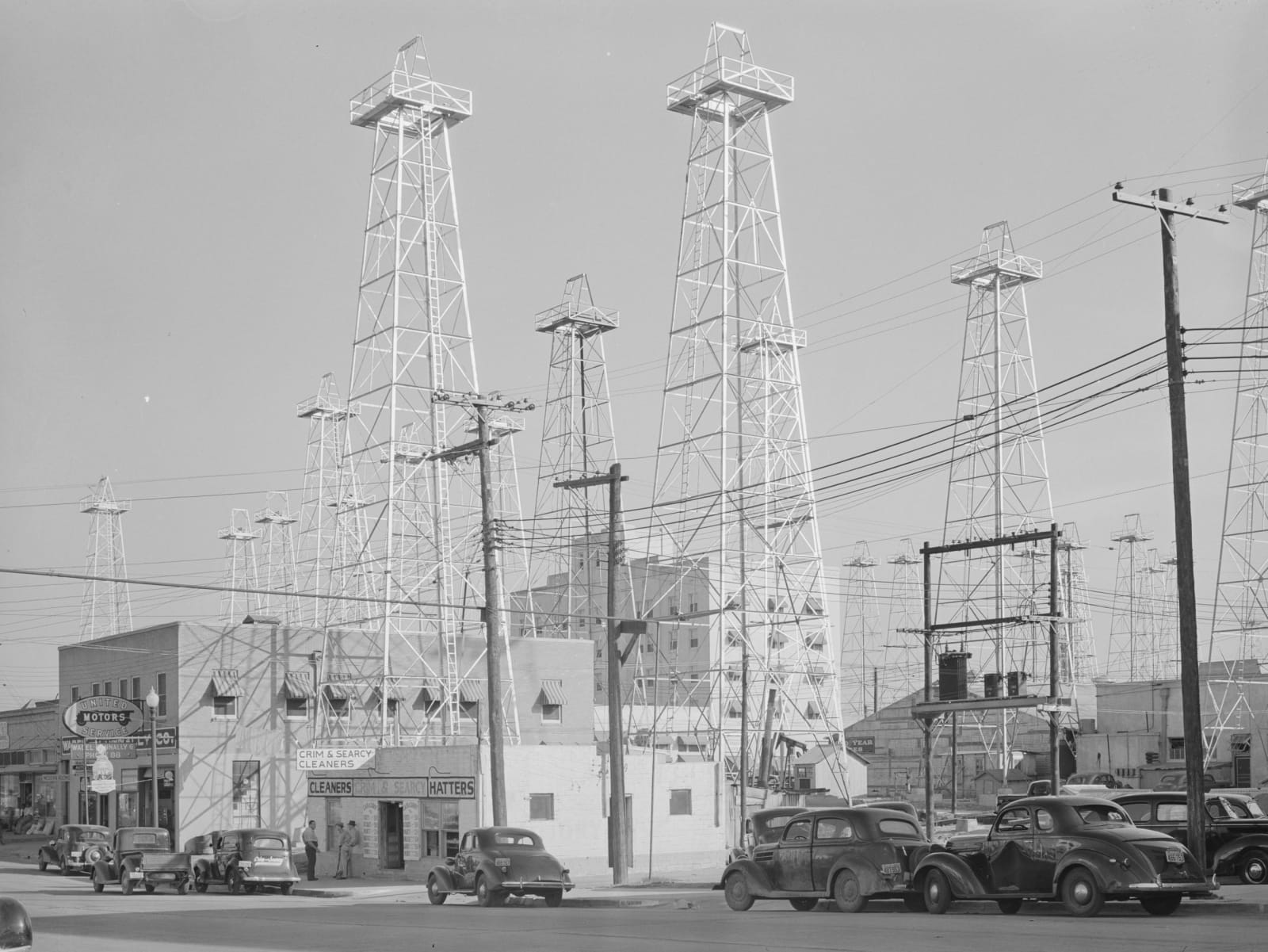
East Texas oil came in on October 3, 1930, when the Bradford No. 3 was completed on a Rusk County farm, and the field proved the largest in the lower forty-eight states. The Handbook of Texas says it had no plan and no governor. Landowners sold leases measured in feet, wells went up in house yards, and one block in Kilgore held forty-four of them. Under the rule of capture an operator who drilled slowly lost his oil to the neighbor's well, so everyone drilled fast.
Too much oil
Crude that sold for ninety-nine cents a barrel when the Bradford came in had fallen to forty-six by 1931, and operators answered by pumping more, which pushed it lower. The Railroad Commission's first proration order, in April, set a limit of 50,000 barrels a day against a yield above 200,000, and many operators ignored it. On July 28 a three-judge federal court threw it out as price fixing. By midsummer about 1,200 wells were making some 900,000 barrels a day. Oklahoma's governor had put his own oil fields under martial law on August 4. Hundreds of East Texas producers wanted the same, and the State Library counts 1,200 of them meeting in Tyler on August 14 to ask Governor Ross Sterling, himself an oilman, to declare it. Carl Estes, the Tyler editor who championed the small independents, had already told the legislature that its promises to the little man were now being tested.
The troops at Kilgore
On August 17 Sterling declared a state of insurrection in Gregg, Rusk, Smith and Upshur counties and sent the Texas National Guard and Rangers, about 1,100 soldiers by the State Library's count, to Kilgore under Brig. Gen. Jacob Wolters. All 1,644 wells in the field were shut in. Production resumed on September 5 under a new order of 400,000 barrels a day and 225 barrels a well. Operators sued, and some shipped hot oil, crude above the legal limit, past the soldiers with the help of truckers and bribed railroad and pipeline employees.
The owners who sued told the federal court that no civil officer had asked for troops, that the courts were open and that the community was peaceable. The state answered that an organized group of producers was in insurrection against the conservation laws. On February 2, 1932, a federal court ruled martial law illegal. The Supreme Court affirmed an injunction against enforcing the governor's orders on December 12, 1932, in Sterling v. Constantin.
What it left
By autumn the State Library reports 1,500 oilmen meeting in Tyler to ask Sterling for a special session and stronger law. He called it in November 1932, and the legislature allowed the Railroad Commission to set production by market demand. By the end of December hot oil was a felony. Sterling lost his race for a second term that year. Hot oil kept moving through 1933 and 1934, until Congress passed the Connally Hot Oil Act in 1935 and the state declared such crude contraband.
The East Texas Oil Museum on the Kilgore College campus rebuilds a boomtown of the 1930s, with its general store, drugstore and the office of the Gusher Gazette.