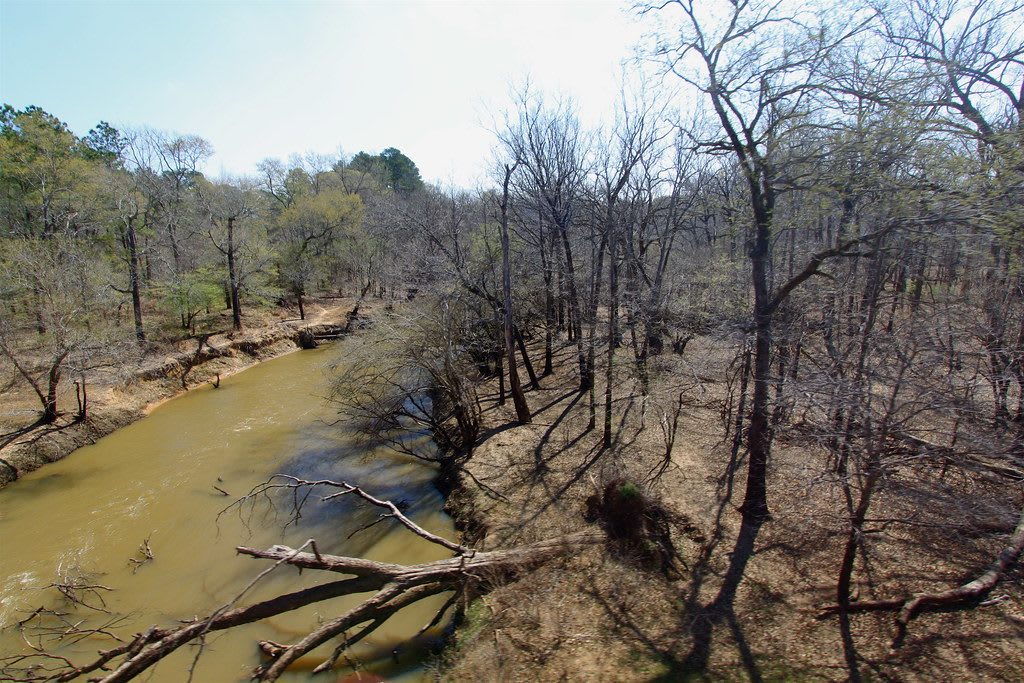
Duwali was born around 1756 in North Carolina, the son of a Scottish father and a Tsalagi mother. He spent his life moving away from settlement: Missouri in 1810, Arkansas by 1813, and in early 1820 Texas, at the head of some sixty families. Pressure from prairie nations pushed them from the Three Forks of the Trinity to a nearly empty country north of Nacogdoches. They cleared farms on land that belonged to their friends the Caddo, and by 1822 there were nearly three hundred of them.
A grant that never came
Spanish and then Mexican officials let the villages stand as a buffer but never gave title. In late 1822 Richard Fields, the council's diplomatic chief, rode to Mexico City to ask for a grant, and Iturbide's fall ended the hope. In 1826 Fields and an American adviser, John Dunn Hunter, negotiated with the Fredonian rebels around Nacogdoches. The Tsalagi council refused to join. After a trial by the council both men fled, were captured separately and were executed in early February 1827. Gatunwali, called Big Mush, succeeded Fields.
In February 1836 Sam Houston and John Forbes signed a treaty with the Tsalagi and a dozen associated bands, among them Shawnee, Delaware, Kickapoo and Caddo. Eight Tsalagi leaders, Duwali and Gatunwali among them, signed. It gave them land north of the Old San Antonio Road that took in the future Smith and Cherokee counties. The Texas Senate tabled it that December and declared it void in December 1837, holding that the Consultation had no power to confirm land grants.
The order
Land the treaty had promised was already being sold to settlers. Houston's successor, Mirabeau Lamar, wanted the Tsalagi out of Texas. After a letter found on the Mexican agent Manuel Flores in May 1839 revealed plans to enlist the East Texas nations, he told Duwali they would go "peaceably if they would; forcibly if they must." In July some five hundred soldiers camped near the main village. The Tsalagi agreed to leave and be paid for crops and removal, but refused to accept an armed escort. Fighting began July 15 west of present Tyler. Duwali, about eighty-three, died on July 16, and so did Gatunwali. More than a hundred people were killed or wounded, and the army burned the villages and more than two hundred acres of corn.
Where the people went
Survivors crossed the Red River into Indian Territory, where about six thousand Western Cherokee already lived. Those Old Settlers joined the eastern government that same year under an Act of Union, and the combined government has run continuously since as the Cherokee Nation. A party under Chief Egg and Duwali's son John Bowles tried for Mexico over the winter, and Edward Burleson's command attacked it near the San Saba on December 25, 1839. Both leaders died and twenty-seven women and children were taken. Treaties with those who remained followed in 1843 and 1844. The sword Houston gave Duwali reached the Cherokee Nation in the 1890s, and a Masonic lodge in Tahlequah keeps it.
In Nacogdoches, Eugenia Sterne Park at 700 East Main has a bronze of Houston and Bowles by Michael Boyett, with a marker for the 1836 treaty beside it.