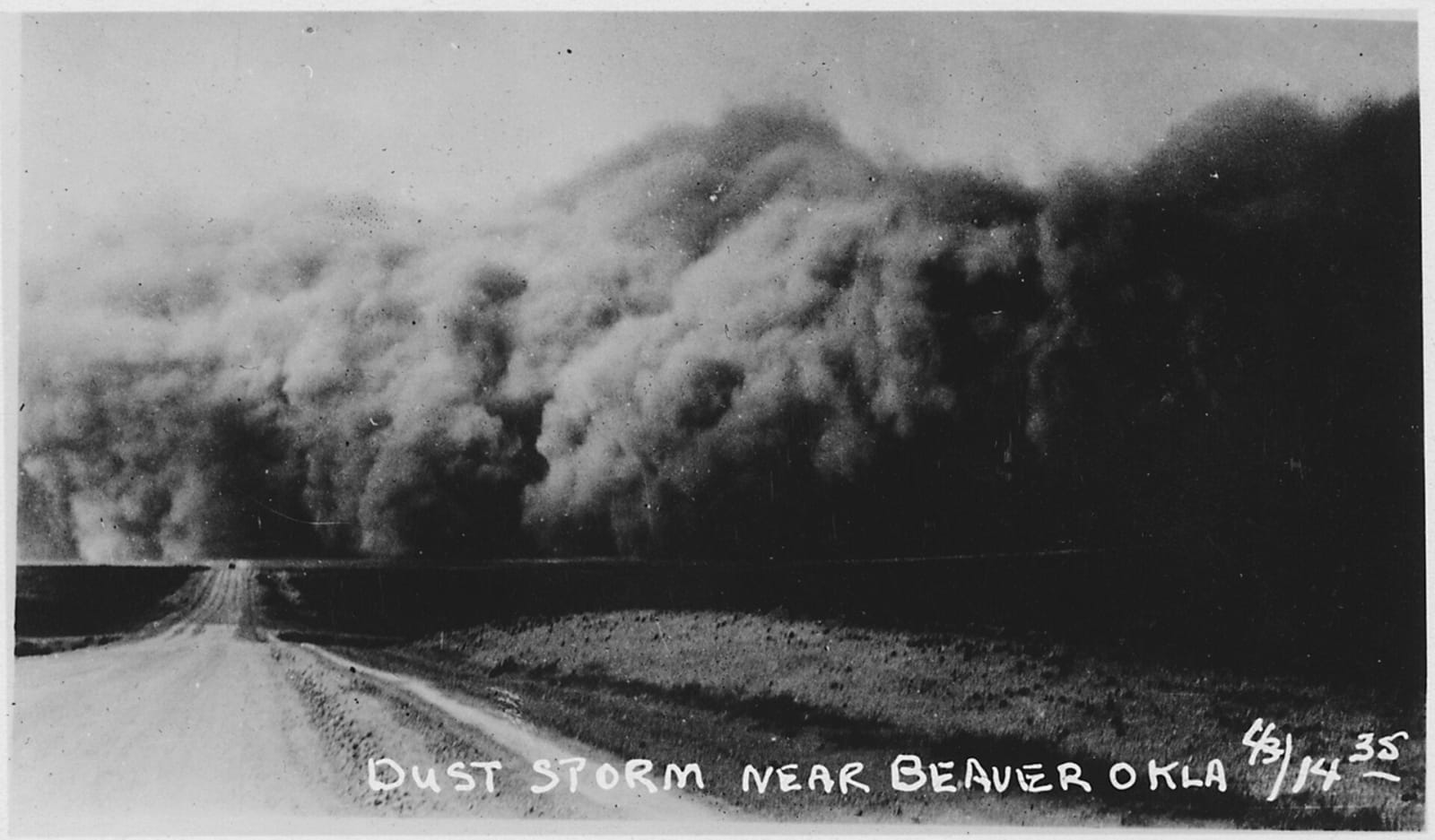
On Sunday, April 14, 1935, Guymon woke to a clear sky and a temperature in the upper eighties. It was the fourth year of drought in Texas County, and the Methodist church was full for a rain service. The minister told the congregation that good rains within three weeks would still mean a harvest, and that prayer was their last resort. By late afternoon the sky had gone dark, and not with rain.
Black Sunday
The storm was the worst of the black blizzards. It reached Beaver around four o'clock and Boise City at about a quarter past five. Across the southern High Plains the temperature fell more than fifty degrees in a few hours, winds reached seventy miles an hour, and total darkness lasted forty minutes, followed by three hours of half-light. It was one storm among many. The Oklahoma Historical Society counts forty severe dust storms in 1935 and sixty-one in 1938, and it puts the worst-hit ground in Cimarron, Texas and Beaver counties. Across the Great Plains, farmers had broken out thirty-two million acres of sod between 1909 and 1929.
Three little words
Robert Geiger, an Associated Press staff writer, was in Guymon that week writing a series on the storms. His dispatch of April 15 said that three little words, "achingly familiar on a Western farmer's tongue," ruled life "in the dust bowl of the continent," and the words were "If it rains." It was the first time the phrase appeared in print, and within three months the whole country was using it. Geiger meant western Kansas, southeastern Colorado, the Oklahoma Panhandle, most of the Texas Panhandle and northeastern New Mexico, nearly the area the Soil Conservation Service mapped as the Dust Bowl in 1939.
Because his story and others carried the dateline Guymon, Oklahoma, the state took the name. It had less of the federal Dust Bowl inside its borders than Kansas, Colorado, New Mexico or Texas. Woody Guthrie, an Okemah native, drew his dust songs from what he saw in Pampa, Texas. And most of the families who went west to California were tenant farmers and sharecroppers from eastern and southern Oklahoma, pushed off cotton land by machinery, low prices and a New Deal program that paid owners, not tenants, to plow under their fields.
Who stayed
The Panhandle emptied in its own way. Texas County had 14,100 people in 1930 and 9,896 in 1940. Those who stayed farmed through it, and some wrote it down. Caroline Henderson, a Mount Holyoke graduate who had claimed 160 acres near Eva in 1907, sent letters about the dust years to The Atlantic Monthly, which printed them in 1936. The settlers' own historical society, founded in 1934, keeps rooms for the Depression and the Dust Bowl at the No Man's Land Museum in Goodwell, the next town down the railroad from where Geiger filed.