Joe Jackson went to work in the Brandon Mill on the west side of Greenville at six or seven years old, and he never went to school. His father, George, had brought the family down from Pickens County, where Joe was born in July of 1887, 1888 or 1889, depending on the record, and took a mill job paying $1.25 a day. They lived in a company house, and Joe, the oldest of eight children, never learned to read or write. What the mill gave him besides wages was a baseball team.
The mill nine
Nearly every Upstate textile town fielded a team; by 1913 Spartanburg had a league of mill clubs alone. Jackson made the Brandon lineup at 13 for $2.50 a game. He pitched, then caught, then settled in the outfield, and from 1901 to 1907 he played for mill teams around the state. A local fan, Charlie Ferguson, made him a hickory bat about 36 inches long and close to 48 ounces, darkened with tobacco juice. Jackson called it Black Betsy.
In 1908 he signed with Greenville's Class D professional club, the Spinners, for $75 a month, against about $45 from the mill and mill ball together. He signed with an X. That season new spikes blistered his feet and he played a game in his stockings, and a jibe about it, credited to a fan or to a Greenville News writer, became the name the country knew him by. Jackson insisted he never played the outfield barefoot. On July 19, 1908, he married Katie Wynn, who was 15 and could read and write. She handled his letters, money and contracts for 43 years of marriage.
Chicago and the ban
The Philadelphia Athletics bought his contract that summer. Traded to Cleveland, Jackson hit .408 in 1911, and his lifetime .356 is the third-highest average in the game's history. He won the 1917 World Series with the Chicago White Sox. In the 1919 Series he batted .375 and tied a record with 12 hits, but teammates had taken money to lose it. A jury acquitted the accused players in 1921, and Commissioner Kenesaw Mountain Landis banned all eight for life anyway. Historians still argue over Jackson's part; his SABR biographer concludes he had no role in planning the fix and was paid $5,000 of the $20,000 promised.
Back to the west side
Barred from organized baseball, Jackson ran a poolroom and a dry-cleaning business in Savannah and played outlaw and semipro ball across the South into the early 1930s. Back near the Brandon Mill he ran a restaurant and, for years, a liquor store, and he taught neighborhood children the game. In 1940 he and Katie built a small house at 119 East Wilburn Street. In 1951 Cleveland fans voted him into the team's hall of fame, and he was booked for Ed Sullivan's television show. He had a heart attack before the broadcast and died at home on December 5, 1951, and is buried at Woodlawn Memorial Park.
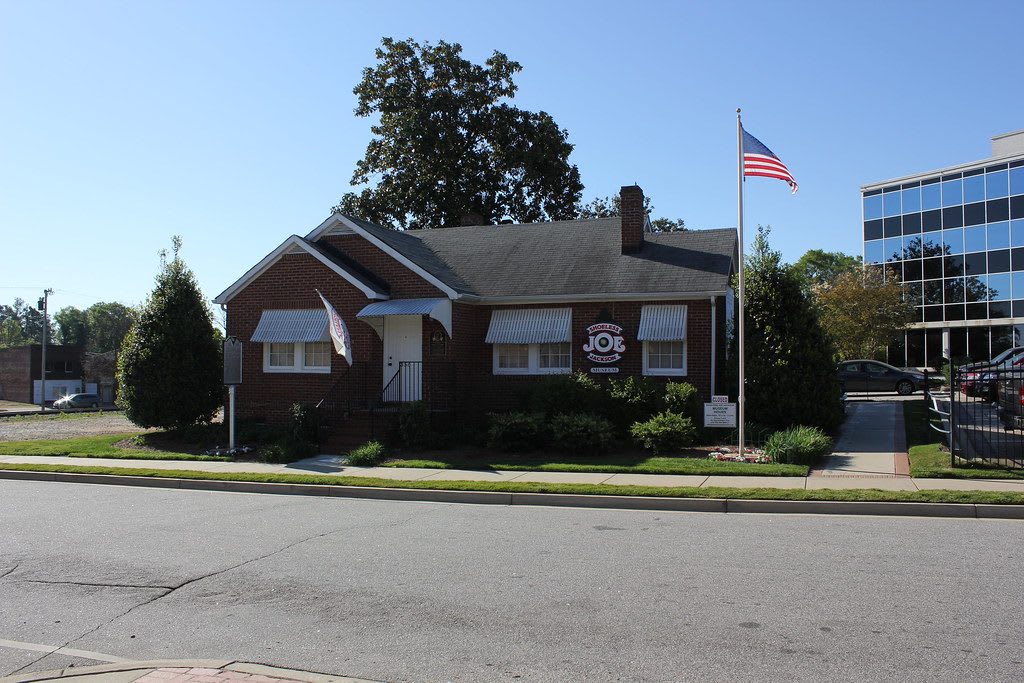
In 2006 the house was moved to Field Street, across from the ballpark now called Fluor Field. It opened in 2008 as the Shoeless Joe Jackson Museum and Baseball Library, at 356 Field Street in Greenville's West End.