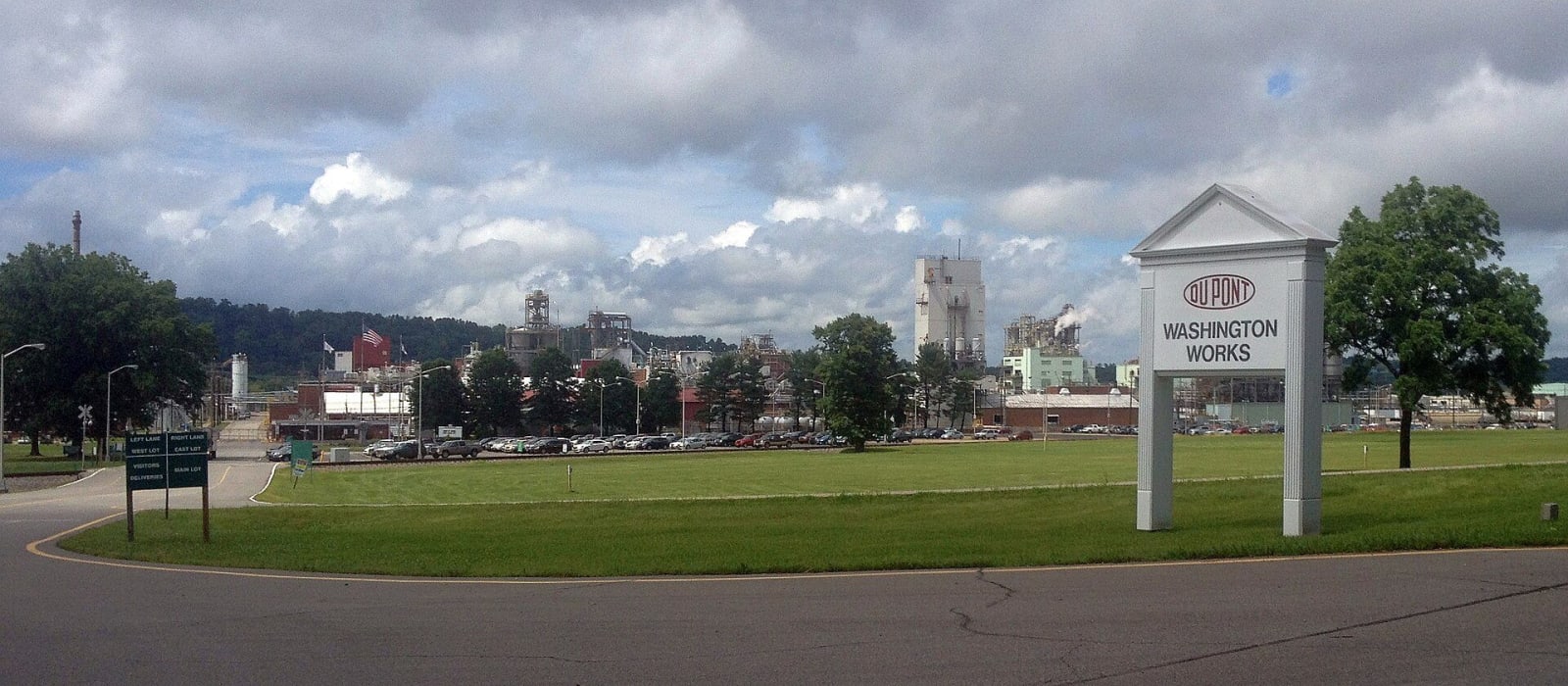
From the summer of 2005, about 69,000 people who lived near DuPont's Washington Works, on the Ohio below Parkersburg, filled out health questionnaires and gave blood. Each sample was tested for one chemical. The testing was part of a court settlement, and over the next eight years three epidemiologists used it to decide, disease by disease, what the chemical had probably done to the people of the Mid-Ohio Valley.
The chemical
Perfluorooctanoic acid, called C8 for the eight carbon atoms in its formula, was used by DuPont from 1951 through 2012 to make Teflon at the plant. Residues went into the air and the river, and state investigators later noted that no permit DuPont held set a specific limit on how much C8 it could release. In 2002 C8 was found in six water districts near the plant, and an EPA consent order required DuPont to supply other water wherever levels passed 150 parts per billion, a screening level set by a state toxicity team.
Residents sued, charging that DuPont knew the health risks and increased its use of C8 anyway. A 2004 class-action settlement in Wood County Circuit Court offered medical monitoring to nearly 100,000 people, though fewer than 7,000 registered for it. The settlement also paid for the year of blood draws, the C8 Health Project, and created a science panel.
More likely than not
The panel's members, Tony Fletcher of the London School of Hygiene and Tropical Medicine, David Savitz of Brown University and Kyle Steenland of Emory University, were chosen jointly by the lawyers for the community and the company. The settlement defined a probable link as a connection that was more likely than not among the class members. From 2005 to 2013 the panel ran its studies and filed its conclusions with the Wood County court. It found probable links to six conditions: diagnosed high cholesterol, ulcerative colitis, thyroid disease, testicular cancer, kidney cancer and pregnancy-induced hypertension. For others, including coronary artery disease and Parkinson's disease, it found none.
In December 2005 DuPont agreed to pay the EPA $10.25 million, which the agency called its largest civil administrative penalty under any environmental law. Seven of eight counts concerned failures to report risk information about C8.
A falling line
The safe level kept dropping. The EPA lowered the action level for water near the plant to 0.50 parts per billion in 2006 and 0.40 in 2009, and after its 2016 health advisory of 70 parts per trillion it amended the order again in 2017. In 2015 DuPont spun off the Chemours Company, which took over the plant. Of six test trials over individual illnesses, the companies lost two and settled four. Their lawyers argued that DuPont had acted on the best science of the time; the plaintiffs said it had known since 1980 that C8 caused cancer in rats. In February 2017 the companies agreed to pay nearly $671 million to settle the thousands of remaining suits. In 2023 Chemours signed an EPA compliance order over alleged permit violations for C8 and its replacement, GenX, dating from 2018.
Upriver at Williamstown, the Ohio River Islands National Wildlife Refuge tends the islands and mussels of the same river.