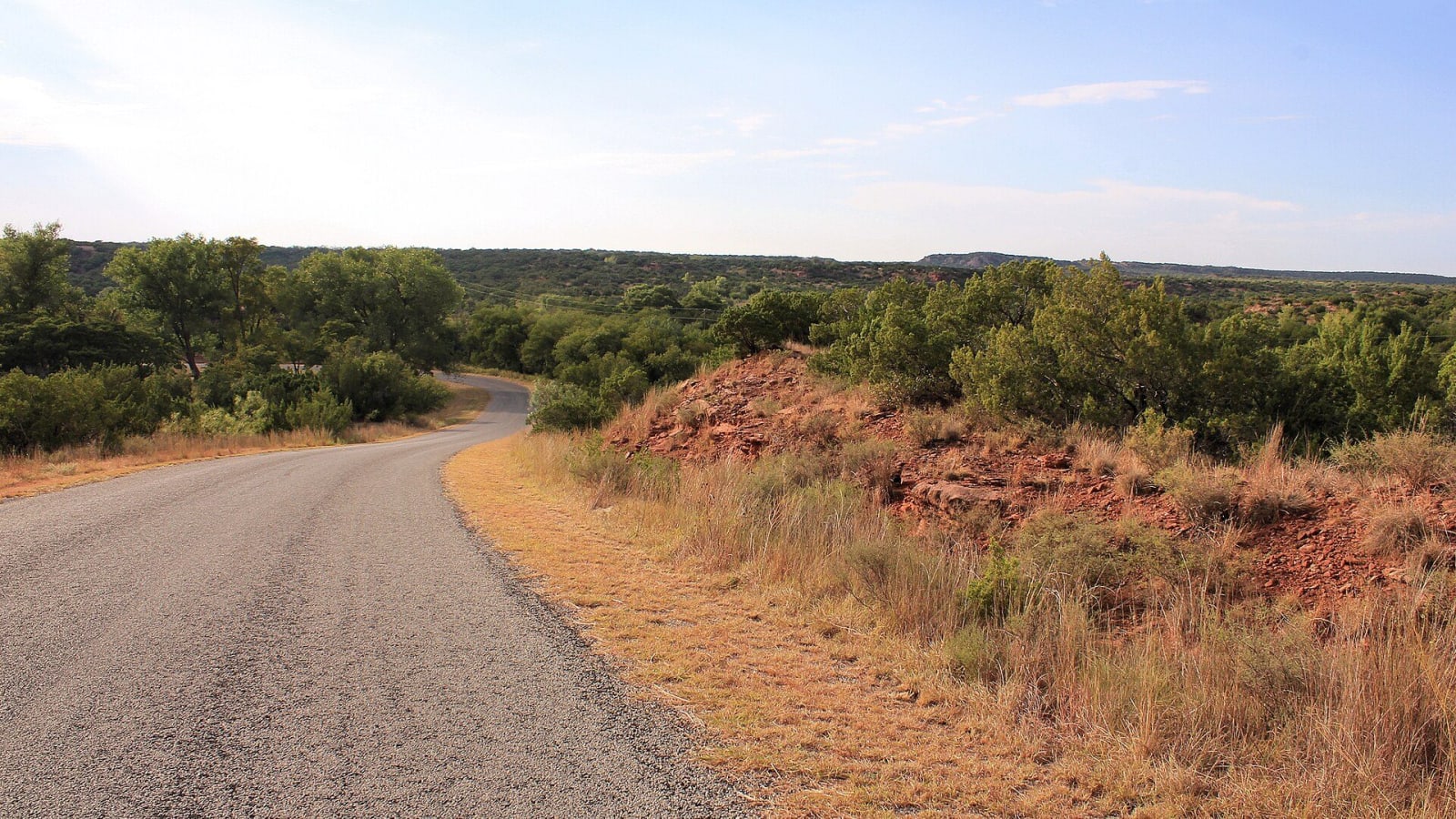
A paved park road curving past a red dirt bank and juniper-covered hills at Copper Breaks State Park.
Larry D. Moore / CC BY-SA 4.0 via Wikimedia Commons
Texas · Region

Quanah, Vernon & the Pease River

Quanah and Copper Breaks State Park, the Pease River country of the Comanche, Doan's Crossing on the Western Trail, Vernon, and the Matador and Four Sixes ranches.

9 places to explore

Below the Caprock the plains break into red, eroded country cut by the Pease River and the forks of the Wichita, and this was Comanche country to the end. The town of Quanah, founded on the Fort Worth and Denver City Railway in 1884, is named for Quanah Parker, the Comanche leader whose mother, Cynthia Ann Parker, was taken when Texas Rangers attacked a Comanche camp on the Pease in 1860. The site is on private land and is told here without directions. So are the Medicine Mounds, four hills the Comanche hold sacred, on private ranch land.

Copper Breaks State Park, on the Pease south of Quanah, has red mesas and juniper breaks, a share of the state longhorn herd and night skies dark enough for stargazing. The park takes its name from the copper ore found in its rocks.

The cattle trails crossed here on the way north. At Doan's Crossing, north of Vernon, herds on the Western Trail forded the Red River into Indian Territory, and the Doan family's store and adobe house served the drovers. Vernon's Red River Valley Museum tells the trail and ranching story. Farther west, the great ranches still hold the land: the Matador around the town of Matador and the Four Sixes at Guthrie, in King County. US-287 runs the length of the region, from Vernon to the Panhandle.

What to See in Quanah, Vernon & the Pease River

9 places across the region, grouped by what they are.

Natural Areas

Copper Breaks State Park

Quanah

Red badlands on the Pease River between Quanah and Crowell, streaked with the green copper that lured a Civil War general here to mine, with longhorns and a dark-sky designation.

View details →

Matador Wildlife Management Area

Paducah

Twenty-eight thousand acres of mesquite, shinnery oak and juniper hills in the Rolling Plains north of Paducah, bought by the state in 1959 for wildlife research and open to permit holders.

View details →

Historic Sites

6666 Supply House

Guthrie

The Four Sixes Ranch's store in Guthrie, where Burk Burnett kept his office and bed, still the town's only shop and now a stop for travelers from as far as Australia.

View details →

Doan's Crossing

Vernon

A store, an adobe house and a granite marker of ranch brands at the Red River ford where the Western Trail herds left Texas, kept alive by a May picnic held since 1884.

View details →

Fire Hall Museum

Crowell

Crowell's local museum in the 1922 firehouse on Main Street, in a county-seat town that was almost wiped away by the tornado of April 1942 and rebuilt.

View details →

Motley County Historical Museum

Matador

Matador's museum in the 1928 Traweek Hospital, in the county seat a Scottish-owned ranch created by having its cowboys open one-day businesses to pass a state rule.

View details →

Quanah, Acme and Pacific Depot Museum

Quanah

The Spanish Colonial Revival depot of a little railroad that set out for El Paso and never got past Floydada, now Hardeman County's museum alongside the county's 1890 jail.

View details →

Spur-Dickens County Museum

Spur

Dickens County's museum on the main block of Spur, a town born on November 1, 1909, when the first train reached the land a New York syndicate was selling off from the Spur Ranch.

View details →

Towns & Gateways

Red River Valley Museum

Vernon

Vernon's museum on College Drive, with rooms on the Waggoner ranch empire, Doan's Crossing and early Vernon, and the largest known collection of Electra Waggoner Biggs's art.

View details →

Quanah, Vernon & the Pease River rewards the unhurried. Pick a base, fan out, and let the country between the headline stops surprise you.

← Explore more of Open Road Guide