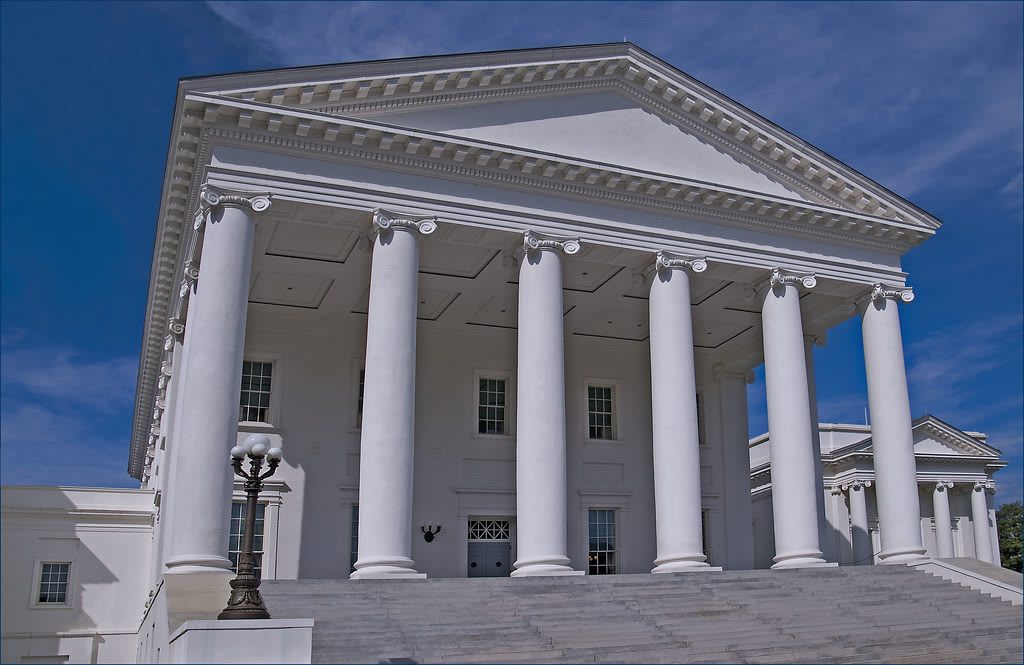
 Ron Cogswell / CC BY 2.0 via Flickr
The Story
Thomas Jefferson, then the American minister in France, worked out the design with the French architect Charles-Louis Clérisseau, taking it from the Maison Carrée, a Roman temple at Nîmes. The cornerstone was laid in August 1785 and the building was finished in 1788 on the hill above the falls of the James, a temple front for a republic. The General Assembly first met in it in October 1792 and has met here since. Houdon's marble statue of George Washington stands in the rotunda.
During the Civil War the building served as the capitol of the Confederacy, the government formed to keep Black people enslaved. Five years after the war, on April 27, 1870, the floor of the crowded second-floor courtroom gave way during a hearing of the Supreme Court of Appeals and fell into the House chamber below. Sixty-two people died and 251 were injured. The two wings that now flank the old building were added in 1904.
Outside, Capitol Square holds the Virginia Civil Rights Memorial, added in 2008. It honors Barbara Johns and her classmates at Moton High School in Prince Edward County, whose 1951 strike against their unequal school became one of the cases decided in Brown v. Board of Education. The Virginia Women's Monument followed in 2019. Visitors enter through the underground visitor entrance below the south lawn on Bank Street, where tours start; then walk the square for the view down toward Shockoe Bottom.
Visitor Info
On the Map
Nearby
The closest stops worth working into your route
Historical markers nearby
Roadside plaques and monuments within a short detour