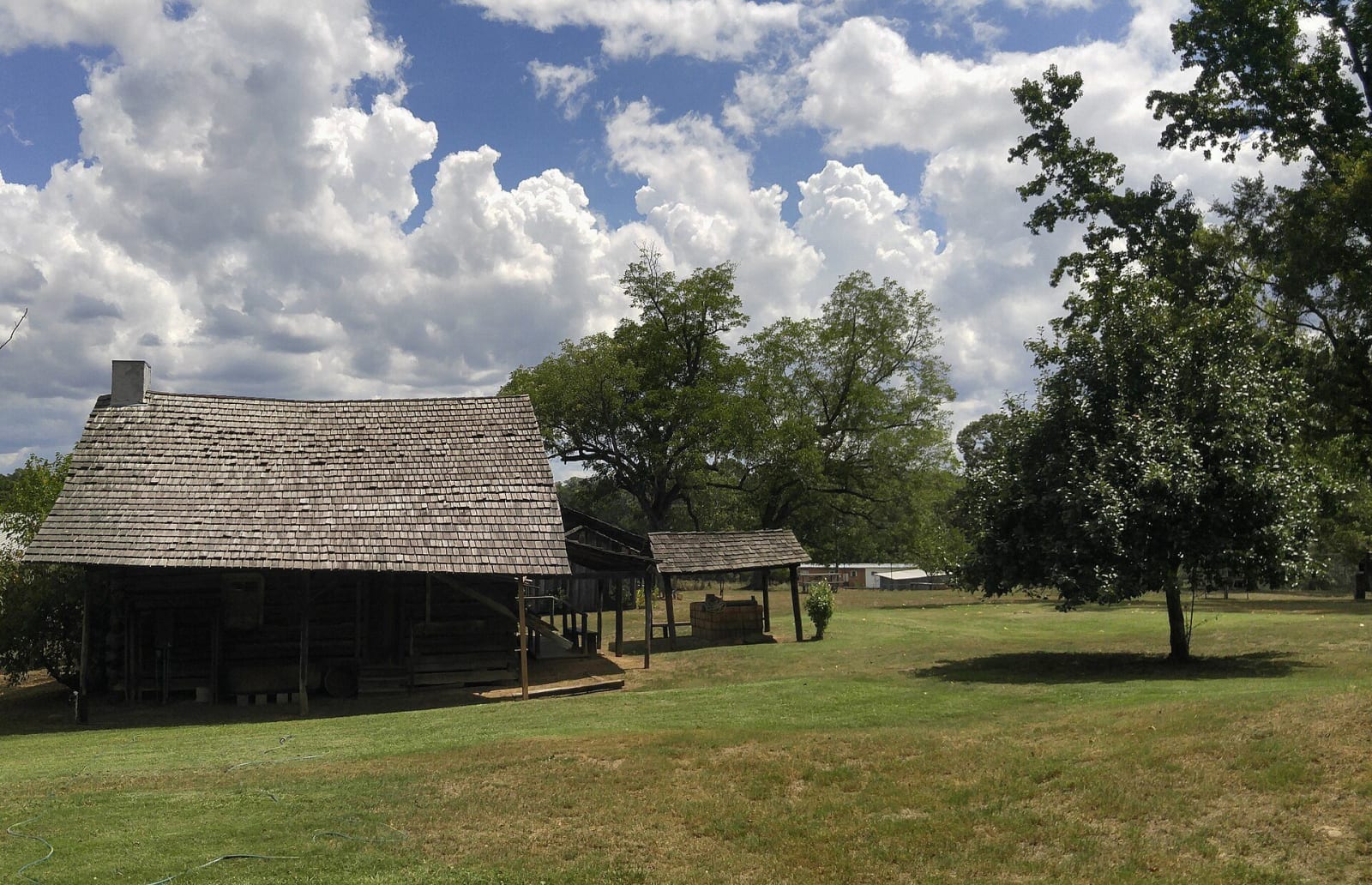
 Americannomad1776 / CC BY-SA 4.0 via Wikimedia Commons
The Story
Germantown began with a man who called himself Count Leon. According to 64 Parishes, Bernhard Müller led the Philadelphian Society, a breakaway from the Harmony Society, and took the name Count de Leon. His followers reached Grand Ecore in February 1834, and yellow fever killed many of them there, the count among them, in late August of that year. Floods later destroyed the houses and cemetery at Grand Ecore. In July 1836 the group moved to a site about eight miles northeast of Minden, where the National Register nomination calls Germantown the earliest religious communal settlement in Louisiana. His widow, Elisa Leon, led it.
It was a true commune, with no private property. The colony had five dwellings, a bachelor hall, a kitchen-dining hall, a store, a school, barns, workshops, a blacksmith shop and a cotton gin, and colonists raised silkworms on mulberry leaves. In 1839 the settlers learned they were on government land, and business manager John Bopp claimed it as a homestead. About a hundred people lived there between 1836 and 1870. The Civil War split the colony, and the commune ended in 1871, when Countess Leon and her daughter Anna moved to Bastrop.
Only the countess's residence and the kitchen-dining hall survive from the colony, both of hewn logs with dovetailed corners. The museum opened in 1975, and the site holds reconstructed buildings and the Germantown cemetery. It was listed on the National Register in 1979, and the state took it over in 2009. The address is 200 Museum Road, Minden.
Visitor Info
On the Map
Nearby
The closest stops worth working into your route