County guide · South Carolina
Charleston County
8 places to stop and 103 historical markers in Charleston County, South Carolina.
Towns: Charleston (52), North Charleston (10), Mount Pleasant (8), James Island (7), Goose Creek (4), Johns Island (3), Johns Island vicinity (3), Ravenel (2), Folly Beach (2), McClellanville (2)
Places to stop
historical · Ravenel
Caw Caw Interpretive Center
Old rice fields carved from cypress swamp by enslaved Africans near Ravenel, tied to the 1739 Stono Rebellion, now crossed by trails and boardwalks.
historical · Charleston
Charles Towne Landing State Historic Site
The marshy point on the Ashley River where English colonists and enslaved Africans landed in 1670, in the country of the Kiawah.
historical · Sullivan's Island
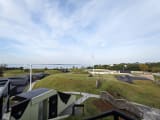
Fort Moultrie
The Sullivan's Island fort restored through two centuries of harbor defense, on the island where enslaved Africans were held in quarantine before Charleston's markets.
historical · Charleston
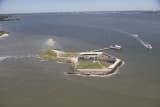
Fort Sumter
The unfinished harbor fort where Confederate guns opened the Civil War on April 12, 1861, reached by ferry from the Liberty Square visitor center.
cultural · Charleston
International African American Museum
The museum raised on columns over Gadsden's Wharf, where tens of thousands of enslaved Africans were landed, with a tidal memorial garden open at all hours.
historical · Charleston
McLeod Plantation Historic Site
A James Island Sea Island cotton plantation told through the 74 people enslaved there in 1860 and the freed Gullah families who lived in its cabins until 1990.
historical · Charleston
Mother Emanuel AME Church
The Calhoun Street church of a congregation founded in 1818, where nine people were killed at Bible study on June 17, 2015.
historical · Awendaw
Sewee Shell Ring
A ring of oyster shell piled up about 4,000 years ago on the marsh edge near Awendaw, reached by a one-mile trail in the Francis Marion National Forest.
Historical markers
Folly Beach · Erected 2018
"Porgy House"
Heyward grew up close to the Gullah world. After his father died in a rice-mill accident, his mother Janie ran a boardinghouse on Sullivan's Island and wrote down and…
McClellanville · Erected 2000
Archibald Rutledge Birthplace
Rutledge made Hampton and the Santee delta his subject from his 1918 memoir, Tom and I on the Old Plantation, onward, and to a national audience he spoke for an Old…
James Island · Erected 2006
Battery Haig
The guns along the Stono guarded a city being shelled from the other side. From August 1863 Union guns fired into Charleston on and off until the evacuation in February…
James Island · Erected 2008
Battery Haskell
On the day Haskell fell, July 10, 1863, Union troops under General Quincy Gillmore and Admiral John Dahlgren crossed from Folly Island and took most of Morris Island.
James Island · Erected 2023
Beefield Community
Beefield's eight families bought their land privately in 1872, the year South Carolina's experiment in selling land to freedpeople began to work.
Charleston · Erected 2015
Blake-Grimké House
The sisters first saw poverty as members of the Ladies Benevolent Society, led by their mother in the late 1820s; its visiting committees took them into the homes of…
Mount Pleasant · Erected 1999
Boone Hall Plantation
The bricks that made the Horlbeck family's name as Charleston builders were fired at Boone Hall by enslaved workers, and enslaved masons and carpenters did much of the…
Charleston · Erected 2010
Burke High School
With no Black college in the city and the College of Charleston and the Citadel closed to Black students, Burke's students became the core of Charleston's movement.
Charleston · Erected 2023
C.A. Brown High School
The school opened in 1962 as the city's long resistance to integration was ending. Charleston County spent millions after 1951 building and improving Black schools to…
Folly Beach · Erected 2010
Camp of Wild's "African Brigade," 1863-1864
While camped here the 55th Massachusetts was in the middle of a protest over pay. Recruited on a promise of thirteen dollars a month, the same as white soldiers, they…
Charleston · Erected 2010
Cannon Street Hospital
Charleston's Black doctors founded the hospital because segregation kept Black nurses out of the training ward at City Hospital.
Charleston · Erected 2019
Carolina Art Association
The founders were lowcountry planters and factors, and the association first showed art on the upper floor of the Apprentices Library on Meeting Street.
Charleston · Erected 2023
Charleston Riot of 1919
Isaiah Doctor, 22, was shot in the chest behind his home; James Tolbert, 23, was shot in the abdomen; William Brown, 20, was shot running home and died on May 16.
Wadmalaw Island · Erected 2014
Charleston Tea Plantation
South Carolina's tea story is a run of false starts. Junius Smith grew plants near Greenville from 1848 until his death in 1853, and Alexis Forster raised tea at…
Charleston · Erected 2019
College of Charleston
The college's first years were thin. Instruction began on January 1, 1790, in rooms carved out of an old military barracks at the city's western edge, under the Reverend…
Mount Pleasant · Erected 2003
Confederate Lines
Mount Pleasant's earthworks were one ring of the defenses that kept Charleston in Confederate hands for most of the war.
Goose Creek · Erected 2008
Crowfield Plantation
Eliza Lucas, later Eliza Lucas Pinckney, described the gardens in 1743. The house could be seen from a mile off, and the drive curved around a spacious basin in a large…
Sullivans Island · Erected 1997
CS H. L. Hunley
Built in Mobile and named for one of its investors, the iron boat was forty feet long, five feet tall and four feet wide.
Charleston · Erected 1984
Drayton Hall
Its recessed two-story portico, the earliest of its kind in America, has no clear English model and seems drawn straight from Palladio's Four Books of Architecture; the…
Charleston · Erected 2019
Federal Building
By the time the building emptied, damaged by Hurricane Floyd in 1999, it was one of the city's few examples of late twentieth-century modern design.
John's Island · Erected 2006
Federal Expedition on John's Island
Among the Federals here was a Black regiment in its first fight. The 26th U.S. Colored Infantry had been raised by the Union League Club of New York and trained on…
Johns Island · Erected 2021
Fenwick Plantation
The house tells its later history through its additions. After the Revolution John Gibbes owned the plantation and added an eight-sided wing with polygonal bays, a…
Charleston · Erected 2016
Fireproof Building
Mills drew the building soon after joining the state Board of Public Works in 1820, and it is often called the first fireproof building in the country.
Charleston · Erected 2017
First Memorial Day
Freedpeople did much of the organizing, as the Friends of the Martyrs and the Patriotic Association of Colored Men, joined by some 200 members of the Mutual Aid Society…
North Charleston · Erected 2008
French Botanical Garden
Charleston was Michaux's base, not his destination. From here he ranged south to Florida and north to Hudson Bay, and the Carolina mountains were a favorite ground; the…
Goose Creek · Erected 2010
French Huguenot Plantation
Fleury came early in a long flight. In the 1670s and 1680s Louis XIV squeezed France's Protestants, banning daytime funerals and psalm singing outside church, and from…
Mount Pleasant · Erected 2001
Friendship A.M.E. Church
The 1911 storm that nearly destroyed this church struck on the night of August 27. Winds in Charleston were estimated at 106 miles an hour, and tides ran more than ten…
Charleston · Erected 2023
Gibbes Landing
The supplies landed here fed a siege that ended in the worst American defeat of the war.
Rantowles · Erected 1991
Grave of Colonel William A. Washington
Washington came to stay in the Lowcountry as a prisoner of war. Wounded and captured at Eutaw Springs in 1781, he spent the rest of the war in Charleston, and in April…
Charleston · Erected 2011
Hampstead Cemetery
The Germans buried here belonged to a new wave. North German immigration to Charleston resumed in the late 1830s, outnumbering the old colonial German families, who had…
Charleston · Erected 2022
Hampstead Village
Henry Laurens bought the first of this land in 1769 from George Austin, his former partner, and had it platted on an English model.
Charleston · Erected 2011
Hampton Park Terrace
Related development companies laid out the suburb on former truck farms at the edge of the city, and more than a hundred of its 251 lots sold within a month.
Charleston · Erected 2014
Harmon Field
Robert Morrison, president of the Cannon Street YMCA, entered the team, and Esau Jenkins helped pay its way to Williamsport, Pennsylvania, where the boys practiced on…
Charleston · Erected 2013
Hospital Strike of 1969
It began in February 1967, when five Black workers were fired the day after refusing to work because a white head nurse denied them the usual access to patients' charts.
North Charleston vicinity · Erected 2012
Inland Rice Fields, ca. 1701-1865
Inland rice was swamp work. By the 1720s commercial planting had moved off dry high ground into freshwater swamps like this one, which had to be drained, cleared of…
Charleston · Erected 2010
Institute Hall
Four days after the signing in this hall, the same convention adopted a Declaration of the Immediate Causes, and it named its cause.
North Charleston · Erected 2008
Jenkins Orphanage
Daniel Jenkins was born enslaved at Beaufort Bridge in Barnwell District and ran a lumber business in Charleston when, delivering an order, he found four hungry children…
Charleston · Erected 2017
John L. Dart Library
Susan Dart Butler had trained as a milliner in Boston and made hats in Charleston until 1918.
Charleston · Erected 1973
John Rutledge Home
At the 1787 convention Rutledge chaired the Committee of Detail, which turned the delegates' resolutions into the first full draft of the Constitution.
John's Island · Erected 1960
John's Island Presbyterian Church
When a long lawsuit over the church's estate ended in May 1846, the court listed what the congregation held: $12,000 in bonds, $2,000 in stocks, winter and summer…
Charleston · Erected 2013
Jonathan Jasper Wright Law Office
Pennsylvania's examiners turned Wright away in 1864, apparently because of his race; he won his license there in 1866, becoming that state's first Black attorney, and…
Charleston · Erected 2024
K.K. Beth Elohim
The 1841 synagogue was raised largely by enslaved Black workers. Its contractor, David Lopez Jr., a congregant who later backed the Confederacy, used people he held in…
Mt. Pleasant · Erected 2017
Laing School
The 1953 Laing High was a product of the state's equalization program, built to keep Black and white children apart by narrowing the gap between their schools.
Mount Pleasant · Erected 2002
Laing School
Cornelia Hancock opened the school with fifty pupils in the shell of the Presbyterian church.
North Charleston · Erected 2005
Liberty Hill
Liberty Hill was one of three settlements freed people built in this area, with Petigrue and Lincoln Village. Most families farmed; some kept shops or cut hair.
Charleston · Erected 2019
Lincoln Theatre
Samuel Banov advertised his new house with the slogan "Let the Lincoln Theater be for the Colored People and by the Colored People," and it was run by the Bijou…
James Island · Erected 2022
Little Rock Golf Club
Richard Smalls laid out his six holes on about eight acres in the Grimball Farms community, drawing on what he had learned caddying at the whites-only Country Club of…
Isle of Palms · Erected 1972
Lord Cornwallis
Before it was Isle of Palms the island was uninhabited, a game-rich larder for coastal Native people, recorded first as Hunting Island and called Long Island by the…
North Charleston · Erected 2024
Louie Tenement
Louis Joseph's Syrian community fought for citizenship in a Charleston courtroom. In February 1914, federal Judge Henry A. M.
North Charleston · Erected 2007
Magnolia Cemetery
Charleston built Magnolia on the pattern of Mount Auburn near Boston, Laurel Hill outside Philadelphia and Green-Wood in Brooklyn, rural cemeteries meant for walking as…
Mount Pleasant · Erected 2007
Maybank Green
Jacob Read, born at Hobcaw about 1752 and buried in its family cemetery, made enemies on both sides.
McClellanville · Erected 1995
McClellanville
The village shows both of its lives in its buildings. The first planters' retreats, like the L. P.
Charleston · Erected 2019
Memminger House
Memminger came late to disunion. He mocked nullification in The Book of Nullification in 1832 and sided with the Unionists in 1850 and 1852.
Folly Beach vicinity · Erected 2019
Mosquito Beach
In 1960 Mosquito Beach was one of six beaches in Charleston County open to Black visitors, with Seaside on Edisto Island, Frasier Beach on Seabrook Island and Riverside…
North Charleston · Erected 2019
Naval Hospital District
The 1942 hospital was laid out as a set of specialist wards. Separate one-story wings held medical, surgical, neuro-psychiatric, contagious, genito-urinary and eye, ear…
Johns Island vicinity · Erected 2024
New Bethel African Methodist Episcopal Church
The prenatal clinic held here filled a gap the state had long left open. Black maternal and infant death rates in South Carolina were among the highest in the nation for…
Charleston · Erected 1967
Old Bank Building
The building shows its earthquake. The ground-floor walls are about 37 inches thick, pierced by stepped arch windows, and the basement still holds the vaulted, tiled…
Charleston · Erected 2011
Old Bethel Methodist Church
The building records two breaks between its Black and white members. In 1818 some Black members left with Morris Brown for the Hampstead church, later Emanuel AME, after…
Goose Creek · Erected 1986
Otranto Plantation
The Revolution split the Gardens. Dr. Garden sympathized with the colonists' grievances but stayed loyal to the Crown, and at the war's end he was stripped of his…
North Charleston · Erected 2002
Park Circle
For most of its history North Charleston was an unincorporated working district, the old State Road and the 1830 railroad lined with industrial works, then fertilizer…
Charleston · Erected 2019
Pinckney Mansion
The governors' lease began the year the family left. In 1753 Charles Pinckney went to London to represent South Carolina at the Board of Trade, and the couple placed…
Meggett · Erected 2011
Plainsfield Plantation
The governor who laid out these fields was accused of running a racket in the harbor. In 1698 the crown's customs surveyor, Edward Randolph, spent five months in…
Charleston · Erected 2014
Plymouth Church
Francis L. Cardozo was born free in Charleston in 1836, worked as a carpenter and shipbuilder, then studied at Glasgow and at seminaries in Edinburgh and London before…
Charleston · Erected 2006
Pollitzer House
As a Columbia University student, Anita Pollitzer became close friends with a young artist named Georgia O'Keeffe.
Mount Pleasant · Erected 1999
Rifle Range Road
The range was one piece of a wartime boom centered on the Charleston Navy Yard. The city was on edge before war came: in February 1917 the skeleton crew of a German…
James Island · Erected 1999
Riversville
Tradition says the new name began as a taunt. Older planters who kept to more established retreats ridiculed the James Island men building this summer village, saying…
Sol Legare Island · Erected 2024
Seashore Farmers' Lodge No. 767
The lodge belonged to the International Farmers' Liberty Union Justice order, whose twelve-point creed ran from equal rights and opposing all forms of oppression to…
Charleston · Erected 2018
Septima Clark Birthplace
Clark began her career at Promise Land School on Johns Island because state law then barred Black teachers from Charleston's public schools.
James Island · Erected 2017
Simeon Pinckney Homestead
The regiment Simeon Pinckney joined had to fight its own government for fair pay. Organized at Hilton Head and mustered in June 1863, the 3rd South Carolina had been…
James Island · Erected 2024
Skirmish at Grimball's Plantation
The fight here came six days before a battle the Union commander had been told not to fight.
Charleston · Erected 2021
Skirmish at St. Andrew's Parish Church
The troops at the church were the vanguard of a slow approach. The British had landed on Seabrook Island on February 11 and 12, 1780, and worked across Johns and James…
Charleston · Erected 2016
Slave Auctions
Because the post office long occupied the Exchange, visitors to Charleston saw the sales in front of it and just north of it, where from several hundred to many…
Charleston · Erected 2022
Slave Trading Complex
The sales room on Chalmers Street was built as a stage. Two octagonal pillars more than twenty feet high framed an open arch, and the auction table, about ten feet long…
Mount Pleasant · Erected 1990
Snee Farm
Charles Pinckney grew rice and indigo at Snee Farm with enslaved labor, and the census shows its scale: 18 people held here in 1800, 58 by 1810.
Charleston · Erected 1970
South Carolina Canal & Rail Road Company Original Track Location in Charleston
The engine that opened the service was the Best Friend of Charleston, built at the West Point Foundry in New York and the first locomotive made in the United States for…
Charleston · Erected 2021
St. Andrew's Parish Church
Under the Church Act this building was a seat of local government as well as worship. Proclamations and public notices were read and posted here, the parish recorded…
McClellanville vicinity · Erected 1996
St. James Santee Parish Church
Eight brick columns carry the two pedimented porticos, with molded brick bases and capitals and a visible swell along the shaft, a refinement a remote country parish…
Charleston · Erected 1992
St. John's Church
Bachman came south for his lungs; a second bout of tuberculosis sent him to Charleston in 1815. Two of his daughters married Audubon's sons.
Johns Island · Erected 2023
St. John's Episcopal Church
The parish this church served was built on plantation wealth and on the people forced to make it.
Johns Island vicinity · Erected 2023
St. Mark's Union Methodist Episcopal Church
St. Mark's comes from a small family of Black Methodist churches born of Charleston quarrels.
Charleston · Erected 1968
St. Michael's Church
St. Michael's was the second Anglican church in Charleston, authorized when the town was split into two parishes in 1751 and set on the civic square opposite the site of…
Ravenel · Erected 2021
St. Paul's Parish Church
The parish this chapel served was built on an enslaved majority from the start. Rice and indigo drew enslaved Africans to St.
Charleston · Erected 1968
St. Philip's Church
St. Philip's was the first English church in Carolina, and the colony paid for its minister in kind: in 1698 the assembly voted him a salary and directed that an…
Hanahan · Erected 2010
Steepbrook Plantation
The fortune of the wealthiest man in British North America rested on the people who worked his land.
Charleston · Erected 2020
Stevens-Lather House
Susan Pringle Frost came to preservation by necessity. When her family's Santee rice plantations declined and her father's fertilizer business failed, she learned…
Sullivans Island · Erected 2018
Sullivans Island Quartermaster Dock
The dock is a wood-frame pier reaching into the water off the north end of Station 16, with a one-story frame shed on its east side under a side-gabled metal roof.
Mount Pleasant · Erected 1997
Sweetgrass Baskets
The plantation form was the fanner, a wide winnowing tray used the same way in Senegambia, and enslaved makers built it on bulrush stitched with saw-palmetto strips on…
North Charleston · Erected 2008
The Elms
The third Ralph Izard lost heavily in the war and rebuilt on a grand scale. He reckoned the British carried off 170 people he held in slavery, and pressed for the…
Charleston · Erected 1987
The Grand Lodge of Ancient Freemasons of South Carolina
The same corner gave Freemasonry a second beginning. In May 1801 eleven men met at Shepheard's Tavern and founded the Supreme Council of the Scottish Rite, still called…
Charleston · Erected 2004
The Parsonage
The best-known child of these two houses carried their schooling into public life. Mamie Garvin, born in 1888, started school at three in her cousin's classroom on Short…
Johns Island · Erected 2013
The Progressive Club
Esau Jenkins left school after the fourth grade to help support his family; all seven of his children who survived infancy went on to earn college degrees.
Charleston · Erected 2012
The Seizure of the Planter
Smalls brought out knowledge as well as a ship: he knew the Confederate defenses, and what he told Union officers helped them plan operations.
Rantowles · Erected 2006
The Stono Rebellion
The rebels likely chose their moment. Yellow fever had swept the colony that summer, war between Spain and England was rumored, and a law requiring white men to carry…
Charleston · Erected 1967
Thomas Smith
Smith governed a quarrelsome colony. A Dissenter in a province split between Dissenters and Anglicans, and between friends and foes of the Lords Proprietors, he took…
Johns Island vicinity · Erected 2024
Tobin-Boyd Elementary School
Tobin-Boyd belonged to the one Charleston County district that put more equalization money into white schools than Black ones. St.
Charleston · Erected 1970
Trinity Methodist Church Original Site
Charleston had heard Methodists long before Trinity. John Wesley visited South Carolina three times in 1736 and 1737 while chaplain to the Georgia colony, published his…
Charleston · Erected 2020
U.S. Vegetable Laboratory
The lab's most famous product is a watermelon. Charles F. Andrus, an Illinois horticulturist who joined in 1938 and stayed thirty years, bred the Charleston Gray…
North Charleston · Erected 2014
Union Heights
During World War II women and minority workers joined the yard that built these neighborhoods.
James Island vicinity · Erected 2021
W. Gresham Meggett School
Before Meggett, Black children on James Island learned in places like Society Corner, Cutbridge and Cherry Beam, schools of about two rooms where one teacher took…
Charleston · Erected 2020
Weston-Grimké Homesite
When the war came, Henry Grimké's white son Montague moved to reassert ownership of his half-brothers and forced them into household service; in 1862 Archibald ran away…
Goose Creek · Erected 2010
White House Plantation
The blacksmith patriot who rebuilt this house raised a son who defied Charleston. William Johnson Jr., born in 1771, joined the U.S.
Charleston · Erected 2002
William Rhett House
Rhett had fought pirates long before he hunted Bonnet. In April 1699 his ship Providence, a galley of twenty-two guns, was taken by the Dutch pirate Hendrick van Hoven…
North Charleston · Erected 2010
Windsor Hill Plantation
The general once buried here ended his public life in a stormy second term as governor.